Scarcity and rivalry | Basic Economic Concepts | Microeconomics | Khan Academy

Scarcity and rivalry | Basic Economic Concepts | Microeconomics | Khan Academy

Foundations of Economics: Scarcity and Rivalry

Understanding Scarcity

  • The instructor introduces the foundational concepts of economics: scarcity and rivalry.
  • Scarcity is defined as a situation where there are not enough resources for everyone, highlighting that resources are limited while human wants are potentially unlimited.
  • An example of a scarce resource is oil, which has a limited supply but high demand if it were free.

Exploring Rivalry

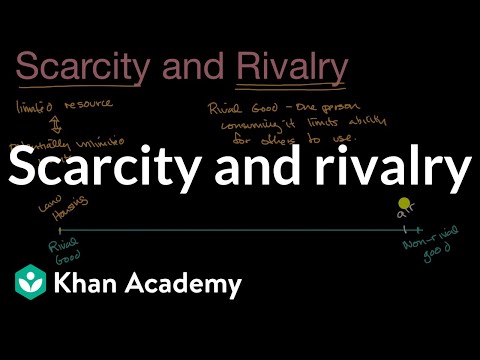
  • Rivalry in economics refers to goods or resources that, when consumed by one person, limit availability for others.
  • A cake serves as an example of a rival good; if one person eats it, others cannot share it.

Spectrum of Rivalrous Goods

  • Economists create a spectrum to categorize goods based on their rivalry. On one end are highly rivalrous goods (e.g., housing), while the other end features non-rival goods.
  • Housing is highlighted as a rival good due to competition among individuals for limited availability in urban areas.

Non-Rival Goods Examples

  • Non-rival goods have almost unlimited supply relative to current demand; air is cited as an example since one person's use does not hinder another's ability to breathe simultaneously.
  • However, under extreme conditions (like being in an airtight room), air can become rivalrous because consumption affects availability for others.

Additional Examples of Rivalry

  • Hammers are classified as rival goods since their use by one individual prevents simultaneous use by another.
  • Roads during rush hour exemplify rival goods due to congestion limiting access for multiple users compared to roads at night, which can be considered non-rival.
Playlists:
Video description

Keep going! Check out the next lesson and practice what you’re learning: https://www.khanacademy.org/economics-finance-domain/ap-microeconomics/basic-economic-concepts/ap-economics-introduction/v/economic-models This video discusses two closely related ideas in economics: scarcity and rivalry. Watch the next lesson: https://www.khanacademy.org/economics-finance-domain/ap-macroeconomics/basic-economics-concepts-macro/introduction-to-the-economic-way-of-thinking-macro/v/economic-models Missed the previous lesson? Watch here: https://www.khanacademy.org/economics-finance-domain/ap-macroeconomics/basic-economics-concepts-macro/introduction-to-the-economic-way-of-thinking-macro/v/scarcity AP(R) Microeconomics on Khan Academy: Microeconomics is the study of individual decisionmakers in an economy, such as people, households, and firms. Learn how markets work, how incentives drive decisionmaking, and how market structure influences market outcomes. We hit the traditional topics from an AP Microeconomics course, including basic economic concepts, markets, production and costs, profit maximization perfect competition, imperfectly competitive market structures, game theory, factor markets, and income inequality. About Khan Academy: Khan Academy offers practice exercises, instructional videos, and a personalized learning dashboard that empower learners to study at their own pace in and outside of the classroom. We tackle math, science, computer programming, history, art history, economics, and more. Our math missions guide learners from kindergarten to calculus using state-of-the-art, adaptive technology that identifies strengths and learning gaps. We've also partnered with institutions like NASA, The Museum of Modern Art, The California Academy of Sciences, and MIT to offer specialized content. For free. For everyone. Forever. #YouCanLearnAnything https://www.youtube.com/subscription_center?add_user=khanacademy