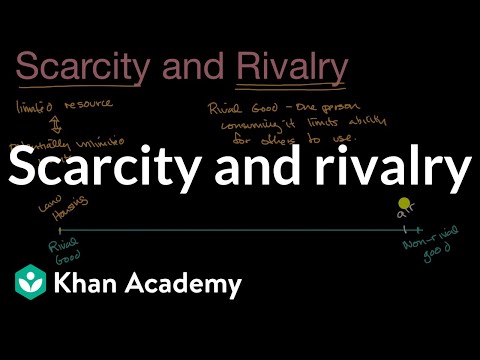
Scarcity and rivalry | Basic Economic Concepts | Microeconomics | Khan Academy
Foundations of Economics: Scarcity and Rivalry
Understanding Scarcity
- The instructor introduces the foundational concepts of economics: scarcity and rivalry.
- Scarcity is defined as a situation where there are not enough resources for everyone, highlighting that resources are limited while human wants are potentially unlimited.
- An example of a scarce resource is oil, which has a limited supply but high demand if it were free.
Exploring Rivalry
- Rivalry in economics refers to goods or resources that, when consumed by one person, limit availability for others.
- A cake serves as an example of a rival good; if one person eats it, others cannot share it.
Spectrum of Rivalrous Goods
- Economists create a spectrum to categorize goods based on their rivalry. On one end are highly rivalrous goods (e.g., housing), while the other end features non-rival goods.
- Housing is highlighted as a rival good due to competition among individuals for limited availability in urban areas.
Non-Rival Goods Examples
- Non-rival goods have almost unlimited supply relative to current demand; air is cited as an example since one person's use does not hinder another's ability to breathe simultaneously.
- However, under extreme conditions (like being in an airtight room), air can become rivalrous because consumption affects availability for others.
Additional Examples of Rivalry
- Hammers are classified as rival goods since their use by one individual prevents simultaneous use by another.
- Roads during rush hour exemplify rival goods due to congestion limiting access for multiple users compared to roads at night, which can be considered non-rival.
Turn any video into a summary like this
YouTube links, meetings, lectures. With transcripts, search, and chat.