UD1 Introducción a los sistemas microinformáticos 6
Understanding Electronic Components in Computer Systems
Overview of Functional Blocks
- The discussion begins with an overview of functional blocks within a computer system, emphasizing the importance of understanding the electronic technology used for each block.
Key Electronic Components
- The speaker highlights essential components such as transistors and vacuum tubes, stressing the need to familiarize oneself with these elements.
- It is noted that CPUs are primarily designed using electronic circuits, which consist mainly of transistors—basic yet crucial components in electronics.
Transistor Types and Usage
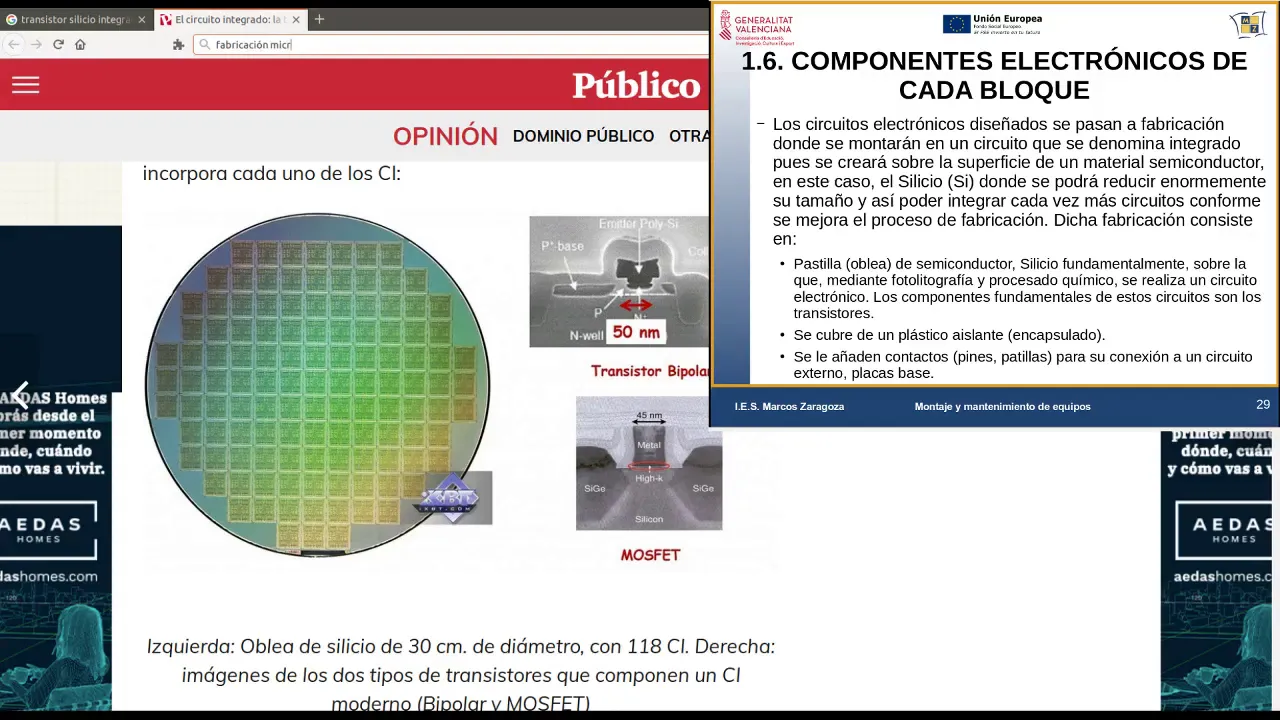
- The focus shifts to MOSFET transistors, explaining their prevalence in CPU design. Visual aids are suggested for better understanding.
- Integrated circuits (ICs), or chips, contain numerous silicon-based transistors. A visual representation is mentioned to clarify this concept.
Manufacturing Process of CPUs
- An explanation follows on how bipolar MOSFET transistors are constructed on silicon wafers, which serve as the foundation for CPUs.
- Millions of interconnected transistors form complex logic circuits within CPUs, enabling them to perform various functions.
Silicon Wafer Characteristics
- The speaker describes the process of creating intricate patterns on silicon wafers akin to drawing circuits on a cookie-like surface.
- Advances in photolithography and chemical processing allow for increasingly smaller circuit designs on silicon wafers.
Final Assembly and Packaging
- After fabrication, silicon chips are encapsulated in plastic housing with added contacts for external connections. This encapsulation is crucial for functionality.
Microprocessors and Memory Modules
Microprocessor Production Insights
- Videos showcasing microprocessor manufacturing processes provide additional context about how circuitry is drawn onto large silicon wafers before being cut into individual processors.
Understanding Memory Types
- Transitioning to memory modules, RAM (Random Access Memory) is introduced as a key component allowing access to any data position independently.
Memory Cell Composition
- Each memory cell consists of bits stored through combinations of capacitors and transistors; this structure enables data retention over time.
Technologies Behind Memory Storage
- Two primary technologies are discussed: dynamic memory (using capacitors + transistors) and static memory (utilizing bistable circuits).
Visual Representation of Memory Structures
Understanding Memory Components in CPUs
Overview of Memory Modules
- The discussion begins with the components involved in memory modules, specifically transistors and capacitors, which are essential for creating memory units.
Cache Memory within CPUs
- Cache memory is highlighted as an integral part of the CPU, although it does not form a separate chip but is encapsulated within the CPU itself.
External Memory Structure
- Externally to the CPU, additional memory exists in integrated chips. These black encapsulated chips contain electronic components like capacitors and transistors that interconnect to form a complete memory module.
Integration with Motherboard
- The modules are designed to fit into the motherboard, where they connect with various electronic components related to input/output operations. This includes both input/output controllers and interfaces.
Complexity of Circuitry
- The circuitry associated with these controllers is complex, involving various electronic components such as resistors, capacitors, coils, diodes, and transistors.
Chipsets and Their Role
Functionality of Chipsets
- A chipset on the motherboard acts as a controller similar to a CPU chip; it manages data flow between different parts of the computer system.
Printed Circuit Boards (PCBs)
- Various devices like printers and SSDs utilize printed circuit boards (PCBs), which can vary in complexity depending on their function and design.
Interfaces for Connectivity
Types of Connectors