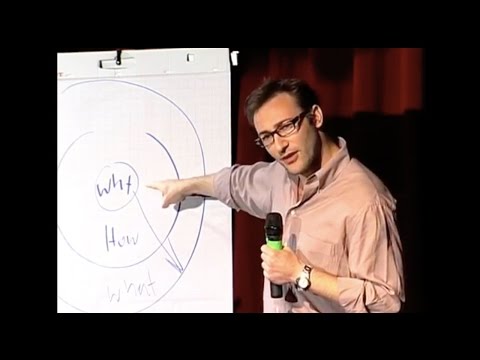
Start with why -- how great leaders inspire action | Simon Sinek | TEDxPugetSound
Start with Why by Simon Sinek
In this section, Simon Sinek introduces the concept of starting with "why" and explores why some individuals and organizations are able to inspire while others struggle in this aspect.
The Importance of "Why"
- Sinek questions why certain individuals and companies, like Apple, Martin Luther King Jr., and the Wright brothers, stand out in their fields despite having similar resources as their competitors.
- He emphasizes that great leaders and organizations share a common way of thinking, acting, and communicating that sets them apart from others.
- Sinek introduces the Golden Circle concept - Why? How? What? - which explains how inspirational leaders focus on their purpose rather than just what they do.
Understanding Purpose
- The Golden Circle highlights that while most know what they do and some know how they do it, very few understand why they do what they do.
- Sinek clarifies that "why" refers to the purpose or belief behind actions, not merely profit-driven motives.
Communication Strategy
- Inspired leaders communicate from the inside out, focusing on their purpose first. Sinek contrasts Apple's inspiring message with traditional marketing approaches to illustrate this point.
- By reversing the order of information to start with "why," organizations can better connect with their audience and inspire action.
Biology Behind Decision Making
This part delves into the biological basis for decision-making processes related to understanding "why."
Biological Perspective
- Sinek explains how our brain is structured into three components: neocortex (rational thought), limbic brain (feelings and behavior), and primal brain (instinctive reactions).
The Power of Why
In this section, the speaker discusses the importance of communicating from the inside out to drive behavior effectively.
Communicating from Inside Out
- When we communicate from the inside out, addressing the part of the brain that controls behavior is crucial for driving actions.
- Gut decisions stem from communicating internally; rationalizing with tangible information follows.
- Decision-making is controlled by the limbic brain, not language; understanding why we do things influences others' responses.
Belief and Success
This segment emphasizes the significance of belief in achieving success and loyalty.
Importance of Belief
- Selling or hiring based on shared beliefs fosters dedication beyond mere transactions.
- Hiring individuals who share beliefs leads to passionate commitment rather than just working for a paycheck.
Wright Brothers vs. Langley
Contrasting Samuel Pierpont Langley's approach with that of the Wright brothers highlights how purpose drives success.
Purpose-driven Success
- Langley had resources but lacked purpose, while the Wright brothers were motivated by a cause to change the world.
- Despite limited resources, education, and recognition, Orville and Wilbur succeeded due to their strong belief in their mission.
Law of Diffusion of Innovation
Exploring how attracting like-minded individuals aligns with mass-market acceptance through innovation diffusion.
Innovation Adoption
- Attracting those who share beliefs aligns with innovators and early adopters before reaching mass-market acceptance.
- The law dictates a tipping point for widespread acceptance after 15-18% market penetration.
Finding Those Who "Get It"
Addressing challenges in identifying individuals who resonate with your beliefs before engaging in business relationships.
Identifying Alignment
Crossing the Chasm: Understanding Consumer Behavior
In this section, the speaker discusses the concept of "Crossing the Chasm" by Geoffrey Moore and delves into consumer behavior patterns related to product adoption.
The Early Majority's Behavior
- The early majority hesitates to try something new until others have tested it.
- Innovators and early adopters are comfortable with intuitive decisions based on personal beliefs.
Consumer Motivations
- Consumers often make purchases to be among the first to own a product.
- People buy based on why a product is made, not just what it does.
Examples of Success and Failure
- TiVo serves as an example of a well-funded but commercially unsuccessful product due to messaging issues.
- TiVo failed because they focused on features rather than conveying their purpose effectively.
Law of Diffusion of Innovation: Successful vs. Unsuccessful Examples
This section explores successful and unsuccessful applications of the Law of Diffusion of Innovation through real-world examples.
Failed Implementation - TiVo
- Despite being high-quality and well-funded, TiVo failed commercially due to ineffective communication about its value proposition.
Successful Implementation - Dr. King's Movement
- Dr. King's success in mobilizing people was rooted in sharing his beliefs rather than directives for change.
- 250,000 individuals gathered for Dr. King's speech not for him but because they believed in his cause.
Inspiring Leadership vs. Authoritative Position
Contrasting inspiring leadership with authoritative positions, emphasizing the power of belief-driven leadership.
Belief-driven Leadership
- Leaders who inspire through shared beliefs attract followers who resonate with their vision.