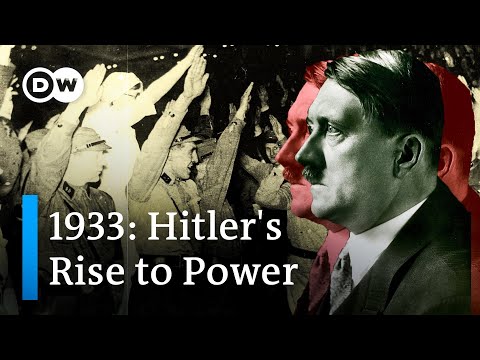
5 Reasons Why Adolf Hitler Gained Absolute Power | History Stories
Introduction
The video begins with the celebration of Adolf Hitler becoming the Chancellor of Germany. Despite concerns about his power-hungry nature, some Germans believe he will be less dangerous in government office than on the streets commanding his Stormtroopers.
Adolf Hitler Becomes Chancellor
- On January 30th, 1933, Adolf Hitler is appointed German Chancellor constitutionally, although the majority of Germans did not vote for him in the previous elections.
- The Nazis want to consolidate their power and call for new elections on March 5th.
- They form a coalition with the German National People's Party and ban the Communist Party to achieve the two-thirds majority needed to pass the enabling act.
- On March 23rd, they pass the enabling act which makes Parliament obsolete and gives dictatorial power to the Nazi government.
Underestimation of Adolf Hitler
Conservative and nationalist elites in Germany underestimated Adolf Hitler's true intentions, leading to World War II and the Holocaust.
Underestimation Leads to Catastrophe
- Conservative and nationalist elites in Germany tried to use Adolf Hitler to stay in power themselves.
- Their underestimation of Hitler's true intentions leads to World War II, resulting in millions of deaths and atrocities such as the Holocaust.
Hitler's Deception
Part of Hitler's success lies in his ability to appear harmless while pushing through his plans for dictatorship.
Deceptive Tactics
- Hitler appeases conservative nationalist elites by appearing as a harmless politician who respects traditional values.
- He trades his uniform for a tailcoat at celebrations like Potsdam, symbolizing respect for Old Germany.
- Hitler combines nationalist myth-making with biblical metaphors to appeal to religious groups.
Consolidation of Power
With Adolf Hitler in power, the Nazis solidify their control through propaganda and eliminating political opposition.
Nazi Control
- The masses are drawn to Hitler's false promises.
- The Nazis use radio, film, and propaganda master Joseph Goebbels to reach the masses.
- Anti-terrorism laws are passed, leading to the incarceration and deportation of political enemies.
- Concentration camps are established, free trade unions are forbidden, and Jews face harassment and seizure of their possessions.
- By July 1933, only the Nazi party remains as the sole political party in Germany.
Context for Rise of Nazism
The Treaty of Versailles and economic crisis contribute to the rise of Nazism in Germany.
Contextual Factors
- The Treaty of Versailles imposes reparation payments on Germany after World War I.
- The global economic crisis worsens unemployment rates in Germany.
- Democracy is relatively new and unpopular in Germany at this time.
- Nazis exploit these conditions to promote their cause.
Propaganda Techniques
The Nazis effectively use propaganda techniques such as orchestrated mass events and controlled imagery.
Effective Propaganda
- Orchestrated mass events like torchlight marches create a sense of unity among supporters.
- Joseph Goebbels controls the images people see through film and other media forms.
New Section
This section discusses the rise of Hitler and the establishment of a personality cult around him in Nazi Germany.
The Cult of Hitler
- Jesus
- Hitler is portrayed as the savior of the Germans.
- Minister for propaganda, Gabas, builds up a personality cult around Hitler.
- The Hitler salute becomes mandatory in Nazi Germany.
- The swastika becomes the official symbol.
- Interviews with foreign journalists are staged and broadcasted to create a positive image of Germany.
New Section
In this section, an interview with a purported journalist from abroad is staged to promote the image of Germany under Hitler's leadership.
Staged Interview
- A journalist claims to be an old visitor of Germany and praises Adolf Hitler as a great leader.
- The journalist admires the new vitality and centralized government under Hitler's rule.
New Section
Most of the world watches events unfold in Germany with a mix of dread and disregard.
World's Reaction
- The world observes events in Germany with fear and indifference.
New Section
After President Hindenburg's death, Adolf Hitler assumes totalitarian power in Germany.
Transfer of Power
- President Hindenburg dies on August 2nd, 1934.
- Adolf Hitler now has complete control over Germany for the next 11 years, marked by terror, murder, and war.
Turn any video into a summary like this
YouTube links, meetings, lectures. With transcripts, search, and chat.