Economic Schools of Thought: Crash Course Economics #14
Crash Course Economics: Understanding Economic Ideologies
Introduction to Economic Theories
- Adriene Hill and Jacob Clifford introduce the topic of economic ideologies, acknowledging viewer comments about their previous content.
- They announce a discussion on various schools of economic thought, starting with historical context.
Historical Context of Economic Thought
- Thomas Malthus's theory from 1798 posited that population growth would outpace food production, leading to famine; however, this was proven incorrect as advancements in technology allowed for increased food production.
- Malthus's ideas were misinterpreted by some scholars who combined them with Darwinian concepts, leading to Social Darwinism—a flawed belief that welfare assistance is immoral.
Foundational Economists
- Adam Smith is introduced as the founder of modern economics through his influential work "The Wealth of Nations" (1776), advocating for self-interest serving the common good and free trade.
- David Ricardo expanded on Smith’s ideas with the theory of comparative advantage, suggesting mutual benefits from trade even when one party is more efficient in all areas.
Marxist Critique and Class Conflict
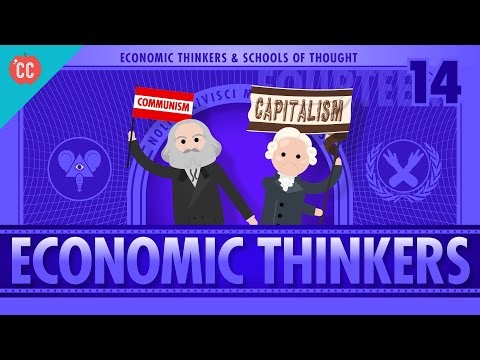
- Karl Marx and Friedrich Engels challenged classical economics by focusing on class conflict between workers and property owners, predicting an eventual overthrow leading to communism.
- This led to two main economic camps: free market capitalism supporting private property versus communism advocating collective ownership.
Evolution of Economic Theory
- Classical economics continued to dominate until the Great Depression challenged its principles; Alfred Marshall's "Principles of Economics" (1890) laid foundational concepts like supply and demand.
- John Maynard Keynes emerged during the Great Depression with new theories in "A General Theory of Money, Interest, and Employment" (1936), arguing for government intervention during recessions due to slow price adjustments.
Keynesian Economics and Socialism
- Keynesian economics became mainstream as it advocated for government involvement in stabilizing economies during downturns—contrasting classical views that saw such intervention as harmful.
Economic Ideologies and Their Evolution
The Role of Socialist Policies in Scandinavian Countries
- Scandinavian countries like Norway and Sweden embrace socialist policies, contrasting with the U.S. rejection of many such ideas.
- Despite this, U.S. economists often support Keynesian economic policies during economic downturns, indicating a complex relationship with socialism.
Austrian School's Critique of Government Intervention
- The Austrian School, represented by figures like Friedrich Hayek and Ludwig von Mises, argues against heavy state involvement in the economy, claiming it fails to deliver promised results.
- They contend that government regulation complicates economic dynamics rather than solving issues, advocating for minimal fiscal and monetary policy intervention.
Milton Friedman and the Chicago School
- Milton Friedman advanced the ideas of the Austrian School in the U.S., promoting privatization and deregulation while attributing the Great Depression to poor monetary policy rather than capitalism itself.
- His theories led to the establishment of the Chicago School of economics, gaining prominence during stagflation in the 1970s when traditional Keynesian approaches struggled to explain economic conditions.
Emergence of Monetarism and Supply-Side Economics
- Monetarists focus on maintaining price stability through controlled money supply growth as a means for steady economic expansion.
- Concurrently, supply-side economics (or trickle-down economics) gained traction by advocating tax cuts and deregulation as pathways to stimulate growth. Mainstream economics today incorporates elements from both monetarism and Keynesianism into what is known as new neoclassical synthesis.
Ongoing Debates on Economic Policy Implementation
- The global recession of 2008 highlighted differing opinions among economists regarding effective responses: some favored Keynesian deficit spending while others advocated austerity measures to curb budget deficits.
- This ongoing debate underscores that these discussions are not merely academic; they have real-world implications affecting millions globally.
Future Directions for Economic Thought
- While many former communist nations have shifted towards capitalism, Marxist ideas persist within capitalist frameworks through social programs resembling socialist policies. North Korea remains an outlier but does not serve as a viable test case for communism's efficacy in modern economies.
Turn any video into a summary like this
YouTube links, meetings, lectures. With transcripts, search, and chat.