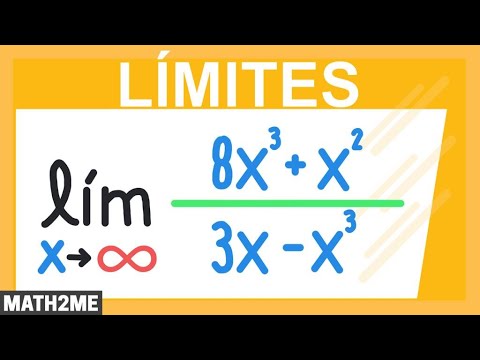
Límites cuando x tiende al infinito | Profe Andalón
Understanding Limits in Differential Calculus
Introduction to Limits
- The instructor introduces the topic of limits in differential calculus, emphasizing its importance and suggesting viewers watch a prior video on operations with infinity for foundational knowledge.
Determining Limits as x Approaches Infinity
- When determining the limit of a rational function as x approaches infinity, it's crucial to consider the reciprocal limit of x, which equals zero. This concept lays the groundwork for understanding more complex limits.
- A common technique involves algebraic manipulation by identifying the variable with the highest exponent (in this case, x), which will be used for simplification.
- The process includes dividing each term by this identified variable (x), ensuring that the original function's value remains unchanged while preparing for limit evaluation.
Simplifying Expressions
- After performing algebraic simplifications, constants remain while terms involving x are reduced. For example, simplifying yields expressions like 10 and fractions involving x that approach zero.
- It is established that any term with a variable in the denominator approaches zero as x tends to infinity. Thus, only constant values contribute to the final limit result.
Evaluating Specific Limits
- The instructor evaluates a specific limit where it simplifies down to evaluating 10 divided by 2, resulting in a final limit of 5 when x approaches infinity.
Further Examples and Techniques
- In another example, identifying the highest exponent (x^3) leads to further algebraic division among all terms within both numerator and denominator without altering their values before applying limits.
- Each term is divided by x^3; this results in simpler forms such as constants or fractions that can be evaluated easily at infinity.
- As simplifications continue, it becomes clear that terms involving powers of x diminish towards zero when taking limits at infinity.
Final Limit Evaluation
- Ultimately, through careful application of properties regarding limits and signs during division processes, one arrives at a final conclusion: for certain functions approaching negative values leads to an overall limit of -8 when evaluated correctly.