Rearranging Charles', Gay-Lussac's, and Avogadro's Laws
Understanding Gas Laws: Rearranging Charles, Avogadro's, and Gay-Lussac's Laws
Introduction to Gas Laws
- The video focuses on rearranging Charles' Law, Avogadro's Law, and Gay-Lussac's Law to solve for any variable within these equations.
- All three laws share a similar structure with fractions on both sides of the equation, making them fundamentally alike.
Solving for V2 Using Charles' Law
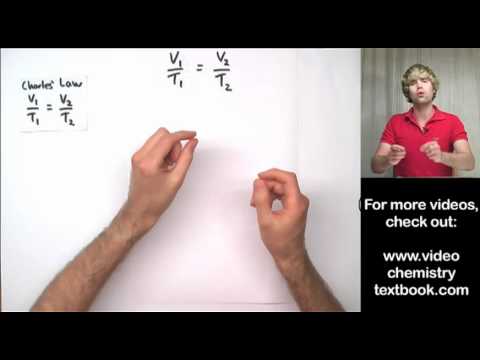
- The formula V1/T1 = V2/T2 is introduced as a basis for solving for variables.
- To isolate V2, T2 is multiplied by both sides of the equation to eliminate it from the denominator.
- The equation can be expressed as either T2 * V1 / T1 = V2 or flipped to show V2 = T2 * V1 / T1.
Techniques for Isolating Variables
Cross Multiplication Method
- A shortcut method called cross multiplication is introduced to solve for variables in the denominator.
- For example, when solving for T2 using cross multiplication: V1 * T2 = T1 * V2.
Alternative Method Without Cross Multiplication
- An alternative approach involves multiplying both sides by T1 first to move it out of the denominator.
- After isolating T1 on top of the fraction, further steps are taken to isolate it completely.
Final Steps in Rearranging Equations
- To isolate T1 after moving it above the fraction line: multiply both sides by T2 and then divide by V2.
- The final expression can be presented as either (T1 = T2 * V1 / V2), maintaining flexibility in how results are displayed.