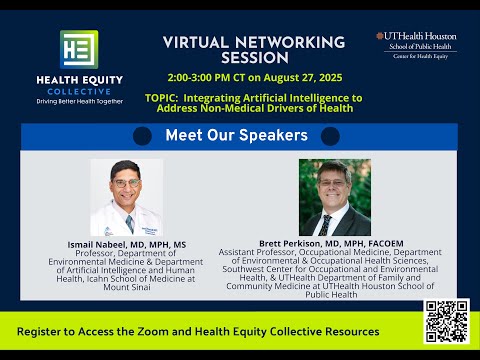
Virtual Networking Session - Integrating AI into EHRs
Introduction to Speakers
Overview of Dr. Nabil
- Dr. Nabil is a distinguished expert in internal medicine, occupational environmental medicine, and clinical bioinformatics.
- His work focuses on identifying risk factors related to climate change and environmental determinants affecting human health, particularly in occupational settings.
- He is involved with the World Trade Center health program, aiming to improve outcomes for those affected by the tragedy.
- Dr. Nabil utilizes AI and data analysis from electronic health records to enhance practices in occupational environmental medicine.
- He produces a podcast for the American College of Occupational Environmental Medicine that explores relevant topics in his field.
Overview of Dr. William Brett Pergason
- Dr. Pergason is an assistant professor at the University of Texas School of Public Health specializing in occupational environmental sciences.
- He holds multiple roles including assistant medical director and residency director, with board certifications in family medicine and occupational environmental medicine.
- His research interests include disaster response, heat stress, diabetes prevention, and improving electronic health records for better identification of exposures impacting health.
Discussion on AI's Impact
Introduction to AI in Healthcare
- The discussion begins with appreciation for previous presentations and highlights the inspirational work being done by attendees.
- Emphasis is placed on exploring new areas together that can lead to advancements in understanding and improving human health through AI.
Case Study: Lower Back Pain
- A real-life case study involving a 43-year-old O technician named Sally illustrates how AI can be integrated into practice regarding workplace injuries.
- Sally suffered a significant back injury after slipping at work; this case serves as an example of common workplace injuries leading to chronic pain issues.
Challenges in Treating Lower Back Pain
- Lower back pain is prevalent among patients; it often leads to chronic conditions if not treated early or effectively.
- The complexity of lower back pain treatment arises from various underlying causes such as herniated discs or degenerative disc disease which require tailored approaches.
Importance of Early Intervention
- Early diagnosis and treatment are crucial for effective management; many patients experience prolonged suffering due to delayed care.
Understanding Disability in the Workforce
The Impact of Lower Back Pain on Disability
- Lower back pain, along with arthritis and musculoskeletal conditions, is a leading cause of disability affecting both patients and workforce functionality.
- The complexity of lower back pain arises from its multifaceted nature; it is often coded under various terms like myalgia or dorsalgia for billing purposes.
- Coding challenges complicate understanding patient experiences, as multiple codes may not accurately reflect the patient's condition or treatment needs.
Research Challenges in Treating Lower Back Pain
- A study involving primary care doctors aimed to improve treatment for acute low back pain by integrating a tool into electronic health records (EHR).
- The intervention group using the EHR tool wrote more return-to-work prescriptions compared to the control group, highlighting the tool's effectiveness.
- Early activation of patients with acute low back pain can significantly reduce the risk of developing chronic pain, emphasizing timely intervention.
Limitations in Understanding Patient Conditions
- Providers expressed concerns that existing coding does not adequately differentiate between acute and chronic low back pain cases.
- The inability to observe practices simultaneously across multiple providers makes it challenging to assess patient conditions accurately.
Leveraging Technology: Artificial Intelligence and Natural Language Processing
- The potential of artificial intelligence (AI), particularly deep learning and natural language processing (NLP), was explored as a means to enhance understanding and treatment outcomes.
- NLP allows machines to interpret written notes but faces challenges due to inconsistent terminology used by different healthcare providers.
Enhancing Communication through AI
- An example illustrates how shorthand medical notes can be difficult for computers to decipher, necessitating clearer communication methods among healthcare professionals.
Understanding Neural Networks and Their Application in Health Records
The Process of Classification in Neural Networks
- Neural networks assign new identifiers to data, allowing for classification based on visual input, such as distinguishing between a truck and a car.
- Unlike humans who can easily identify vehicles, machines require extensive processing power to classify images accurately through multiple steps.
- Current advancements aim to simplify the classification process compared to earlier neural network models.
Challenges in Medical Terminology
- Medical professionals use varied terminology (e.g., "lower back pain," "spasm") that complicates machine understanding of health records.
- Standard codes like ICT10 are often unreliable and fail to provide context about patient conditions, leading to misrepresentation of symptoms.
Evolution of AI in Healthcare
- The introduction of transformer architecture in 2017 marked a significant shift in AI capabilities, enhancing how machines process language and context.
- Google's research paper titled "Attention is All You Need" revolutionized AI by enabling machines to remember sequences and translate languages effectively.
Implementation of Transformer Models
- Transformers allow computers not only to predict subsequent words but also understand context, making them essential for natural language processing tasks.
- The availability of transformer models facilitated the extraction and analysis of electronic health record notes for better patient classification.
Data Extraction and Model Training
- Researchers labeled patient notes related to lower back pain, training neural networks for effective classification within electronic health records.
- The study expanded its focus beyond lower back pain to include knee and shoulder problems, recognizing the complexity of musculoskeletal conditions.
Addressing Complex Clinical Cases
- Acknowledging both acute and chronic cases led researchers to adapt their approach towards more comprehensive classifications within musculoskeletal issues.
- Open-source foundation models were utilized due to restrictions on proprietary models when handling sensitive electronic health data.
Control Over Data Privacy
Understanding the Evolution of AI in Healthcare
The Groundbreaking Nature of AI Models
- The discussion begins with chronic pain conditions, highlighting how new models communicate like humans, revolutionizing information sharing among healthcare professionals.
- Unlike previous models that were condition-specific (e.g., lower back pain), the foundational model can address any health issue without needing adjustments for different conditions.
- The ability to extract detailed patient history from electronic health records has improved significantly, making models agnostic to specific conditions and enhancing their utility across various cases.
Challenges and Limitations of Current Models
- Early challenges included the limited input window for large language models; most clinical notes exceed this limit, complicating data processing.
- A study published in Lancet Digital demonstrated that foundational models could effectively analyze electronic health records, achieving high sensitivity and specificity in identifying conditions.
Types of AI Models in Use Today
- Three main types of AI models are emerging: simple response models, chain-of-thought models, and reasoning models. Each serves a distinct purpose in clinical decision-making.
- Simple response models provide quick answers but lack depth; chain-of-thought models demonstrate a visible thinking process by considering multiple factors before responding.
Advancements in Reasoning Models
- Reasoning models represent an advanced step that incorporates systemic reasoning and differential diagnosis into responses, offering comprehensive assessments including limitations and recommendations.
- These complex reasoning capabilities allow for a deeper understanding of patient cases compared to simpler response methods.
Case Study: Application of AI in Clinical Practice
- A case involving a 35-year-old male construction worker illustrates how AI can assist clinicians by providing likely diagnoses based on symptoms such as sharp pain after lifting heavy objects.
Retrieval Augmented Generation and AI in Healthcare
Introduction to Retrieval Augmented Generation (RAG)
- RAG is a new method that enhances large language models by integrating new information sources, improving their ability to process and understand current knowledge.
- For instance, if a new moon is discovered on Jupiter, RAG allows this information to be incorporated into the language model's understanding.
Enhancements in AI Capabilities
- RAG can improve AI systems to mimic human thought processes, making them more effective for research and nuanced understanding.
- The concept of "ambient AI scribes" is introduced, which are tools that assist in generating clinical notes during patient interactions seamlessly.
Implementation of AI Scribers
- Ambient AI scribes utilize smartphones to record conversations between patients and physicians, automatically generating notes for electronic health records.
- The institution mentioned ranks among the top 50 globally for supercomputing capabilities, allowing advanced data processing and analysis.
Data Management and Standardization
- Epic is used as the primary electronic health record system; data is stored in a server called Kabuto before being standardized into OMOP format for real-time access.
- This standardization enables efficient extraction of millions of records instantly within the institution.
Advanced Computing Infrastructure
- The HPC cluster built with H100 GPUs supports sophisticated data processing; upcoming B200 U GPUs promise further advancements in capabilities.
Case Study: Cognitive Assessment Using AI
- A case study involving a female patient with cognitive complaints illustrates how large language models can analyze historical medical data effectively.
- The model assesses whether memory issues indicate Alzheimer's disease based on extracted mocha scores and previous assessments over two years.
Insights from the Case Study
- The model identifies patterns of cognitive decline while considering factors like anxiety and ESL status that may affect test performance.
- Recommendations include MRI scans to rule out structural causes of dementia, showcasing how AI can aid diagnosis even outside specialists' expertise.
Conclusion
Health Equity and AI in Medical Practice
The Role of Health Equity Collective
- The Health Equity Collective empowers healthcare professionals to enhance diagnostic capabilities and identify patients needing non-medical health drivers.
- It supports clinicians, case managers, and social workers by providing critical insights into various health-related factors affecting patient care.
Occupational Environmental Medicine Insights
- The speaker, an occupational environmental medicine physician at UT Physicians, focuses on linking illnesses and injuries to occupational and environmental exposures.
- Collaboration with Hannah Tarver has led to analyzing five years of coding data from UT Physicians regarding occupational environmental issues.
Key Findings on Occupational Exposures
- Initial results indicate inadequate drinking water supply as a common code among patients, highlighting significant public health concerns.
- Heat stress is identified as a challenging diagnosis due to its subtle presentation; often only fatal cases are recognized while other symptoms like dizziness may go unnoticed.
Utilizing AI for Improved Diagnosis
- By leveraging AI, the potential exists to uncover associations between heat stress and local population health that traditional coding misses.
- Integrating GIS codes with patient addresses could help identify social vulnerability indices, enhancing understanding of community needs through AI analysis.
Questions on Data Protection and Bias Mitigation
- Following the presentation, questions arose about how organizations protect patient data used by AI systems from breaches or misuse.
- The institution follows strict IRB protocols for research involving electronic health records (EHR), ensuring ethical extraction of information with proper permissions.
Addressing Algorithmic Bias in AI Systems
- Concerns were raised about algorithmic bias perpetuating health disparities; biases exist inherently within both human practitioners and AI models trained on historical data.
Understanding AI Behavior Modification
Modifying AI Behavior and Biases
- The speaker discusses the ability to modify AI behavior by implementing guardrails that reflect personal biases, allowing for a more tailored interaction with the AI.
- It is now possible for users to train and adjust AI systems to recognize and address biases, which was not feasible in earlier iterations of AI technology.
- An example is provided regarding ESL (English as a Second Language), highlighting how the model's attention to specific cases can significantly impact care decisions.
- Emphasis is placed on the importance of diversity among programmers to ensure comprehensive checks against biases, as human interpretation plays a crucial role in this process.
- The discussion transitions into auditing AI models for bias, particularly concerning insurance coverage and treatment options.
Auditing AI Models in Healthcare
- The speaker describes scenarios where insurers question medication prescriptions due to prior authorizations influenced by flagged data from AI processes.
- A call is made for collaborative development of AI models that minimize inherent biases while ensuring transparency in decision-making related to patient care.
- There’s an insistence on maintaining human assessments alongside automated processes, advocating for transparency when using AI in reimbursement decisions.
- The speaker expresses concern about invasive feelings associated with new developments in AI but stresses the need for proactive engagement with these technologies.
Patient Access and Consent Regarding AI Use
- Discussion shifts towards patient understanding of how their data is used by AI systems, emphasizing the importance of informed consent during interactions involving ambient AI technologies.
- An example from New York state illustrates varying consent requirements when recording conversations; transparency about these practices fosters better patient relationships.
- The speaker advocates for clear communication about recording practices within healthcare settings, enhancing trust between patients and providers.
Incorporating Diverse Healthcare Notes for Enhanced Patient Care
The Importance of Team-Based Care
- The discussion emphasizes the need for transparency in patient care, allowing patients to understand their treatment better, which leads to increased receptiveness.
- There is a focus on enhancing team-based care and coordination between healthcare providers, including nurses and community health workers, to improve health equity.
Utilizing Comprehensive Provider Notes
- Current practices filter notes primarily from physicians but acknowledge the potential value of incorporating insights from other healthcare professionals like nutritionists.
- The ability to analyze vast amounts of notes allows for a more nuanced understanding of patient care beyond traditional coding systems (ICD10).
Future Directions in Healthcare Documentation
- There is optimism about integrating records from various providers within the next year, highlighting the importance of dietitians and social workers in patient treatment plans.
- This integration aims to create a holistic view of patient care that includes multiple perspectives from different healthcare roles.
Impact on Medical Training
- The conversation shifts towards medical education, suggesting that training should adapt to include tools used by students today, such as online resources.
- Educators face challenges in evolving teaching methods to incorporate new technologies effectively while allowing students room for experimentation and learning through failure.
Continuous Learning and Engagement
- The session concludes with an emphasis on ongoing learning and engagement among participants regarding critical topics like environmental justice in AI applications within healthcare.