Potencia | Trabajo y energía | Física | Khan Academy en Español
Understanding Power and Work in Physics
Introduction to Work and Energy
- The concept of work is introduced, defined as the amount of energy transferred. It can be simplified to mean the energy given or taken away.
- Two weightlifters are compared; both lift the same weight (100 kg) to a height of 2 meters, resulting in 1960 joules of work done by each.
Differentiating Between Speed and Power
- The difference between the two lifters is discussed in terms of power, which measures how quickly work is performed.
- The right lifter completes the lift in 1 second while the left takes 3 seconds, leading to different power outputs: 1960 watts for the right lifter versus 653 watts for the left.
Calculating Power Output
- An example involving a car with a mass of 1000 kg accelerating from rest to 5 m/s over 2 seconds illustrates how to calculate power output.
- The kinetic energy given to the car during this time results in an average power output of 6250 watts.
Instantaneous vs. Average Power
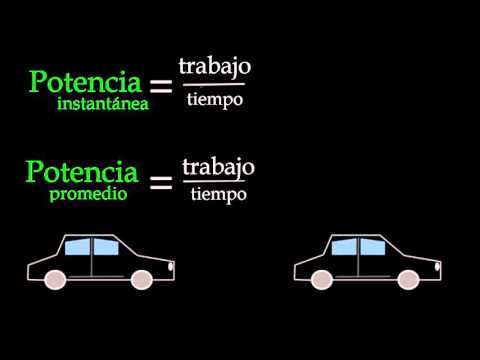
- Clarification on average versus instantaneous power is provided; average power considers total work over time intervals, while instantaneous power focuses on specific moments.
- To find instantaneous power without calculus, one can use known values at any moment when conditions are stable.
Finding Instantaneous Power Using Force and Velocity
- A method for calculating instantaneous power involves using force multiplied by velocity at that instant.
- When force and velocity align (angle θ = 0), cosine factors out, simplifying calculations: instantaneous power equals force times speed directly.
Summary of Key Concepts
- Power represents how quickly work is done; average power is total work divided by time interval.