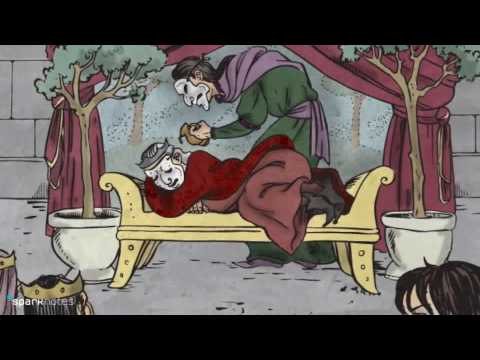
Video SparkNotes: Shakespeare's Hamlet Summary
Introduction to Hamlet's Tragedy
The Setup of the Story
- Hamlet, the prince of Denmark, faces turmoil after his father's death and his uncle Claudius's ascension to the throne.
- Claudius marries Gertrude, Hamlet's mother, shortly after King Hamlet's demise.
- A ghost resembling King Hamlet appears to soldiers, prompting them to inform Prince Hamlet.
Hamlet’s Grief and Relationships
- Claudius urges Hamlet to cease mourning; however, he privately expresses disgust over his mother's quick remarriage.
- Ophelia, Hamlet’s love interest, is advised by her father Polonius and brother Laertes that Hamlet may not genuinely love her due to his royal status.
- After seeing the ghost claiming he was murdered by Claudius, Hamlet vows revenge and considers feigning madness.
The Play Within a Play
Testing Claudius’s Guilt
- Rosencrantz and Guildenstern are tasked with discovering the cause of Hamlet's erratic behavior.
- To confirm Claudius’s guilt in his father’s murder, Hamlet arranges for actors to perform a play mirroring the crime.
Spying on Ophelia
- Claudius and Gertrude spy on a conversation between Ophelia and Hamlet to assess if his madness stems from lovesickness.
- During this encounter, Hamlet harshly rejects Ophelia, leading Claudius to conclude that he poses a threat.
Confrontation with Claudius
The Revelation of Murder
- After witnessing the play's impact on Claudius—who leaves in distress—Hamlet believes he has confirmed his uncle's guilt.
- Alone with Claudius later, he refrains from killing him during prayer out of fear that it would send him to heaven instead of hell.
Confronting Gertrude
- In an intense confrontation with Gertrude about her marriage to Claudius, Polonius eavesdrops but is accidentally killed by Hamlet.
- The ghost reappears during this confrontation urging haste in seeking revenge against Claudius.
Laertes’ Return and New Conflicts
Laertes' Anger
- Following Polonius’s death and Ophelia’s madness from grief, Laertes returns seeking vengeance against those responsible for their suffering.
Plotting Against Hamlet
- As news arrives that Hamlet survived England, both Laertes and Claudius plot new schemes for revenge against him.
Tragic Outcomes
Ophelia’s Death
- News breaks that Ophelia has drowned; her burial becomes a pivotal moment filled with grief as Laertes mournfully leaps into her grave.
Final Confrontations
- Realizing who is being buried leads to an emotional outburst from Hamlet as he declares no one loved Ophelia more than he did.
The Fencing Match
Deception at Play
- Osric invites hamlet to duel laertes while secretly plotting their deaths through poisoned weapons.
Climax of Betrayal
Hamlet's Tragic Conclusion
The Fatal Duel
- Laertes successfully wounds Hamlet with a poisoned sword, leading to a fierce struggle between the two characters as they grapple and exchange weapons.
- In the chaos, Hamlet inadvertently wounds Laertes with the same poisoned sword, marking a pivotal moment in their conflict.
- Gertrude collapses after realizing she has been poisoned, adding urgency and tragedy to the unfolding events.
- Laertes confesses to Hamlet that he was responsible for poisoning the sword, revealing his role in the deadly scheme orchestrated by Claudius.
- Both characters acknowledge their impending deaths due to the poison, highlighting themes of fate and retribution.
The Downfall of Claudius
- In a final act of vengeance, Hamlet stabs Claudius with the poisoned sword and forces him to drink from a cup filled with poison.
- Claudius succumbs to his injuries and dies, symbolizing justice served for his treachery against Hamlet's family.
The Aftermath
- As Laertes lies dying, he expresses remorse for his actions, emphasizing themes of regret and moral consequence within the narrative.
- Before dying himself, Hamlet instructs Horatio to remain alive and tell the truth about what transpired during this tragic series of events.
Fortinbras' Arrival