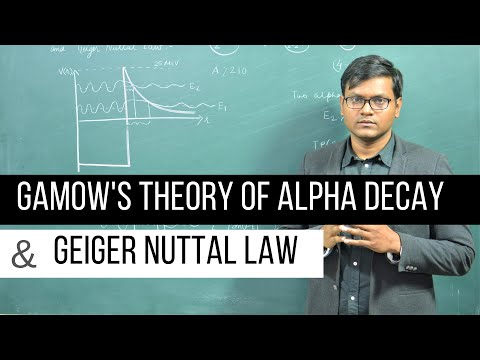
Gamow's Theory of Alpha Decay AND Geiger Nuttal Law
Introduction to Alpha Decay and the Gamow Theory
In this section, the speaker introduces the concept of alpha decay and its relation to the Gamow theory. The nature of nuclear forces and why only large-sized nuclei undergo alpha decay are discussed.
Alpha Decay Process
- Alpha decay is a spontaneous radioactive decay process where a large-sized nucleus emits an alpha particle (helium nuclei).
- Only nuclei with mass numbers greater than 210 undergo alpha decay.
- The nuclear force (attractive) and Coulomb force (repulsive) hold the nucleus together.
- At short distances, the nuclear force dominates over Coulomb repulsion in small and medium-sized nuclei, resulting in stable configurations.
- However, as the size of the nucleus increases, Coulomb repulsion starts dominating over nuclear forces, making the structure unstable.
- Large-sized unstable nuclei become stable by losing protons and neutrons through alpha decay.
Kinetic Energy Puzzle in Alpha Decay
This section explores the puzzle associated with the kinetic energy of alpha particles emitted during different types of alpha decays. The relationship between kinetic energy and potential energy is discussed.
Nuclear Potential Diagram
- Particles inside a nucleus experience a nuclear potential due to their interactions.
- The potential can be approximated as a square well potential within the nuclear radius.
- As an alpha particle tries to escape from the nucleus, it experiences both attractive nuclear potential and repulsive Coulomb force.
Kinetic Energy Puzzle
- Different types of nuclear configurations have potential wells with heights ranging from 25 to 30 mega electron volts (MeV).
- However, alpha particles emitted during alpha decay have maximum kinetic energies ranging from 4 to 9 MeV.
- It is puzzling how particles with lower kinetic energy than the potential barrier height can escape the nucleus.
Analogy with Escape Velocity
- An analogy is drawn with throwing a chalk vertically upwards on Earth.
- If the chalk is thrown with a velocity greater than the escape velocity, it can overcome Earth's gravitational potential and escape to space.
- If the chalk is thrown with a velocity less than the escape velocity, it will fall back to Earth due to insufficient kinetic energy.
- The same situation seems to occur in alpha decay, where alpha particles with lower kinetic energy than the potential barrier height still manage to escape.
Conclusion
The speaker concludes by summarizing the puzzle of alpha decay and how particles can penetrate potential barriers despite having lower kinetic energy.
Explanation of Quantum Tunneling
In this section, the concept of quantum tunneling is explained using principles from quantum physics.
Quantum Tunneling
- Quantum tunneling is a phenomenon in which a particle can penetrate a barrier with a height greater than its kinetic energy.
- According to quantum mechanics, particles have wave behavior associated with them, and their motion can be understood through wave mechanical equations.
- These equations show that particles have a certain probability of penetrating through barriers, even if their kinetic energy is lower than the barrier's height.
- The transmission probability for such particles can be calculated using the equation e^(-2KL), where L is the width of the barrier and K represents the differences in energy.
Application of Quantum Tunneling to Alpha Decay
This section discusses how George Gamow applied the concept of quantum tunneling to explain alpha decay.
George Gamow's Theory
- George Gamow borrowed the idea of quantum tunneling from quantum physics to explain alpha decay.
- He proposed that alpha particles, which are stuck in a potential well, can still escape despite having less energy than the potential barrier.
- By considering alpha particles as wave-like entities, he showed that they have a probability of escaping through the potential barrier.
- The nature of this escape follows probabilistic mechanics.
Relationship between Quantum Tunneling and Geiger-Nuttall Law
This section explores how the Geiger-Nuttall law relates to quantum tunneling in alpha decay.
Comparison between Alpha Particles
- Comparisons are made between two different alpha particles with different kinetic energies (E1 and E2).
- Based on transmission probabilities derived from quantum tunneling theory, it is observed that the high-energy alpha particle has a greater transmission probability compared to the low-energy alpha particle.
- This means that the high-energy alpha particle has a shorter half-life compared to the low-energy alpha particle.
Geiger-Nuttall Law
- The Geiger-Nuttall law states that nuclear decay reactions with higher half-lives result in low-energy alpha particles, while reactions with lower half-lives produce high-energy alpha particles.
- In other words, short-lived alpha particles have greater kinetic energy, while long-lived alpha particles have lesser kinetic energy.
Summary of Geiger-Nuttall Law
This section provides a summary of the relationship between half-life and kinetic energy in the context of the Geiger-Nuttall law.
- The Geiger-Nuttall law states that nuclear decay reactions with higher half-lives lead to low-energy alpha particles, while reactions with lower half-lives result in high-energy alpha particles.
- Short-lived alpha particles have greater kinetic energy, while long-lived alpha particles have lesser kinetic energy.
New Section
This section introduces the concept of Gamos theory of alpha decay and its relationship with the half-life and kinetic energy of alpha particles.
Gamos Theory and Alpha Decay
- The Gamos theory, developed by Gigga and Nuttall, explains the experimental observation that alpha particles can penetrate through potential barriers greater than their kinetic energies.
- The half-life of an alpha particle is inversely proportional to its kinetic energy.
- The equation for the half-life in terms of atomic number (Z), square root of kinetic energy (√e), and a constant (k1) is given as:
half-life = Z / (√e * k1 + e2).
- Experimental observations show that if the half-life is greater, then the kinetic energy is less, and vice versa.
- Gamos theory borrows the idea of quantum tunneling to explain this phenomenon.
New Section
This section discusses how Gamos theory provides an experimental validation for quantum tunneling and introduces the concept of Geiger-Nuttall law.
Experimental Validation and Geiger-Nuttall Law
- Gamos theory successfully explains why alpha particles can penetrate through potential barriers greater than their kinetic energies.
- Theoretical explanation for this experimental observation comes from the concept of quantum tunneling.
- Geiger-Nuttall law states that there is a linear relationship between the logarithm of half-life and the reciprocal square root of kinetic energy for different nuclear species undergoing alpha decay.
- Geiger-Nuttall law provides an experimental validation for the idea of quantum tunneling.
New Section
In this section, it is mentioned that in the next video, there will be a derivation of Geiger-Nuttall law from the quantum tunneling expression using Gamos theory.
Derivation of Geiger-Nuttall Law
- The next video will focus on deriving the Geiger-Nuttall law from the quantum tunneling expression using Gamos theory.
- The link to the next video will be provided in the description for those interested in the derivation process.
Turn any video into a summary like this
YouTube links, meetings, lectures. With transcripts, search, and chat.