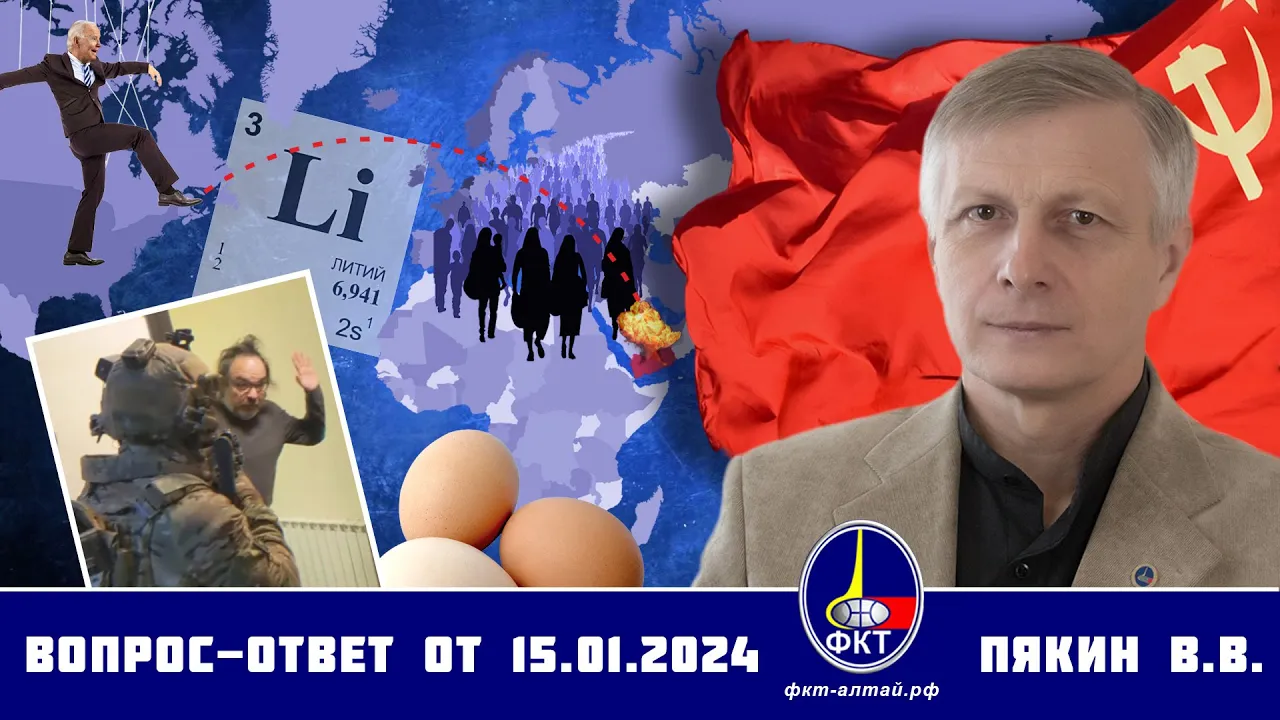
Валерий Викторович Пякин. Вопрос-Ответ от 15 января 2024 г.
Internal Predictor of the USSR: State Symbols and Sovereignty
The discussion delves into the development of state symbols and sovereignty, challenging the assumption that the global system of national flags evolved naturally. It explores how individuals involved in creating national flags may be surprised to discover their ideas were influenced by a leader's management scheme.
Development of Global State Hierarchy
- Individuals' surprise at realizing their thoughts and ideas were implanted through a leader's management style during the creation of national flags.
- Exploration of the global state hierarchy, its representation in state flags, and other national symbols.
- Migration statistics from Africa to Russia, highlighting a relatively low scale compared to Africa's population potential.
Migration Issues and Ethnic Crime Groups
This section addresses migration challenges, ethnic crime groups, and their impact on Russian society.
Migration Dynamics
- Legal presence of African migrants in Russia remains stable around 38,000 to 40,000 individuals annually.
- Tension between migrants from former Soviet republics and locals due to corrupt officials fostering ethnic criminal groups disregarding Russian laws.
Ethnic Crime Groups
- Emergence of ethnic enclaves where Russian laws are ignored, posing challenges for law enforcement.
- Desire of people from former Soviet republics to migrate to Russia contrasts with initial sentiments post-Soviet Union dissolution.
Challenges with National Diasporas
Focuses on issues arising from national diasporas impacting law enforcement and societal norms.
Law Enforcement Challenges
- Struggles faced by law enforcement due to corrupt officials supporting ethnic criminal groups undermining Russian culture and legal system.
Cultural Implications
- Impact of diaspora formation on parallel governance systems within society leading to conflicts with Russian laws.
Corruption Dynamics
- Officials engaging with diasporas out of hatred towards Russians rather than adherence to legal frameworks or cultural integration.
Ethnic Relations and Labor Dynamics
Explores labor dynamics, ethnic relations, and power struggles within societal structures.
Power Struggles
- Influence exerted by ethnic criminal groups through dialogue with diasporas instead of following legal protocols.
Labor Dynamics
- Corrupt officials manipulating legal processes favoring migrants over Russians in law enforcement actions.
Societal Impact
Russian Culture and Identity
The speaker discusses the influence of Russian culture on nations that were part of the Russian Empire or the Soviet Union, emphasizing the importance of maintaining relationships with these nations.
Influence of Russian Culture
- The speaker highlights that it is relatively easy for Russians to establish relationships with nations that have historical ties to Russia, except when impeded by certain groups like Vlasovites and criminal organizations.
- A radical solution to eliminate the Russian people was discussed historically, as seen in Hitler's approach. However, contemporary views from institutions like the Russian Academy of Sciences suggest controversial ideas about replacing Russians with African populations.
- The Russian Academy of Sciences presented a report suggesting replacing the Russian population with Africans, sparking controversy and accusations of inciting genocide against Russians.
Migration and Economic Impact
- There are discussions about plans by certain groups within Russia to eradicate the Russian population and replace them with immigrants from Africa. However, historical ties between Russia and former Soviet Republics show a tendency for quick re-establishment of relations.
- The speaker mentions the need for diverse migration into Russia from African nations without established states. This migration is proposed as a solution to economic crises such as egg shortages and rising prices.
Economic Policies and Inflation
- Economic discussions reveal a shift in policies regarding cheap labor from former Soviet Republics due to changes in inflation rates initiated by the Central Bank. This change impacts sectors reliant on imported labor.
- The Central Bank's actions to combat inflation through increased interest rates are critiqued for potentially leading to hyperinflation, threatening economic stability. There are concerns about deliberate attempts to disrupt Russia's economy.
Academic Perspectives on Cultural Replacement
Academic viewpoints on cultural replacement are explored through controversial statements made by institutions like the Russian Academy of Sciences, raising questions about identity and national preservation.
Academic Controversy
- The Russian Academy of Sciences presented a report suggesting replacing Russians with Africans due to perceived lack of historical perspective among Russians. This viewpoint sparked outrage over its implications for cultural identity.
- Criticism arose regarding statements advocating for African immigration into Russia as a means to replace the existing population. Such views were deemed inflammatory and raised concerns about potential genocidal undertones.
Societal Response
- Public reaction highlighted concerns over calls for cultural replacement through mass immigration, particularly targeting Africans. These sentiments clashed with notions of tolerance and anti-fascism prevalent in society.
- Despite controversial academic perspectives, societal norms around migration dynamics were challenged by proposals advocating for significant influxes of African populations into Russia as a solution to economic challenges like food shortages.
New Section
In this section, the speaker discusses the impact of agricultural policies on crop yields and labor force.
Impact of Agricultural Policies
- The speaker mentions that if farming activities such as plowing, sowing, and harvesting are not carried out, there will be significant crop yields.
- There is a discussion about how raising interest rates for loans has led to a decrease in imported labor. This change has made it easier for foreign workers to return to their home countries due to unfavorable exchange rates.
- It is suggested that deliberately lowering the ruble exchange rate has resulted in a shortage of workforce, particularly affecting poultry farms during certain months like July, August, and September.
New Section
This section delves into the consequences of specific economic decisions on various sectors like poultry farming and egg production.
Economic Consequences
- A significant number of complaints have arisen due to an egg shortage attributed to excessive consumption caused by fluctuating eating habits.
- The discussion shifts towards the introduction of programs importing African workers as replacements for Russian laborers. This move is criticized for its potential long-term implications on the workforce composition.
- The deliberate devaluation of the ruble is highlighted as a political decision rather than an economic one. This decision is seen as detrimental to maintaining a stable economy.
New Section
Here, the focus is on how economic conditions have influenced workforce migration and production optimization in specific industries.
Workforce Dynamics
- People are leaving Russia en masse due to unfavorable economic conditions. Consequently, poultry farms faced challenges in adjusting production levels according to reduced workforce availability.
- The reduction in chicken population and egg production is attributed to intentional actions aimed at reshaping demographics and workforce dynamics within Russia.
New Section
This part explores broader societal implications related to demographic shifts and workforce replacement strategies.
Societal Implications
- The strategy of replacing culturally similar populations with African migrants is discussed as part of a larger plan orchestrated by academic institutions rather than random occurrences.
- There are concerns raised about the systematic displacement of Russian populations through genocidal practices aimed at cultural transformation using African immigrants.
New Section
The narrative transitions towards discussing systemic actions perceived as genocidal against the Russian population through demographic engineering efforts involving African immigrants.
Systemic Actions
- Various systemic actions are viewed as contributing to genocide against Russians while creating new ethnic groups through forced demographic changes.
New Section
The discussion delves into the concept of power dynamics in the United States, contrasting internal and external issues in governance.
Power Dynamics in Governance
- The President being incapacitated and not transferring authority highlights the significance of internal power dynamics.
- American strength historically attributed to its institutions, emphasizing a long-standing democratic system compared to European monarchies.
- Internal problems take precedence over external ones for American presidents, influencing their focus during elections.
New Section
The conversation shifts towards how American presidents prioritize domestic issues over foreign policy matters.
Presidential Focus on Domestic Issues
- American presidents historically prioritize internal challenges over external affairs due to public sentiment.
- Deep State concept discussed as a longstanding feature of American governance, shaping presidential actions.
- Presidents are not autonomous figures but influenced by underlying power structures within the government.
New Section
The discussion delves into the distinction between American national elites and global elites, highlighting their different objectives and roles in shaping governance and international relations.
American National Elites vs. Global Elites
- American national elites are focused on obtaining significant governmental positions, while global elites operate behind the scenes.
- Figures like Henry Kissinger gained peak influence when not holding public office, showcasing the power of global elites in managing processes discreetly.
- Global figures representing shadowy global interests are only identifiable when actively involved in governance processes.
New Section
The conversation explores the distinctions between national and global elites, emphasizing their roles in state management and the significance of understanding these dynamics for effective governance.
Distinguishing National and Global Elites
- Book recommendations like "CIA & Art of Intelligence" provide insights into how culture influences state leadership formation and management.
- Understanding complex social systems' management mechanisms is crucial for grasping public security concepts outlined in texts like "CIA & Art of Intelligence."
New Section
The dialogue underscores the importance of discerning between global governance in the United States and American national elites to comprehend their distinct objectives within international events.
Different Objectives of Elites
- Global elites aim to reformat the United States temporarily by fragmenting it into smaller states before restructuring it as a more functional entity.
- The goal of globalists is to maintain worldwide influence by reshaping America to adapt to new realities, recognizing that an unchanged U.S. lifestyle could endanger Earth's civilization.
New Section
This segment analyzes how American national elites seek to perpetuate control globally while addressing historical support from various sources that sustained U.S. existence during critical periods.
Sustaining U.S. Influence Globally
- American national elites historically gathered resources worldwide to assert dominance, leading them to be perceived as globalists aiming to retain influence through exploitation.
- Acknowledgment that maintaining current U.S. practices could jeopardize Earth's sustainability prompts calls for reformatting America with altered priorities and mentalities.
New Section
The discussion examines how major political events or wars serve diverse purposes for American national versus global elites, illustrating contrasting motivations behind conflicts such as those in the Middle East.
Varied Goals Behind Major Events
- Large-scale conflicts like Middle Eastern wars can benefit American national elites by inducing European turmoil, enabling arms sales that alleviate U.S. debts.
- Comprehensive understanding of social super-system management aids recognition that significant wars can facilitate system collapse and restructuring efforts led by global players.
War Strategies and International Relations
The discussion delves into the strategies employed by countries like France, Britain, and Israel during conflicts with Egypt. It highlights how political maneuvers played a significant role in shaping outcomes.
War Tactics and Political Maneuvering
- Israel faced near defeat due to resource shortages during a conflict with Egypt, leading to ceasefire agreements that masked the actual military situation.
- Despite international narratives of Israeli victories, Israel strategically withdrew from territories post-conflict, showcasing a nuanced approach to warfare.
- Misconceptions about the strength of the Israeli army were debunked during conflicts in Gaza, revealing limitations in combat effectiveness.
- Israel's deliberate provocation of conflicts like those with Hezbollah serves strategic purposes in reshaping regional dynamics.
- Israel's reliance on external support underscores economic challenges and technological advancements as key factors in its military operations.
Global Implications of Conflict Escalation
The conversation shifts towards analyzing how global powers like the United States navigate conflicts involving countries such as Israel and Lebanon, considering broader geopolitical consequences.
Geopolitical Dynamics and Military Interventions
- The need for external support becomes evident as Israel faces backlash for its punitive actions rather than counterterrorism efforts.
- Critiques of Israeli policies highlight underlying ethnocentrism within Zionism, impacting international perceptions and alliances.
- Zionism's evolution from secular ideology to aggressive nationalism raises concerns about its impact on diverse populations globally.
Military Strategies and Power Play
The focus turns to the intricate power dynamics between nations like the United States and their involvement in conflicts such as those with Yemeni Houthis.
Strategic Calculations and Military Engagements
- U.S. strategic calculations prioritize avoiding direct entanglement in conflicts that could lead to widespread repercussions.
- Preemptive measures by the U.S., such as withdrawing naval assets before potential clashes with Hezbollah, demonstrate cautious military planning.
Technological Warfare and Covert Operations
Exploring covert operations and technological advancements within conflict zones sheds light on complex strategies employed by various actors.
Covert Operations and Technological Advancements
- Instances of covert operations reveal attempts at regime change through tactics like state-sponsored coups rather than direct confrontations.
Russian Political Analysis
In this section, the speaker discusses the shooting of rockets in the mountains and its implications for the United States.
Implications of Rocket Shooting
- Rockets produced in limited quantities are being shot in the mountains.
- Shooting these rockets may lead to the need for the US to rearm their ships with different missiles.
- While no damage was caused by the rockets, they stirred up hatred towards the United States, closing off dialogue opportunities.
Global Relations and US Politics
This section delves into how recent events impact global relations and US politics.
Impact on Global Relations
- The actions of the United States have led to a wave of hatred towards them, potentially isolating them further globally.
- Speculation arises about potential large-scale conflicts involving sects like Shiites and Sunnis in regions like the Middle East or Central Asia.
US Government Dynamics
This part explores dynamics within the US government and its implications.
Dynamics Within US Government
- Discussion on decision-making processes within American governance, highlighting challenges posed by current leadership figures.
- The role of shadow deep state actors is emphasized as influential forces behind political figures.
Political Strategies and Consequences
This segment focuses on political strategies and their repercussions.
Political Maneuvering
- Analysis of strategic moves such as reclaiming Twitter accounts post-ban, impacting political narratives.
- Challenges faced by Biden's administration due to lack of consensus internally, hindering effective governance.
International Intrigues and Legalities
Delving into international intrigues and legal complexities shaping current affairs.
Legal Complexities
- Lack of internal agreements among American elites hampers legal proceedings like impeachment against Biden.
New Section
The speaker discusses a situation where an individual's life was threatened, leading to tragic consequences due to lack of protection and potential involvement of external forces.
Threats and Tragic Outcome
- The individual expressed concerns about threats to their life but did not wish to end their life by suicide.
- Despite writing a letter stating the intention not to commit suicide, the individual was found dead during Christmas holidays, raising suspicions.
- An individual named Gonzalo Lira faced imprisonment and torture in the United States, eventually succumbing to these conditions.
- There are implications that certain actions are taken outside the US territory to avoid causing unrest among American society.
New Section
The discussion delves into the complexities of investigations involving international actors and the challenges posed by political dynamics.
International Investigations and Political Dynamics
- Investigations into incidents involving international figures require careful examination beyond national boundaries.
- The importance of arresting individuals like Gonzalo for interrogation using torture methods is emphasized, highlighting underlying political motives.
New Section
The conversation shifts towards instances of targeted killings in the United States and intricate dealings within the lithium industry.
Targeted Killings and Lithium Industry
- Instances of targeted killings in the US are mentioned, indicating a pattern of eliminating individuals without substantial repercussions.
- A deal between a lithium company and Ukraine raises suspicions following immediate interest from Rosatom after its announcement.
New Section
The narrative explores geopolitical perspectives on Ukraine's existence as a state entity and financial obligations tied to historical events.
Geopolitical Perspectives on Ukraine
- Debates around dividing Ukraine stem from notions of debt repayment, with contrasting views on its historical significance.
New Section
In this section, the speaker discusses the disappearance of Bandera and the awakening of Ukrainians to reclaim their identity as Russians. The focus is on economic aspects and the integration of Ukraine into Russia.
Bandera's Disappearance and Ukrainian Awakening
- Bandera must disappear for Ukrainians to awaken from this chaos and rediscover themselves as Russians.
- Talks about Ukraine's territory fully becoming part of Russia, with deals being made with a "bandit" Ukraine banking on betrayal by Russian elites aiming to destroy the Russian people.
- Mentions a calculated plan by the Russian elite to shift interests from Russia to the West, making Ukrainian territory Western-owned.
New Section
This section delves into power dynamics post the 2014 state coup in Ukraine, emphasizing that agreements signed since then hold no validity.
Post-2014 State Coup Dynamics
- Asserts that agreements signed post 2014 in Ukraine are invalid due to power consolidation against Russia.
- Emphasizes that any integration of Ukrainian territory into Russia should align with Russian laws and international treaties beneficial to Russia.
New Section
Here, discussions revolve around rejecting dealings with the Kiev bandit regime and maintaining a clear stance towards Russia and Ukraine.
Rejecting Deals with Kiev Regime
- Advocates for disregarding deals with Kiev's regime, asserting they should remain separate from Russian interests.
- Highlights foreign interference in claiming resources under dubious contracts signed before territorial shifts towards Russia began.
New Section
This segment emphasizes that all agreements post 2014 are void, stressing that every inch of territory must be liberated without obligations towards Western expenses incurred during conflicts.
Void Agreements Post 2014
- States that all agreements since 2014 hold no legal weight or obligation for Russia due to Western-backed conflicts against it.