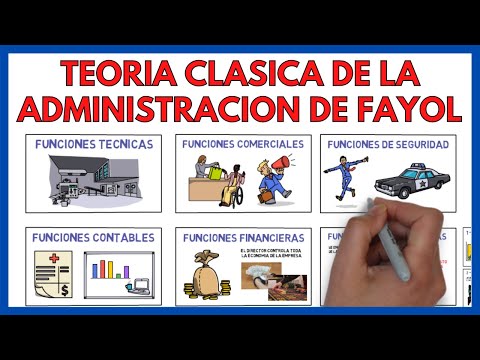
TEORIA CLASICA de la ADMINISTRACION de HENRY FAYOL ✅ | Economía de la Empresa 142#
What is the Classical Theory of Administration?
Overview of Classical Theory
- The classical theory of administration, primarily promoted by Henry Fayol in his 1916 work "General and Industrial Administration," addresses issues overlooked by Taylor's scientific management.
- Unlike Taylor, who focused on production efficiency, Fayol emphasized management-level contributions to organizational effectiveness.
Functions of Classical Theory
- Fayol identified six basic functions essential for organizational success:
- Technical Functions: Involve actions related to producing goods and services.
- Commercial Functions: Encompass activities tied to buying, selling, and exchanging products (e.g., marketing).
- Security Functions: Focus on ensuring worker safety and protecting company assets.
- Accounting Functions: Deal with costs, inventories, and business statistics for financial oversight.
- Financial Functions: Concern capital management; directors must avoid reckless capital use.
- Administrative Functions: Regulate and integrate the other five functions for overall organizational control; deemed the most critical function.
Managerial Responsibilities
- Fayol outlined five key managerial functions necessary for effective administration:
- Planning: Visualizing future strategies for the organization.
- Organizing: Structuring both material resources and workforce effectively.
- Leading: Guiding staff towards achieving organizational objectives.
- Coordinating: Ensuring individual efforts align with collective goals.
- Controlling: Monitoring adherence to established rules and making adjustments as needed when problems arise.
Principles of Classical Management Theory
- Fayol proposed fourteen principles that organizations should follow for optimal operation:
- Division of Work: Specialization enhances efficiency through clear role definitions based on skills.
- Authority and Responsibility: Effective leadership requires respect from workers through competent decision-making and accountability.
- Discipline: Adherence to established rules fosters a harmonious workplace environment with fair conflict resolution mechanisms in place.
- Unity of Direction: All activities should align under a single plan directed by one superior to prevent confusion or misalignment in objectives.
Centralization and Principles of Management
Centralization in Organizations
- Centralization involves concentrating authority and responsibility at the top hierarchy of a company, with senior officials having the ability to delegate some authority but not complete responsibility, as emphasized by Henry Fayol.
Hierarchical Structure
- It is essential for all employees to know their immediate superiors and adhere to the authority associated with each rank within the organization.
Order and Equity
- Employees should be positioned according to their skills, ensuring that work items are organized properly for efficient operations. Leaders must make fair decisions and maintain pleasant interactions with workers to foster good relationships.
Staff Stability and Initiative
- Continuous hiring or redundancies can harm productivity; thus, employee retention is crucial. Organizations should allow employees some freedom in determining procedures, encouraging innovation and improvement.
Group Spirit
- Teamwork should be promoted over individual efforts to prevent division within the company, creating a more pleasant and efficient work environment.
Characteristics of Classical Theory
Origins of Classical Theory
- Developed during the industrial revolution by Henry Fayol in 1916 through his work "General and Industrial Administration," classical theory focuses on organizational structure and functions for administrative efficiency.
Key Concepts Introduced
- Fayol introduced concepts such as formal vs. informal organization, along with staff versus line roles within organizations.
Main Exponents of Classical Theory
Contributions from Key Figures
- While Henry Fayol is recognized as the primary proponent of classical management theory, Lyndall Urwick consolidated Fayol's principles in his 1943 work "The Management Elements."
- Luther Gulick expanded upon Fayol’s five managerial functions (Plan, Organize, Direct, Coordinate, Control), adding Reporting and Budgeting functions which led to the acronym POSDCORB for managerial tasks.
Criticisms of Classical Theory
Limitations Highlighted by Critics
- Critics argue that classical theory lacks empirical experimentation and verification while neglecting human elements in favor of results-oriented approaches that may lead to poor working conditions.