¿Cómo funciona el motor de combustión interna de un automóvil?
How Does an Internal Combustion Engine Work?
The transcript explains the functioning of an internal combustion engine by breaking down its components and detailing the stages of operation.
Components of an Internal Combustion Engine
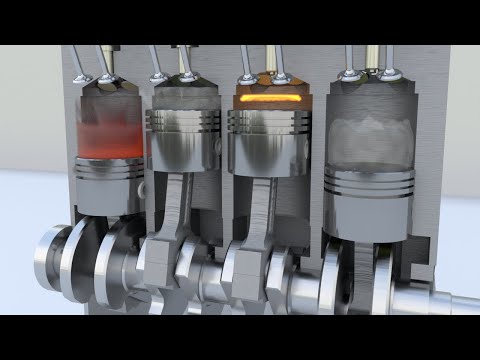
- The piston, connected to a connecting rod attached to the crankshaft, converts linear motion into rotational motion.
- The cylinder block houses the piston within a cylindrical bore, forming the working chamber along with the cylinder head. Valves on the head connect the chamber to intake or exhaust manifolds.
Phases of the Engine Cycle
- First Phase: Requires fuel and air; as the piston moves down, creating space for filling. Intake valves open to allow air entry due to increased volume.
- Second Phase: Compression of the air-fuel mixture occurs as the piston moves up, increasing pressure in the cylinder.
- Third Phase: Ignition takes place through a spark plug in gasoline engines, leading to expansion and downward movement of the piston.
- Fourth Phase: Exhaust phase where burnt gases are expelled as the piston moves up again. Exhaust valves open at this point.
Energy Transfer in Engine Operation
- The energy transfer involves pistons moving due to crankshaft rotation during specific phases of the cycle.