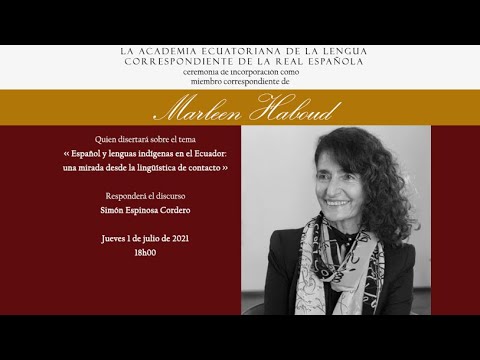
Ceremonia de incorporación de la Sra. D. Marleen Haboud como miembro correspondiente
Ceremony of Incorporation for Dr. Marleen Haboud
Introduction and Welcome
- The event begins with a welcome from Ambassador Francisco Proaño Arandi, highlighting the significance of receiving a new academic member into the Ecuadorian Language Academy.
- Dr. Marleen Haboud is introduced as an exceptional academic known for her contributions to linguistics and anthropology, emphasizing her importance in Ecuador's cultural landscape.
Contributions to Linguistics
- Dr. Haboud's extensive research covers Andean linguistic realities and cultural aspects, particularly focusing on multilingualism in Ecuador.
- Her work is seen as a significant enrichment for the academy, especially as it prepares to publish an academic dictionary of Ecuadorian speech by 2024.
Academic Background and Achievements
- Following the introduction, Susana Cordero de Espinoza speaks about Dr. Haboud’s background, noting her dedication to studying indigenous languages and cultures globally.
- Cordero highlights Dr. Haboud's impressive curriculum vitae that includes numerous awards and recognitions in her field.
Personal Anecdotes from Research
- A personal story shared by Dr. Haboud recounts her experiences working with the Huaorani community, illustrating challenges faced during fieldwork.
- She describes a memorable night spent among the Huaorani people where unexpected encounters with nature led to humorous yet challenging situations.
Reflections on Indigenous Knowledge
- In reflecting on her work with indigenous communities, Dr. Haboud emphasizes the importance of preserving medicinal plant knowledge through projects initiated at their request.
- The project "Voces y Saberes Ancestrales" aims to recover traditional knowledge about plants used in medicine while involving local researchers in documentation efforts.
Future Directions and Impact
- The ceremony concludes with recognition of how Dr. Haboud’s contributions will enhance studies related to indigenous languages within the academy.
- Simón Espinoza welcomes Dr. Haboud formally into the academy, acknowledging her prestigious award from Germany for research excellence over 47 years.
This structured summary captures key moments from the transcript while adhering strictly to your formatting guidelines regarding timestamps and bullet points.
Identity Negotiation and Ancestral Knowledge in Ecuador
Overview of Research Projects
- The project "Voces Andinas" focuses on ancestral health practices and storytelling among indigenous communities in Ecuador, developing an ethnographic lexicon related to health and illness.
- Significant contributions include the identification of 27% of 187 medicinal plants collected from four Quichua communities, emphasizing the importance of local narratives in scientific research.
Recognition and Awards
- Professor Marlene Abud received a lifetime membership at INAC Global Scholars and was invited to a symposium for research award winners worldwide, highlighting her international recognition.
- She is known for her innovative research on minority languages, particularly focusing on indigenous languages in Germany, showcasing her global impact.
Contributions to Linguistic Studies
Interdisciplinary Approach
- Dr. Wood integrates sociolinguistics, bilingualism, and applied statistics to understand sociolinguistic phenomena, reflecting a comprehensive understanding of Andean realities.
- Her work has been published by prestigious publishers like Springer and UNESCO, making it accessible to Spanish-speaking audiences.
Academic Integration
- The rector acknowledges Dr. Wood's contributions as essential for anyone seeking to understand Ecuadorian reality and Latin American linguistics.
Inaugural Speech Highlights
Personal Reflections
- Dr. Wood expresses gratitude towards colleagues and mentors who have influenced her journey in academia.
- She emphasizes the importance of community engagement with indigenous populations throughout her career.
Cultural Insights
- Discussing the influence of contact Spanish with indigenous languages is crucial for understanding identity among Spanish speakers in Ecuador.
Historical Context of Language Development
Language Evolution Post-Conquest
- The arrival of Spanish during colonization introduced various dialectical influences from different regions within Spain.
- Indigenous languages faced decline but left traces that contribute to modern linguistic diversity in Ecuador.
Linguistic Contact Dynamics
- The imposition of Spanish as a dominant language led to the emergence of Kichwa as a lingua franca during colonization processes.
Current Linguistic Landscape
Diversity Among Languages
- There are 13 vital indigenous languages across diverse regions including coastal areas and Amazonia; however, their representation remains limited in academic studies.
Need for Comprehensive Research
- Existing studies on dialectal relationships between Spanish and indigenous languages are insufficient; further exploration is necessary due to internal migrations affecting language dynamics.
Understanding Contact Linguistics
Importance of Contact Linguistics
- Contact linguistics provides insights into how social interactions shape language evolution through dynamic processes between speakers.
Multidirectional Effects
- Language contact leads to multidirectional effects where both dominant and subordinate languages influence each other significantly.
Case Study: Kichwa Influence on Spanish
Mapping Kichwa Identity
- A geolinguistic map illustrates self-identification among Kichwa speakers based on census data from 2010, indicating cultural integration within broader society.
Phonetic Variations
- Variations such as 'r' pronunciation reflect socio-economic identities within different provinces like Tungurahua; these phonetic traits signify deeper cultural connections.
Gerund Usage in Andean Spanish
Unique Gerund Constructions
- In Andean Spanish, gerunds convey simultaneous actions or sequential events differently than standard usage; this reflects unique linguistic adaptations influenced by indigenous interactions.
Sociolinguistic Implications
- These constructions foster social closeness among speakers while also revealing historical influences from missionary efforts during colonial times.
The Role of Contrastive Focus Markers in Spanish
Introduction to Contrastive Focus Markers
- Discussion on the use of contrastive focus markers in Spanish, particularly among monolingual speakers with indigenous heritage.
- Examples from Ecuador illustrate how these markers function in contrasting statements about temperature and living conditions.
Bilingualism and Language Contact
- Examination of bilingual speakers in New York who utilize contrastive focus markers, highlighting the influence of Quichua on their Spanish.
- Inclusion of various speaker types (monolingual, bilingual, varying degrees of bilingualism) in discussions about contact Spanish.
Linguistic Transmission Across Generations
- Emphasis on the long-term transmission of linguistic features through generations despite geographical separation.
- Presentation of a continuum model for bilingualism that illustrates dynamic language use rather than static categories.
The Influence of Indigenous Languages on Spanish
Phonetic Assimilation and Variation
- Discussion on phonetic assimilation processes within monolingual and bilingual populations regarding the pronunciation of 'r'.
- Debate among linguists about the origins and spread of specific phonetic traits from indigenous languages to rural Spanish.
Effects of Language Contact
- Analysis of lexical adoption from indigenous languages into Spanish due to intense language contact situations.
- Specific examples provided, such as terms related to water and days of the week derived from Quichua.
Media Lengua: A Hybrid Language Form
Characteristics and Usage
- Introduction to 'media lengua', a hybrid form combining elements from both Quichua and Spanish with significant lexical overlap.
- Example illustrating syntactic simplification where Quichua negation structures are altered under influence from Spanish.
Changes Over Generations
- Observation that certain discourse markers have diminished across generations, indicating shifts in evidentiality systems within narratives.
Language Displacement and Revitalization Efforts
Quantitative Research Findings
- Overview of geolinguistic research conducted across multiple provinces revealing declining rates of native language identification among communities.
Intergenerational Transmission Challenges
- Data showing significant reductions in self-identification as Quechua speakers over two decades, emphasizing urgent revitalization needs.
Strategies for Cultural Preservation
Importance of Intergenerational Communication
- Highlighting intergenerational transmission as crucial for maintaining linguistic heritage alongside public communication contexts like media and education.
Community Engagement Initiatives
- Description of community-based projects aimed at revitalizing traditional knowledge around medicinal plants through workshops and local engagement.
Digital Tools for Knowledge Preservation
Development Projects
- Creation of digital dictionaries incorporating ancestral plant knowledge aimed at bridging generational gaps in cultural understanding.
Conclusion: The Future Outlook
- Call for collective action towards preserving linguistic diversity while recognizing each individual's unique cultural narrative.
Reflections on Identity and Language
The Journey of Understanding
- The speaker reflects on their past, recalling a time when they acted as an interpreter between Arabic and Spanish, highlighting the challenges of communication among different cultures.
- They express empathy for indigenous girls facing hardships, emphasizing the importance of language in enabling self-defense and understanding.
- The discussion introduces projects aimed at documenting ancestral knowledge through ethnographic work, focusing on Andean voices and geolinguistics in Ecuador.
- Acknowledgment is given to Marlene's contributions towards advocating for linguistic rights and dignity, urging her to trust in the wisdom of her ancestral language.
Celebrating Contributions
- Valeria expresses gratitude towards Marlene for her impactful work within the academic community, particularly regarding Ecuadorian Spanish.
- A toast is proposed to honor Marlene and all women academics who will enrich future generations within the academy.
- Emphasis is placed on collaboration among female scholars as a means to elevate Ecuadorian linguistics.
Closing Remarks
- The speaker thanks attendees for their presence during this emotional gathering while acknowledging ongoing challenges posed by the pandemic.
- A heartfelt farewell is extended, encouraging everyone to stay safe amidst current circumstances.
Turn any video into a summary like this
YouTube links, meetings, lectures. With transcripts, search, and chat.