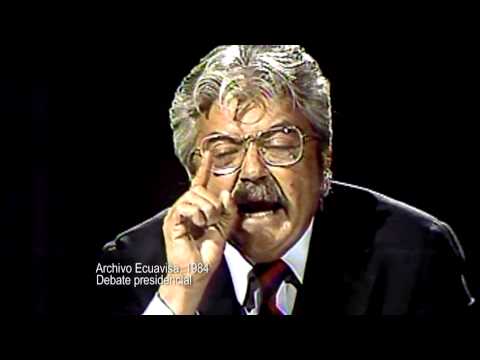
Debate de Rodrigo Borja con León Febres Cordero | Visión 360
Debate on Socialism and Economic Policies
Critique of Political Ideologies
- The speaker critiques the inconsistency in political ideologies, highlighting a disconnect between Marxist goals and the methodology employed by certain leaders.
- Reference is made to a leader's support for nationalizing private banks, raising concerns about their commitment to socialism versus capitalism.
- Accusations are directed at misleading claims regarding education policies, suggesting that promises made do not align with actual intentions.
Discussion on Labor Policies
- A question is posed regarding internal issues facing Ecuador, emphasizing excessive public spending and taxation as primary concerns.
- The speaker outlines seven critical internal problems, including credit policy and labor relations, indicating a structured approach to economic challenges.
- Emphasis is placed on increasing basic wages until economic recovery occurs, reflecting a commitment to addressing poverty directly.
Economic Strategy and Worker Rights
- The importance of collective bargaining is highlighted as essential for worker protection against capital exploitation.
- A clear distinction is drawn between the speaker's proactive approach to production and wealth generation versus perceived ineffective strategies from opponents.
Historical Context of Labor Relations
- The speaker accuses an opponent of historically opposing workers' rights during significant legislative moments in Ecuador’s history.
Congressional Debates on Labor Rights and Economic Policies
Opposition to Worker Participation in Profits
- On April 24, 1969, a congressional trial was initiated against Minister Ramiro Larrea Santos for requesting the imprisonment of Luis Novoa Naranjo due to non-compliance with obligations.
- In March 1970, there was significant opposition in Congress regarding increasing worker profit participation from 10% to 15%, highlighting resistance to labor rights advancements.
Legislative Proposals and Reactions
- Isabel Robalino Boyle proposed that prior voluntary monetary gratifications by employers should count towards additional benefits established by law; this faced strong opposition from Engineer Febres Cordero.
- Dr. Jorge Salvador Lara accused opponents of resisting increases in worker participation rates, specifically referencing a past proposal to raise it from 5% to 10%.
Critique of Public Sector Employment
- The speaker criticized public sector employment practices, suggesting unnecessary bureaucratic positions should be eliminated despite potential backlash from public administrators.
- Acknowledgment of painful solutions needed for Ecuadorians absorbed into bureaucracy; emphasized that all sectors must contribute to overcoming economic crises.
Economic Policy Disputes
- The speaker claimed they paid eight times the minimum wage in 1977 while opposing nominal salary increases when not justified by the economy.
- Questions were raised about vague economic proposals presented by political candidates, particularly regarding "revitalizing the productive apparatus."
Addressing Unemployment and Economic Inequality
- Highlighted alarming unemployment rates affecting up to 50% of Ecuadorians; called for concrete explanations rather than evasive rhetoric from politicians.
- Urged clarity on how aspirations for basic needs like food and housing would be met without abstract or convoluted plans.
Vision for Economic Reform
- Criticism directed at disparities between executive salaries and those of regular workers; emphasized the need for equitable pay structures within companies.
- Proposed ambitious public investment plans aimed at infrastructure development as a means to create jobs and stimulate economic growth.
Contrasting Economic Philosophies
- Differentiated between neoliberal approaches focused on top-down financial distribution versus grassroots strategies aimed at empowering lower-income households through job creation.
Economic Disparities and Production Insights
Discussion on Economic Inequality
- The speaker highlights the stark contrast in salaries between a manager earning 150,000 sucres and a worker earning 6,000 sucres, questioning how wealth can be distributed fairly under such conditions.
- Criticism is directed towards those who support economic rehabilitation through large industrial profits, suggesting that monopolistic practices hinder fair competition and benefit distribution.
Understanding Economic Systems
- The speaker requests clarification from Dr. Borja regarding his understanding of economic principles before proceeding with their argument.
- A personal anecdote is shared about selling shares seven years prior while family members received substantial dividends, emphasizing the disconnect between elite earnings and average living standards.
Production as a Key to Economic Growth
- The speaker argues that production equates to sustenance for the Ecuadorian people, asserting that trust in the economy must be established to foster growth.
- A critique of socialist policies is presented, claiming they fail to generate confidence necessary for productive investment and economic stability.
Policy Recommendations for Economic Stability
- Suggestions include providing farmers with affordable inputs and technical assistance to enhance productivity while ensuring land tenure security.
- Emphasis is placed on controlling public spending to combat inflation effectively; only through increased production can quality goods at fair prices be achieved.
Housing Solutions and Long-term Planning
- Proposals are made for affordable housing options with long repayment terms aimed at easing financial burdens on workers while stimulating construction industries.
- The speaker stresses the importance of manageable payment plans (40% of salary over 30 years), advocating for fixed interest rates to ensure accessibility.
Opposition to Consumer Protection Legislation
- Questions arise regarding Dr. Borja's opposition to consumer protection laws proposed by the speaker, indicating a lack of understanding or misinformation about legislative processes.
- The speaker defends their position against a poorly drafted law that was allegedly rushed through without proper discussion or consideration of its implications.
Critique of Bureaucratic Solutions
- An attack is launched against bureaucratic measures proposed by Dr. Borja, arguing they do not address fundamental issues like product quality or pricing mechanisms effectively.
Debate on Media and Freedom of Expression
The Role of Media in a Free Society
- The speaker argues that media is essential for defending freedom in the country, suggesting that attempts to control or eliminate media are indicative of totalitarian ambitions.
- Emphasizes the need for a free press to combat political forces that threaten freedom of expression and public discourse.
Personal Background and Work Ethic
- The speaker recounts their early career, highlighting their dedication to work from a young age, including roles as a tractor driver and radio announcer.
- Shares experiences working various jobs while pursuing education, illustrating resilience and commitment to personal development.
Professional Achievements
- Details progression through various professional roles, including being a proofreader, messenger, municipal secretary, and eventually an attorney.
- States that all achievements stem from hard work over 15 years in legal practice before entering politics.
Consumer Protection Advocacy
- Critiques opposition to consumer protection laws by emphasizing the importance of quality control in food products for Ecuadorian citizens.
- Claims representation of 8.5 million consumers who deserve better quality goods, framing consumer rights as fundamental human rights.
Critique of Political Opponents
- Challenges the characterization of Catholicism as a sect by opponents, arguing it misrepresents millions of Ecuadorians' beliefs.
- Accuses political adversaries of corruption and incompetence regarding financial mismanagement within government institutions.