How do Satellites work? | ICT #10
Lecture on Satellites Overview
This lecture provides an overview of satellites, their orbits, and the components inside them. It explains how satellites stay in orbit and the different types of orbits they can be placed in based on their purpose. The lecture also discusses the main components of a communication satellite and their functions.
Why Satellites Orbit
- Satellites stay in orbit due to the balance between gravitational pull and centrifugal force.
- The angular velocity of a satellite is determined by the force balance equation that balances gravitational and centrifugal forces.
- Satellites are given sufficient speed during deployment to balance these two forces.
- Satellites near Earth require more speed to resist gravitational pull compared to those further away.
- Once deployed, satellites continue their circular motion around Earth without any external energy source.
Types of Satellite Orbits
- Satellites can be placed in Low Earth Orbit (LEO), Medium Earth Orbit (MEO), or Geosynchronous Earth Orbit (GEO).
- LEO is closest to Earth at an altitude of 160 to 2000 kilometers with an orbital period of approximately 1.5 hours.
- LEO satellites cover less area, so multiple satellites are required for global coverage.
- GEO satellites are at a height of 35,786 kilometers and rotate at the same angular speed as Earth, taking exactly 23 hours 56 minutes and four seconds to complete one rotation.
- Within GEO, there is a special category called geostationary orbit where satellites remain stationary with respect to Earth's equator. These are ideal for television broadcasting as they don't require frequent adjustments.
Choosing Satellite Orbits
- The choice of satellite orbit depends on its application and purpose.
- For Earth observation, weather forecasts, geographic area surveying, and satellite phone calls, orbits closer to Earth are chosen.
- LEO is preferred for Earth observation as it provides high-resolution images.
- GEO is chosen for broadcasting due to its wide coverage area and geostationary nature.
- Navigation applications like GPS use MEO as LEO satellites revolve at a very high speed, affecting navigation accuracy.
Components of Communication Satellites
- Transponders are the main components of communication satellites.
- Transponders change the frequency of received signals, remove noise, and amplify signal power.
- KU band satellites have transponders that convert frequencies from 14 gigahertz to 12 gigahertz.
- Communication satellites can have 20 or more transponders.
- Transponders require a significant amount of electrical power to handle their functions.
Power Supply in Satellites
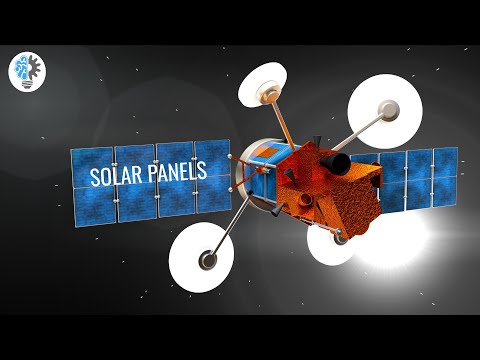
- Satellites use batteries and solar panels for power supply.
- Solar panels power electronic equipment, while batteries are used during eclipse time when sunlight is not available.
- Sun sensors help angle the solar panels correctly to maximize power extraction from the sun.
Signal Reception in Satellites
- Reflector antennas are commonly fixed to satellites for signal reception.
New Section
This section discusses the importance of thrusters in satellites and how they help maintain the satellite's position, avoid space junk, and save fuel.
Thrusters for Satellite Positioning
- Satellites use thrusters to maintain their position and avoid a complete loss of signal.
- Thrusters are fired to keep the satellite in the right position and help it avoid space debris.
- The fuel needed for the thrusters is stored in tanks within the satellite body.
New Section
This section explains how earth stations monitor the position, health, and speed of satellites using tracking, telemetry, and control systems.
Monitoring Satellite Position and Health
- Earth stations continuously monitor the position of satellites and control their thrusters.
- Apart from position controls, earth stations also monitor satellite health and speed.
- Tracking, telemetry, and control systems are used to send signals between Earth and the satellite.
- Signals are exchanged at different frequencies to distinguish them from other communication signals.
New Section
This section describes how inactive satellites are transferred to a graveyard orbit to prevent harm to operational satellites or spacecraft.
Transferring Inactive Satellites
- When a satellite is no longer functional or nearing its end of life, it can be harmful to other operational satellites or spacecraft.
- Inactive satellites are transferred to a graveyard orbit by activating their thrusters.
- Increasing the rotational speed of the satellite helps transfer it to a higher radius orbit.
- The graveyard orbit is located a few hundred kilometers above the geostationary orbit.
- This operation consumes fuel equivalent to three months of station keeping.
New Section
This section provides information about different types of satellites such as communication satellites, GPS satellites, and Earth observation satellites.
Types of Satellites
- Communication satellites rely on atomic clocks and antennas for their operation.
- GPS satellites use L band navigation antennas.
- Earth observation satellites in Low Earth Orbit (LEO) carry various sensors and imagers based on their mission.
New Section
This section explains the purpose of the gold-colored foil seen on satellite visuals and its multi-layered structure.
Gold-Colored Foil as a Shield
- The gold-colored foil seen on satellite visuals is not actually foil but has a multi-layered structure.
- Satellites face extreme temperature variations in space, ranging from -150 to 200 degrees Celsius.
- The foil acts as a shield, protecting satellite components from temperature variations and solar radiation.