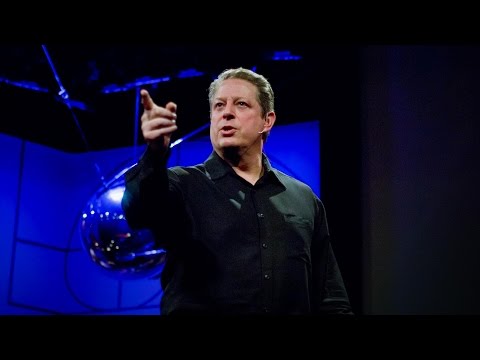
New thinking on the climate crisis | Al Gore
New Section
In this section, the speaker introduces a new slide show and discusses the importance of optimism, behavior change, and citizenship in addressing global challenges.
Optimism and Behavior Change
- The speaker emphasizes that optimism should be about behavior rather than just belief.
- Quoting Mahatma Gandhi, "You must become the change you wish to see in the world," highlighting the significance of actions over mere beliefs.
- Advocating for changing laws alongside personal behaviors to address issues effectively.
Citizenship and Democracy
- Stressing the need for active citizenship in democracy to tackle crises like climate change.
- Shares an anecdote emphasizing the importance of citizen engagement in democracy.
New Section
The speaker delves into historical perspectives on military conflicts and draws parallels with environmental challenges, particularly focusing on the global nature of the climate crisis.
Military Conflicts vs. Environmental Challenges
- Discusses different levels of military conflicts and how they require distinct approaches.
- Draws parallels between local, regional, and global environmental problems with military conflict categories.
Global Climate Crisis
- Highlights the global scale of the climate crisis necessitating a coordinated worldwide response.
- Emphasizes the urgency for a global transition to renewable energy and a low-carbon economy.
New Section
The speaker presents alarming data on polar ice cap melting as a consequence of climate change, underlining the urgent need for action at both individual and global levels.
Polar Ice Cap Melting
- Shows visual evidence of significant North Polar ice cap reduction over 28 years due to climate change.
- Details the extent of ice loss equivalent to areas like states or countries, indicating rapid disappearance trends.
Global Impact
- Expands discussion to include impacts on regions like Alaska, Newfoundland, Antarctica due to melting ice caps.
New Section
Drawing comparisons between Earth and Venus, this section explores carbon distribution differences leading to drastic temperature variations. It also touches upon scientific consensus regarding man-made global warming.
Earth vs. Venus Comparison
- Contrasts Earth's carbon distribution with Venus', explaining temperature disparities despite similar sizes.
Man-Made Global Warming
Climate Crisis and Urgency
In this section, Al Gore discusses the impact of variations in energy from the sun on Earth's atmosphere, public perception of human responsibility for global warming, and the lack of urgency in addressing climate change.
Variations in Energy and Climate Impact
- Al Gore explains how variations in solar energy can affect Earth's atmosphere.
- Public opinion: 68% of Americans believe human activity causes global warming.
Lack of Urgency in Addressing Climate Change
- Despite progress, global warming is not a top priority for action.
- Media coverage: Minimal focus on climate crisis in presidential candidate questions.
Global Emissions and Solutions
This segment delves into global emissions trends, technological advancements, and proposed solutions to combat climate change effectively.
Global Emissions Trends
- Developing countries' rapid increase in emissions catching up to developed nations.
- Impact: Developing countries' cumulative emissions equivalent to 1965 levels.
Proposed Solutions
- Urgent need to address overfishing and adopt sustainable practices.
- Solution: Implement a CO2 tax as a revenue-neutral measure to combat climate change.
Renewable Energy Transition
Al Gore discusses renewable energy initiatives, integrating poverty alleviation with climate solutions, and transitioning towards sustainable energy sources.
Renewable Energy Initiatives
- Proposal for concentrating solar plants linked through a "supergrid" for Europe's power supply.
Poverty Alleviation Integration
- Integrating poverty responses with climate solutions crucial for developing nations' progress.
Investments and Progress
This part focuses on strategic investments in sustainable technologies, shifting away from carbon-intensive assets towards renewable energy sources.
Strategic Investments
- Recommended investments: Geothermal, concentrating solar, advanced photovoltaics.
Shifting Towards Sustainability
New Section
In this section, Al Gore discusses the importance of reframing the climate crisis as an opportunity for generations to rise to a worthy challenge with joy and gratitude.
Reframing the Climate Crisis
- Al Gore urges reframing the climate crisis not as a burden but as an opportunity for generations to rise to a challenge that can bring out their best efforts.
- He emphasizes approaching this challenge with profound joy and gratitude, envisioning future celebrations by acknowledging the generation that found solutions for a bright human future.
New Section
Al Gore reflects on missed opportunities due to design issues in voting forms and highlights the pain caused by voices not being heard in decision-making processes.
Missed Opportunities and Painful Realizations
- Chris Anderson mentions how design issues on voting forms have hindered Al Gore's ability to make impactful changes, leading to deep pain.
- Despite positive shifts in candidates' positions on global warming, Al Gore expresses mixed feelings about campaign dialogues lacking bold initiatives needed for addressing the climate crisis effectively.
New Section
Al Gore critiques the lack of bold initiatives in campaign dialogues regarding climate change and emphasizes the need for significant changes at both individual and systemic levels.
Critique of Campaign Dialogues
- Al Gore points out that while candidates express responsible leadership on climate change, there is a gap between rhetoric and action in campaign dialogues sponsored by entities like "Clean Coal."
- He stresses that despite candidates' promises, real change requires aligning political discourse with public sentiment, highlighting past challenges faced when advocating for environmental treaties like Kyoto Protocol.
New Section
Al Gore underscores the urgent need for transformative actions at societal levels to combat climate change effectively while emphasizing citizen engagement and advocacy.
Urgency of Transformative Actions
- CO2 emissions symbolize civilization's impact, requiring unprecedented speed and scale of change. Al Gore urges citizens to advocate for policy changes alongside personal actions like transitioning to renewable energy sources.
Turn any video into a summary like this
YouTube links, meetings, lectures. With transcripts, search, and chat.