Superhetrodyne Receiver - Modern Electronic Communications - Application of Electronics
Introduction to Superheterodyne Receiver
In this section, the speaker introduces the topic of superheterodyne receiver and explains the process of receiving signals in this type of receiver.
Block Diagram of Superheterodyne Receiver
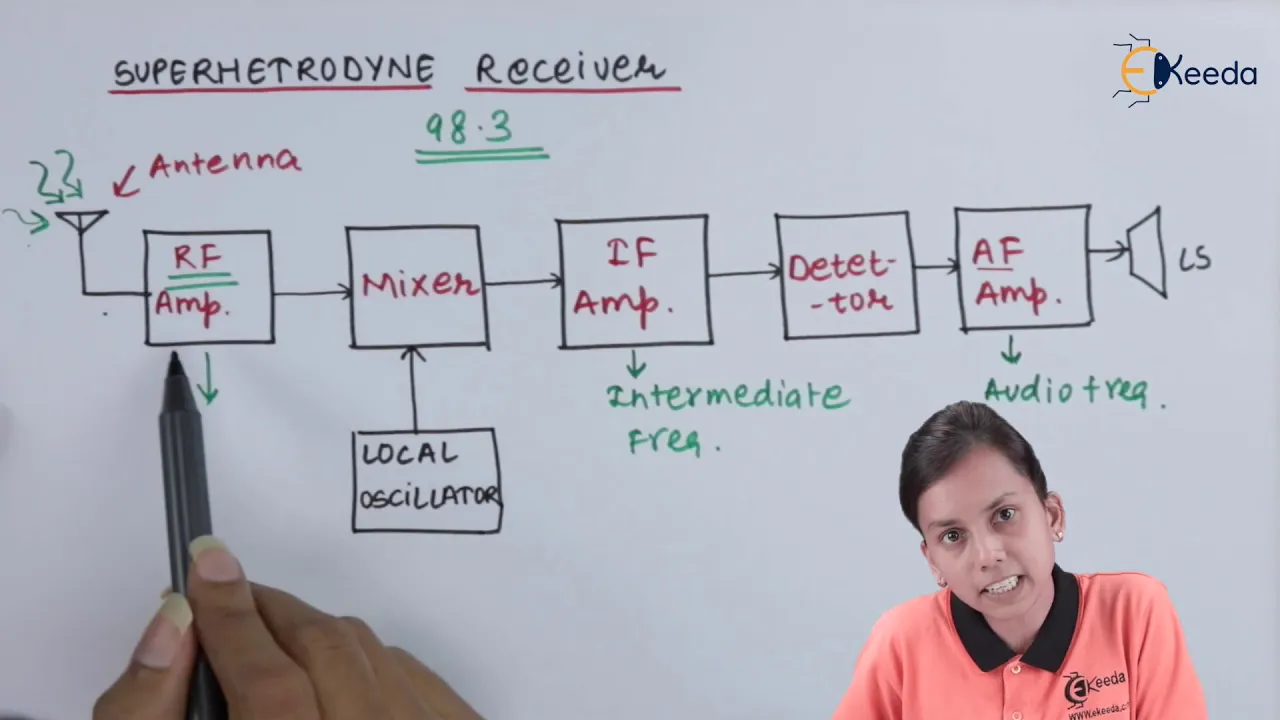
- The superheterodyne receiver consists of several components: RF amplifier, mixer, oscillator, amplifier detector, IF amplifier, and loudspeaker.
- The first step in the receiver is antenna reception.
- The antenna accepts electromagnetic waves of various frequencies and converts them into electrical waves.
Function of Antenna
- The antenna accepts electromagnetic waves of different frequencies.
- It converts the electromagnetic wave into an electrical wave.
Radio Frequency (RF) Amplifier
- The RF amplifier selects the desired frequency from the received signal.
- It rejects all other frequencies and amplifies the desired frequency.
Mixer
- The mixer converts the desired frequency into a medium frequency using a local oscillator.
- It subtracts or adds frequencies to obtain the intermediate frequency (IF).
Conclusion
The introduction provides an overview of superheterodyne receivers and explains how they receive signals. It covers topics such as antenna reception, RF amplification, and mixing to obtain intermediate frequencies.
New Section
This section explains the working of a mixer in a communication system and introduces the concept of intermediate frequency.
Working of Mixer
- A mixer converts the tuned frequency into an intermediate frequency with the help of mixing.
- The mixing process is done using a local oscillator.
- The medium frequency produced by the mixer is referred to as the intermediate frequency.
- The mixer performs the heterodyne process, which reduces interference and losses in the signal.
New Section
This section discusses the importance of an intermediate amplifier in increasing selectivity and fidelity in a communication system.
Intermediate Amplifier
- An intermediate amplifier is introduced to amplify the intermediate frequency signal.
- It helps increase selectivity, sensitivity, and fidelity in the communication system.
New Section
This section explains the role of a detector in demodulating signals and extracting information.
Detector (Demodulation)
- The detector performs demodulation by converting modulated signals into uncorrelated signals.
- It detects audio signals or any other type of modulated signal.
- After demodulation, it extracts information from the signal.
New Section
This section highlights the purpose of an audio frequency amplifier in amplifying low-frequency signals.
Audio Frequency Amplifier
- After detection or demodulation, the signal is in low-frequency form.
- An audio frequency amplifier boosts up this low-frequency signal for further processing.
New Section
This section explains how a loudspeaker converts electrical waves into sound waves to transmit audio information.
Loudspeaker
- The loudspeaker converts electrical waves, specifically audio frequencies, into sound waves.
- It allows us to receive the transmitted information in the form of sound.
New Section
This section provides an overview of the entire signal processing flow in a communication system.
Signal Processing Flow
- The signal processing flow starts with the antenna, followed by a radio frequency amplifier.
- Next, the mixer converts the tuned frequency into an intermediate frequency.
- The intermediate frequency signal is then amplified using an intermediate amplifier.
- The detector performs demodulation and extracts information from the signal.
- After demodulation, the low-frequency signal is amplified using an audio frequency amplifier.
- Finally, the loudspeaker converts the electrical audio signals into sound waves for reception.
The transcript was provided in English.