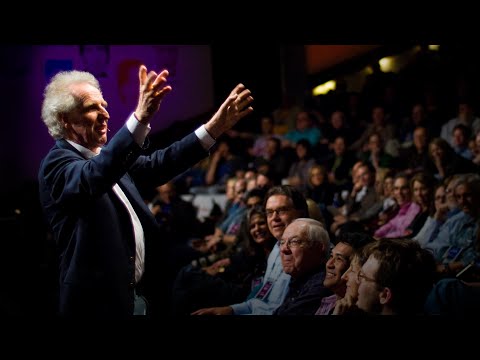
The transformative power of classical music | Benjamin Zander | TED
The Story of the Two Salesmen
This section introduces a story about two salesmen who went to Africa in the 1900s to find opportunities for selling shoes. One salesman sees the situation as hopeless, while the other sees it as a glorious opportunity.
The Story of the Two Salesmen
- One salesman writes a telegram saying "Situation hopeless. Stop. They don't wear shoes."
- The other salesman writes a telegram saying "Glorious opportunity. They don't have any shoes yet."
Classical Music: Dying or Thriving?
This section discusses contrasting views on the state of classical music. While some believe that classical music is dying, others believe that there is still much to be seen and experienced.
Classical Music: Dying or Thriving?
- Some people think that classical music is dying.
- Others believe that there is still much more to come and explore in classical music.
- Rather than focusing on statistics and trends, an experiment will be conducted to showcase the potential of classical music.
An Experiment with Classical Music
In this section, an experiment is introduced to challenge the notion that classical music is dying. Although the outcome is already known, it serves as an illustration of what can be achieved through practice and dedication.
An Experiment with Classical Music
- The speaker presents an experiment, although they already know the outcome.
- The experiment aims to demonstrate how progress can be made in playing piano by showcasing different stages of development in a child pianist's performance.
- Each year of practice brings improvement and refinement in playing skills.
Progression in Piano Playing
This section explores how practicing and taking lessons lead to progression in piano playing skills. It emphasizes how reducing impulses and adding control can enhance musical performance.
Progression in Piano Playing
- The speaker demonstrates the progression of a child pianist's skills over the years.
- As the child practices and takes lessons, the impulses in their playing are reduced.
- The reduction of impulses leads to more controlled and refined playing.
One-Buttock Playing
This section introduces the concept of "one-buttock playing" as a metaphor for being fully engaged and immersed in music. It highlights how music can move and influence performers physically.
One-Buttock Playing
- The speaker describes how playing with full engagement is like being pushed by the music, leading to physical movement.
- Anecdote: A gentleman was transformed by experiencing one-buttock playing during a presentation, which inspired him to change his company's approach.
- Music has the power to move people both emotionally and physically.
Different Perspectives on Classical Music
This section categorizes people's attitudes towards classical music into four groups based on their level of passion or interest.
Different Perspectives on Classical Music
- There are four groups of people when it comes to classical music:
- Group 1: Those who are passionate about classical music (estimated around 45 individuals).
- Group 2: Those who don't mind classical music and enjoy it casually.
- Group 3: Those who never listen to classical music and have no relationship with it.
- Group 4: People who think they are tone-deaf (a small group).
Everyone Has a Fantastic Ear
This section challenges the notion that some people are tone-deaf by highlighting our natural ability to perceive sound differences. It emphasizes that everyone has a fantastic ear.
Everyone Has a Fantastic Ear
- Many people mistakenly believe they are tone-deaf, but this is not true.
- Being able to distinguish different sounds and tones is a natural ability that everyone possesses.
- Examples are given to demonstrate how we can recognize voices, moods, and accents through our fantastic ears.
The Tone-Deaf People
This section acknowledges that the tone-deaf people mentioned earlier are no longer present in the discussion.
The Tone-Deaf People
- The group of people who think they are tone-deaf (mentioned earlier) is no longer part of the conversation.
The Power of Belief in Leadership
In this section, the speaker emphasizes the importance of a leader's unwavering belief in their team's potential to achieve their dreams.
The Confidence of a Leader
- The speaker highlights the significance of leaders having unwavering confidence in their team's abilities, using Martin Luther King Jr. as an example.
- A piece of Chopin is played to demonstrate the power of music and evoke emotions.
Perception and Engagement
- The speaker discusses how our thoughts can wander during classical music performances, leading to humorous moments.
- It is suggested that feeling sleepy during classical music may not be due to personal fatigue but rather the composition itself.
- Impulses in classical music are highlighted as a way for listeners to engage with the piece.
Understanding Musical Composition
- The speaker explains how specific notes and chords create different emotional responses in musical compositions.
- The pattern B-A-G-F is introduced, showcasing how composers manipulate expectations and build tension.
- Audience participation confirms familiarity with the expected note progression.
Delaying Resolution
- Similarities between Chopin's composition and Shakespeare's play Hamlet are drawn, emphasizing the use of delay to maintain interest.
- The deceptive cadence technique is explained, where unexpected chord progressions deceive listeners' expectations.
- Multiple attempts at reaching resolution are made before finally achieving it.
Journey from Away to Home
- The final resolution represents coming home after a long journey or struggle.
- A complete performance of the composition is played, allowing listeners to follow the musical journey.
- The concept of "one-buttock playing" is introduced, emphasizing the focus on the overall musical line rather than individual notes.
Mandela's Imprisonment
- A brief mention of Nelson Mandela's 27-year imprisonment in South Africa serves as a reminder of resilience and endurance.
Timestamps are approximate and may vary slightly.
The Power of Classical Music
In this section, the speaker discusses the power of classical music and its ability to evoke emotions and connect with people on a deep level.
The Vision for South Africa and Human Beings
- The speaker emphasizes that classical music is about vision and the long line.
- He compares it to a bird flying over a field without caring about fences underneath.
- The speaker asks the audience to follow the line from B to E while thinking about someone they adore who is no longer there.
Connecting with Chopin's Music
- By following the line from B to E, listeners can hear everything that Chopin had to say.
- The speaker plays a piece by Chopin.
Impact of Classical Music
- After playing the piece, the audience applauds.
- The speaker shares an anecdote about seventh graders in Boston who were moved by classical music.
- He mentions how 1,600 people in Ireland during troubled times were able to listen, understand, and be moved by classical music.
Awakening Possibility in Others
In this section, the speaker reflects on his role as a conductor and how he realized that his job was not about making sound but awakening possibility in others.
Conductor's Role
- The conductor doesn't make a sound but depends on his ability to make other people powerful.
- This realization was life-changing for the speaker.
Awakened Possibility
- The speaker shares that he wanted to know if he was awakening possibility in others.
- He looks at their eyes - if their eyes are shining, he knows he's doing it right.
Extending Awakening Possibility
- The same concept applies to children - if their eyes are not shining, we need to ask ourselves who we are being as parents or educators.
The Power of Words
In this section, the speaker emphasizes the importance of the words we use and shares a lesson he learned from a Holocaust survivor.
Definition of Success
- The speaker defines success as having shining eyes around him, not about wealth or fame.
Impact of Words
- The speaker learned from a Holocaust survivor that the words we use can have a profound impact on others.
Going Back into the World
- As the audience prepares to leave the event, the speaker encourages them to consider who they are being as they go back out into the world.
New Section The Vow Made in Auschwitz
In this section, the speaker shares a powerful story about a vow made in Auschwitz and reflects on the importance of choosing our words wisely.
The Story of Lost Shoes
- The speaker recounts a conversation with a woman who was in the train to Auschwitz. She noticed that her brother's shoes were missing.
- Frustrated, she scolded him for not keeping his things together. Little did she know that it would be the last thing she ever said to him.
- Sadly, her brother did not survive.
The Vow Made in Auschwitz
- After surviving Auschwitz, the woman made a vow as she walked out into life.
- Her vow was to never say anything that couldn't stand as the last thing she ever says.
- While it may be challenging, living into this possibility is important.
Impact and Conclusion
- The audience responds with applause and shining eyes, acknowledging the power of the story and its message.
This summary focuses on one specific part of the transcript and does not include any additional information beyond what is provided.
Turn any video into a summary like this
YouTube links, meetings, lectures. With transcripts, search, and chat.