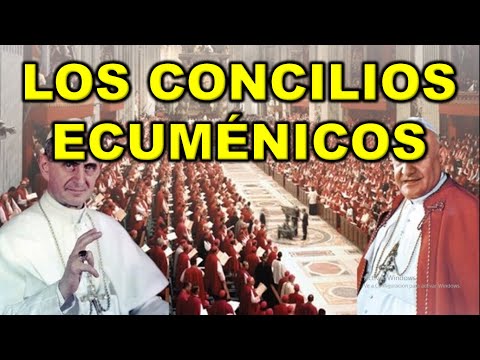
¿Cuáles fueron los 21 concilios de la Iglesia Católica?
What is an Ecumenical Council?
Understanding the Concept of Ecumenical Councils
- To attain knowledge of truth and a deep love for God, it is essential to study the history of salvation and understand the concept of ecumenical councils in the Catholic Church.
- An ecumenical council is a gathering of bishops and other church authorities to decide on matters of dogma and discipline, as outlined in Canon Law (337 and 341).
- The term "ecumenical" signifies universality; thus, an ecumenical council involves all bishops reflecting on doctrinal issues that need clarification, promulgating dogmas, correcting pastoral errors, condemning heresies, and addressing universal church concerns.
Role of the Pope in Ecumenical Councils
- The Roman Pontiff has exclusive authority to convene, preside over (personally or through others), suspend, dissolve, or approve decrees from an ecumenical council. His presence is not mandatory for validity but his confirmation is necessary.
- According to Catholic theologians' calculations, there have been 21 ecumenical councils recognized so far. The list was established by Robert Bellarmine up until the Fifth Lateran Council.
Nature of Bishops' Authority
- The solemn authority exercised by bishops during an ecumenical council can also be enacted through collective action by dispersed bishops worldwide when accepted by the Pope. This creates a truly collegial act representing community consensus.
Overview of the 21 Ecumenical Councils
Introduction to Each Council
- A general overview will be provided regarding each council's leader, name, date of celebration, and main topics discussed. Detailed discussions will follow in subsequent videos.
First Council: Nicea I
- Led by Pope Sylvester I from May 20 to July 25 in 325 AD; it aimed to unify Christianity.
- Key topics included condemning Arianism as heresy and affirming equality between Father and Son while drafting the Nicene Creed recited during Mass.
Second Council: Constantinople I
- Directed by Pope Damasus I from May to July in 381 AD; it addressed divine nature concerning the Holy Spirit.
Third Council: Ephesus
- Led by Pope Celestine I from June 22 to July 17 in 431 AD; it condemned Nestorianism as heresy while affirming Christ's personal unity with Mary.
Fourth Council: Chalcedon
- Directed by Pope Leo I from October 8 to November 1 in 451 AD; this council condemned Monophysitism while asserting Christ's dual natures—human and divine.
Fifth Council: Constantinople II
- Led by Pope Vigilius from May 5 to June 2 in 553 AD; it focused on condemning Origen’s teachings along with Nestorian documents known as "the Three Chapters."
Sixth Council: Constantinople III
- Directed by Pope Agathon from November 7 in680 AD until September16th681AD; it dogmatized Christ's two natures while condemning Monothelitism.
Seventh Council: Nicea II
- Led by Pope Adrian I from September24thto October23rd787AD; this council regulated image veneration while condemning iconoclasm.
Eighth Council: Constantinople IV
Concilios Ecuménicos de la Iglesia Católica
Concilio de Letrán I (1119-1123)
- Este concilio se realizó del 18 de marzo al 6 de abril del año 1123, abordando la querella de las investiduras y la independencia de la iglesia frente al poder temporal.
- El Papa Inocencio II fue el líder durante este concilio, que sentó bases importantes para la relación entre la iglesia y el estado.
Concilio de Letrán II (1139)
- Realizado en abril del año 1139, este concilio reafirmó el celibato obligatorio para el clero en la iglesia occidental.
- Se puso fin al cisma del antipapa Anacleto II bajo la dirección del Papa Alejandro III.
Concilio de Letrán III (1179)
- Celebrado en marzo del año 1179, se discutieron normas sobre la elección papal, estableciendo una mayoría de dos tercios.
- También se definió una edad mínima de 30 años para los obispos y se condenó a los varones que apoyaban a los cátaros en Francia.
Concilio de Letrán IV (1215)
- Este concilio tuvo lugar del 11 al 30 de noviembre del año 1215. Se determinó que todo cristiano con uso de razón debe recibir confesión y eucaristía durante Pascua.
- Se condenaron a los albigenses, maniqueístas y valdenses; además, se definió el concepto de transubstanciación.
Concilios de Lyon I y II
Lyon I (1245)
- Realizado del 28 de junio al 17 de julio del año 1245, trató exclusivamente sobre la deposición del emperador Federico II.
Lyon II (1274)
- Celebrado entre el 7 mayo y el 17 julio del año 1274, buscó reconciliarse con la iglesia ortodoxa e introdujo regulaciones sobre el cónclave papal.
Concilio de Vienne (1311-1312)
- Este concilio tuvo lugar desde el 16 octubre hasta el 6 mayo entre los años mencionados. Se discutió sobre la supresión de los templarios y otros temas relevantes como burdeles en Roma.
Concilio de Constanza (1414-1418)
- Dirigido por Papas Gregorio XII y Martín V, este concilio extinguió el Gran Cisma Occidental y reafirmó la supremacía del concilio sobre el papa.
Concilio Basilea-Ferrara-Florenia (1431–1449)
- Bajo Papa Eugenio IV, este concilio sancionó oficialmente el canon católico e intentó unir iglesias orientales ortodoxas mientras ratificaba conceptos como purgatorio.
Concilios Vaticanos
Vaticano I (1869–1870)
- Dirigido por Papa Pío IX, reforzó dogmas establecidos anteriormente como infalibilidad papal y condena a racionalismo y modernismo.
Vaticano II (1962–1965)
- Bajo Papas Juan XXIII y Pablo VI, promovió reformas litúrgicas significativas e impulsó un diálogo moderno con diversas corrientes sociales.
Reflexiones Finales
- La importancia histórica y doctrinal estos veintiún concilios ecuménicos es fundamental para entender las bases actuales dentro della Iglesia Católica.
What Were the Councils and Their Outcomes?
Overview of the Councils
- The speaker discusses the purpose behind convening councils, emphasizing their significance in historical context.
- Key events that transpired during these councils are highlighted, showcasing their impact on religious and social structures.
- The most crucial aspect addressed is the outcomes or fruits of each council, which shaped future doctrines and practices.