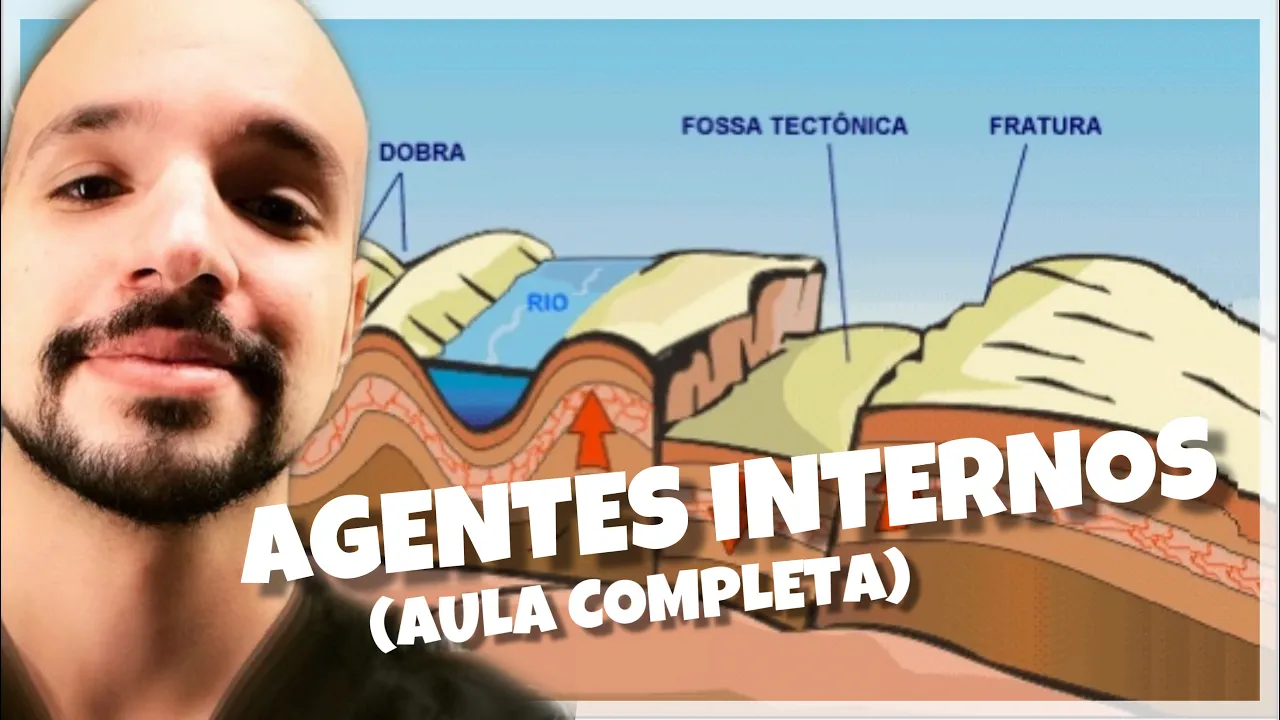
Geomorfologia: agentes internos do relevo | Ricardo Marcílio
Understanding Geomorphology and Internal Agents
Introduction to Geomorphology
- The video introduces geomorphology, focusing on internal agents such as volcanism, orogenesis, and epirogenesis that shape the Earth's relief.
- The speaker encourages viewers to subscribe for comprehensive geography content relevant for exams and current events.
Key Concepts in Geomorphology
- Geomorphology is defined as the study of landforms; it derives from "morphology," meaning formation, relating to how the planet's surface is shaped.
- Notable geomorphologists mentioned include Aziz Ab'Saber, Gerardo Rosa, and Aroldo de Azevedo, who have contributed significantly to understanding Brazilian relief.
Understanding Relief
- Relief refers to the shape or form of the Earth's surface; it can be described using terms like mountains, plateaus, and depressions.
- The speaker explains that geological structures influence relief; for example, crystalline structures contribute to irregular terrain.
Processes Affecting Relief
- The discussion highlights that relief is constantly changing due to various processes including sedimentation and tectonic activity.
- Examples are given of areas like the Amazon and parts of the Middle East where oil deposits indicate past geological conditions.
Tectonism and Plate Tectonics
- The lesson focuses on internal agents related to tectonism—the movement of tectonic plates—and their role in shaping landforms.
- An analogy is made with a cutaway view of Earth showing layers: core, mantle, crust—emphasizing how these layers interact during geological processes.
Structure of Earth's Layers
- The speaker describes Earth's structure: a solid outer layer (lithosphere), a semi-fluid layer (asthenosphere), and deeper magma layers influencing tectonic movements.
Understanding Magma Movement and Tectonic Plates
The Nature of Magma
- The superficial layer of magma has a relatively low temperature, around 25 degrees Celsius, while temperatures near the core are extremely high. This creates a fluid-like state in the magma that is neither fully liquid nor gas.
Temperature Differences and Convection
- Changes in temperature within the magma lead to heat exchange; hotter magma from near the core tends to rise, while cooler magma descends. This cycle creates a continuous movement known as convection.
Constant Movement of Magma
- The ongoing convection process results in constant movement of magma, which influences tectonic plates situated above it. As hot magma rises and cools down, it causes tectonic plates to shift.
Interaction Between Magma and Tectonic Plates
- The movement of convection in the magma directly affects tectonic plates. For instance, if one plate moves due to rising hot magma, another plate may move in response.
Effects on Plate Boundaries
- Tectonic plates can either converge or diverge based on the direction of convection currents in the underlying magma. This interaction leads to various geological phenomena such as earthquakes and mountain formation.
Plate Movements: Types and Consequences
Types of Plate Boundaries
- Tectonic plates can collide (convergent), separate (divergent), or slide past each other (transform). Each type of boundary has distinct geological implications.
Convergent Boundaries Explained
- At convergent boundaries where two plates collide, one plate is typically denser than the other. The denser plate subducts into the mantle while causing deformation in the less dense plate.
Orogenesis: Mountain Formation Process
- The collision at convergent boundaries leads to orogenesis—the process by which mountains are formed through folding and faulting as one plate dives beneath another.
Examples of Orogenesis Locations
- Notable examples include:
- Andes Mountains along South America's west coast.
- Himalayas formed by Indian and Asian continental collision.
- Alps resulting from European tectonics interacting with surrounding regions.
Geological Implications of Plate Interactions
Tectonic Plate Movements and Their Consequences
Types of Tectonic Plate Interactions
- The interaction between tectonic plates can lead to significant geological events such as earthquakes, volcanic eruptions, and the formation of mountains. These processes are driven by movements in the Earth's magma beneath tectonic plates.
- Convergent plate boundaries, where plates collide, are exemplified by regions like Japan, Ecuador, Chile, and the west coast of the United States. Here, seismic activity is prevalent due to the collision of tectonic plates.
- Divergent plate boundaries occur when two tectonic plates move apart from each other. An example includes the separation between South America and Africa.
Geological Processes at Plate Boundaries
- At convergent boundaries, one plate may subduct beneath another leading to melting and magma formation. This process results in new rock formations while also causing destruction of existing structures.
- The Mid-Atlantic Ridge is a notable divergent boundary where magma rises to form new oceanic crust. In some cases, this can lead to volcanic islands like Iceland being formed due to intense magma activity.
Geothermal Energy Utilization
- Iceland serves as an example of utilizing geothermal energy derived from internal heat sources for practical applications such as heating water and generating electricity.
Transformative Boundaries: Sliding Plates
- Transform boundaries involve lateral sliding movements between tectonic plates. A prominent example is California's San Andreas Fault where significant seismic activity occurs due to friction between moving plates.
- The San Andreas Fault illustrates how transform boundaries can lead to earthquakes and other geological phenomena through continuous stress accumulation along fault lines.
Seismic Activity in Brazil
- Brazil experiences potential seismic activity despite being located away from major plate boundaries. For instance, Montes Claros in Minas Gerais sits atop a minor fault line that could release energy during seismic events.
- Understanding key tectonic plates—Nazca, South American, and African—is crucial for grasping regional geological dynamics without overwhelming memorization requirements for students studying geology or geography.
Understanding Tectonic Movements and Their Effects
Overview of Volcanism in Africa
- The occurrence of volcanism in Africa is less common compared to regions like Chile, Ecuador, and Peru. The African tectonic plate sits above the Atlantic Ocean and the rest of the continent.
Convergent Plate Boundaries
- At convergent boundaries, one tectonic plate is denser than the other; typically, oceanic plates are denser due to their basaltic composition. This results in subduction when an oceanic plate meets a continental plate.
- The process of orogenesis occurs at these boundaries, leading to mountain formation as rocks fold under pressure. An example includes the Andes mountain range along South America's west coast.
Earthquake Dynamics
- As tectonic plates exert pressure on each other over time (70-80 km deep), they can create cracks that release energy, resulting in seismic activity such as earthquakes.
- In contrast to the intense geological activity on the western side of South America, eastern regions experience significantly less seismic intensity between the South American and African plates.
Divergent Plate Boundaries
- Divergent movements occur when magma rises from below to fill gaps created by separating tectonic plates. This process leads to volcanic activity in places like the mid-Atlantic ridge.
- The constant outflow of magma forms underwater mountain ranges known as mid-ocean ridges due to cooling and solidification.
Mid-Atlantic Ridge Formation
- A schematic representation shows how tectonic plates separate at the mid-Atlantic ridge, allowing magma to escape and form a visible underwater mountain chain called "dorsal meso-atlântica."
Internal Geological Processes: Orogenesis vs Epirogenesis
- Two primary processes affecting landforms are orogenesis (mountain formation through converging plates) and epirogenesis (vertical movement within a single tectonic plate).
Orogenesis Explained
- Orogenesis involves horizontal movements where two plates collide; one undergoes subduction while creating mountains. Examples include major ranges like the Himalayas and Alps.
Epirogenesis Characteristics
- Epirogenesis occurs within a single tectonic plate under uniform pressure from multiple directions. It results in gradual uplift or subsidence rather than dramatic folding seen in orogenesis.
Understanding Epirogenesis and Tectonic Movements
Epirogenesis Explained
- Epirogenesis refers to the gradual uplift or subsidence of large land areas, which can occur over distances of 100 to 200 meters.
- When tectonic plates are pressed, they can either tilt upwards (anticlinal movement) or downwards (synclinal movement). The Middle East is cited as an example where such movements have occurred.
Oil Formation and Geological Implications
- Positive epirogenesis can expose previously submerged tectonic plates, making it easier to explore for oil in regions rich in organic deposits.
- Different movements create geological features like horsts (elevated areas) and grabens (lowered areas), with Brazil's Pantanal being a notable example of a graben.
Characteristics of the Pantanal
- The Pantanal is referred to as the "drain" of Latin America due to its low elevation causing rivers to converge there, forming a unique ecosystem.
Vulcanism: More Than Just Volcanoes
Definition and Examples
- Vulcanism encompasses any magma release from Earth's interior, not limited to volcanic eruptions; it can also include simpler forms like basaltic flows.
- In Brazil, particularly in Paraná, basaltic magma has contributed to fertile soil known as terra roxa.
Uncommon Vulcanism Events
- While rare, vulcanism could theoretically occur anywhere if conditions allow for magma escape through cracks in tectonic plates.
Seismic Activity: Understanding Earthquakes
Mechanisms Behind Seismic Events
- Seismic activity includes earthquakes and tsunamis caused by energy release at tectonic plate boundaries.
- Pressure builds up on tectonic plates until it's released through cracks, resulting in seismic waves that propagate outward.
Key Terms Defined
Understanding Seismic Activity and Its Implications
The Richter Scale and Energy Release
- The Richter scale measures the intensity of seismic activity, indicating that a magnitude 2 earthquake is ten times more powerful than a magnitude 1.
- A magnitude 3 quake is 100 times stronger than a magnitude 1, while a magnitude 4 quake is 1,000 times more powerful. This logarithmic scale illustrates the vast differences in energy release during earthquakes.
Types of Seismic Events
- Earthquakes occurring on land are termed "terremotos," whereas those under the ocean are referred to as "maremotos."
- All maremotos can cause tsunamis; however, not every maremoto results in noticeable tsunami waves due to varying energy releases.
Tectonic Plate Movement
- Brazil experiences numerous minor seismic events due to its tectonic plate movements, but most are too weak for humans to feel.
- Understanding the concepts of hypocenter and epicenter is crucial for identifying where seismic activities occur—either on land or underwater.
Global Warming and Tsunami Correlation
- There’s often confusion regarding climate factors affecting tsunamis; however, they are primarily linked to tectonic movements rather than weather conditions like rain or hurricanes.
Geological Processes Influencing Relief Formation
- The study of orogenesis (mountain formation), epirogenesis (uplift), and volcanic activity helps understand endogenous agents shaping Earth's relief.