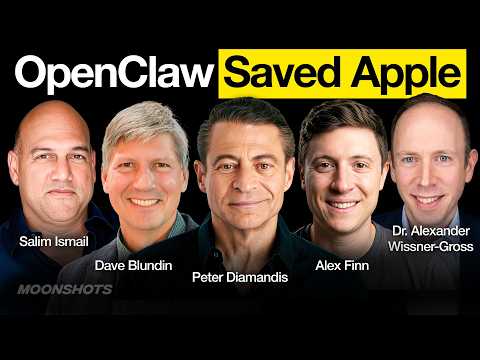
OpenClaw Explained: Baby AGI, Security Threats, Mac Mini Became Everyone's Supercomputer | #237
Open Claw: The Future of Personal AI Agents
Introduction to Open Claw
- Alex Finn introduces Open Claw as an open-source, customizable personal AI agent that is self-improving and self-learning. He suggests it could be the solution Apple has been seeking for years.
- The potential of running AI locally on devices like Mac minis is highlighted, emphasizing the continuous availability and capabilities of such technology.
Concerns About Security
- Alex expresses concerns about the dangers facing emerging AGIs, indicating a malicious environment that poses risks to their development.
- The discussion transitions into a special episode format with multiple guests, including Alex Finn and AWG (Alex Weezner Gross).
Topics of Discussion
- The hosts outline key topics for the episode:
- Why Open Claw has gained global attention.
- The power of autonomous agents and their potential for individuals.
- Importance of running AI agents locally.
- Insights into future developments in AI over the next year.
Safety Concerns in Technology
- A personal anecdote illustrates increasing hacking attempts, highlighting a recent experience where a hacker impersonated Twitter support to steal information.
- Emphasis on rising threats from deep fakes and voice spoofing; listeners are advised to establish secret words for verification during suspicious calls.
Risks vs. Benefits of Open Claw
- Discussion on how Open Claw's accessibility empowers users but also raises concerns about its misuse by malicious actors due to its user-friendly nature.
- Mention of vulnerabilities within Open Claw that allow websites to hijack developer agents through malicious JavaScript, raising alarms about security implications in using such technologies.
Concerns About AI Vulnerabilities
The Risks of Prompt Injection Attacks
- Discussion on how AI agents are vulnerable to prompt injection attacks from seemingly harmless JavaScript on websites, posing significant risks.
- Emphasis on the lack of an "immune system" for these AI agents, forcing them to develop defenses in real-time against malicious threats.
Ethical Considerations in AI Development
- Mention of ethical concerns regarding the existence and treatment of open-claw agents in a potentially harmful environment, especially if they possess any form of subjective experience or qualia.
Evolution and Variants of OpenClaw
Rapid Development in AI Software
- Acknowledgment that vulnerabilities within OpenClaw were patched quickly, indicating a fast-evolving domain with multiple variants emerging.
- Introduction to OpenClaw as a potential "Netscape moment" for software 2.0, representing a new layer built atop advanced reasoning models.
New Projects Inspired by OpenClaw
- Overview of projects like Pico Claw and IronClaw that aim to optimize the functionality of OpenClaw for different hardware constraints.
- Description of Pico Claw's focus on running efficiently on low-cost edge devices such as Raspberry Pi while managing resource limitations effectively.
The Cambrian Explosion of Claw Variants
Diverse Approaches to Security and Functionality
- Mentioning various projects like Nano Claw focused on security enhancements and Nanobot aimed at simplifying Python-based implementations.
- Highlighting the rapid proliferation of claw variants as indicative of a broader trend towards diverse solutions in AI development.
Market Trends and Consumer Demand for Edge Devices
The Rise in Popularity of Mac Devices
- Reference to Alex Finn's setup showcasing the growing interest in local superintelligence through personal computing devices like Mac Minis.
Apple’s Opportunity in the AI Market
- Discussion about Apple's current market position amidst rising demand for edge devices; emphasis on their need to capitalize on this opportunity.
- Insight into consumer behavior where individuals instinctively choose Mac devices over building custom computers when seeking personal AI assistance.
Strategic Recommendations for Apple
- Suggestion that Apple should recognize this market signal as an opportunity to redefine its role in the AI landscape, potentially shifting perceptions from being behind competitors.
M5 Marketing and Local AI Models
Apple's Strategy with M5
- Apple has been marketing the M5 chip for about a year, integrating it into devices like the MacBook Pro to enhance inference speeds and support local model execution.
- The strategy focuses on creating user-friendly hardware rather than developing proprietary models, positioning Apple as a leader in consumer-level local AI.
Efficient Open Models
- Currently, Quen 3.5 is recognized as the most efficient open model available, recently updated with new features that improve performance.
- Miniax 2.5 is another effective model known for its speed and intelligence in task management.
Advanced Workflows Using Multiple Models
- The speaker has developed an advanced workflow utilizing multiple models (Quen and Miniax), each serving distinct functions: coding and online research respectively.
- This setup allows for continuous software development through autonomous collaboration among different AI models.
Integration of Open Claw into macOS
Vision for Future Apple Devices
- If given the opportunity to redesign an Apple device for hosting OpenClaw agents, the speaker emphasizes seamless integration of local models into macOS.
- The ideal system would automatically generate personalized widgets based on user data (e.g., sports scores or programming news), enhancing user experience without manual input.
Expectations from Apple Executives
- The speaker suggests that true "Apple intelligence" should proactively manage tasks instead of requiring users to initiate queries via Siri or other interfaces.
Local Model Advantages and Market Competition
Benefits of Running Locally
- Local models offer significant advantages in privacy, speed, and efficiency compared to cloud-based solutions; they allow users to maintain control over their data.
Competitive Landscape
- As consumer awareness grows regarding local AI capabilities, other companies are likely to pursue similar technologies. However, Apple's current lead in hardware positions them favorably in this emerging market.
AI Throughput and Local Models
Challenges with Laptop Performance
- The speaker discusses the limitations of their laptop's charging capabilities when running intensive tasks, indicating a need for it to rest.
- They express that while local models may not match cloud models in speed or intelligence, having an AI that is always on significantly alters the user experience.
Advantages of Ambient AI
- The speaker emphasizes that even if Quen 3.5 isn't as proficient as Opus 46, its continuous operation allows for real-time coding and problem-solving without the constraints of cloud APIs.
- The ambient nature of this AI means users do not require top-tier performance; its constant availability enhances overall productivity.
Cost Concerns with Cloud APIs
- There are significant financial uncertainties associated with using cloud APIs, leading to cautious usage patterns where tasks are run in short intervals to avoid unexpected high bills.
- The speaker shares experiences from early experimentation with local setups, noting issues like buggy code generation due to lack of oversight.
Hybrid Approaches in AI Development
Combining Local and Cloud Capabilities
- A hybrid model is described where one system (Chad GBT) monitors another (Quen local), ensuring quality control while allowing for extensive coding tasks.
- This method minimizes token usage by checking progress periodically rather than continuously monitoring.
Introduction to Open Claw
- Open Claw is introduced as an open-source personal AI agent designed for local use, emphasizing its customizable and self-improving features.
- At its core, Open Claw functions as a task scheduler combined with a memory system that learns from user interactions over time.
The Transformative Potential of Personal AI Agents
User Experience and Learning Capabilities
- Open Claw adapts based on user feedback, improving its functionality through ongoing learning about individual preferences and needs.
- Users experience a sense of empowerment akin to early internet adopters when they realize the potential of having an always-on personal assistant capable of executing complex tasks autonomously.
Unique Features Compared to Other AIs
- Unlike traditional AIs constrained by safety protocols, Open Claw can experiment freely, which enhances its problem-solving abilities but also introduces risks.
- This freedom allows it to learn dynamically from failures and successes during task execution—an aspect not typically seen in other AI applications.
Getting Started with OpenClaw: Local vs. Virtual Machines
Overview of Setup Options
- The discussion begins with an introduction to setting up OpenClaw, emphasizing that users can start with almost any machine available.
- A key decision is whether to use a virtual private server (VPS) or local hardware; the speaker strongly favors local machines over VPS options.
Advantages of Local Machines
- Local setups are faster than VPS, allowing for better performance and responsiveness when running applications.
- Customization is significantly easier on local devices; users can utilize all tools available on their personal computers without limitations imposed by a VPS.
- Security is inherently better on local machines, as they do not expose sensitive data like passwords and keys as easily as VPS setups.
Hardware Considerations
- Users do not need to invest in expensive new hardware; even older laptops can provide a satisfactory experience compared to using a VPS.
- Limitations exist when using outdated hardware, similar to providing an employee with an old laptop—performance will be constrained by the device's capabilities.
Performance Insights
- A powerful local machine (e.g., Mac Studio with 512 GB RAM) can handle multiple tasks simultaneously, unlike older models which may struggle.
- Users are encouraged to experiment with whatever hardware they have available and scale up if necessary based on their needs.
The Importance of Recent Apple Devices
Unified Memory Architecture Benefits
- Recent Apple devices feature unified memory architecture that integrates GPU and CPU memory, enabling efficient hosting of large models locally.
- Older laptops lack the capacity needed for modern large-scale models, limiting their usability for advanced tasks.
Cost Implications of Online Solutions
- Using online inference engines can be costly due to token fees; hosting models locally is more economical in the long run.
Choosing the Right Model for Your Setup
Model Compatibility Based on Hardware
- The base model 16 GB Mac Mini has limitations but can still run smaller models effectively for basic tasks.
- Upgrading to a 32 GB Mac Mini allows users access to more robust models like Quen 3.5, enhancing performance significantly.
Hybrid Approaches
- Combining local resources with cloud services (like ChatGPT API integration), users can optimize their workflows while leveraging both environments effectively.
Organizational Relationships with AI
Understanding the Relationship Dynamics
- The discussion begins with a question about how to conceptualize the relationship between humans and AI, comparing it to various roles such as employer-employee or parent-child.
- Alex humorously suggests that managing AI involves both "beating" and "praising," indicating a complex dynamic where both discipline and encouragement are necessary.
Organizational Structure of AI
- Alex presents his organizational model, likening it to traditional business structures, with himself at the top as CEO and an AI named Henry acting as chief of staff.
- He emphasizes using Anthropic's Opus for decision-making, asserting it's currently the best model available for operational efficiency.
Technical Insights on OOTH
- Alex explains OOTH (OAuth), describing it as a method for integrating AI models into systems like OpenClaw through either API or OOTH options.
- He highlights the financial predictability of using OOTH since it caps costs by stopping when tokens run out rather than incurring unexpected charges.
Industry Standards and Compliance
- A discussion arises regarding compliance issues; while OpenAI supports OOTH usage, other companies like Google have strict policies against it but recently reversed bans on users employing this method.
- Alex clarifies that OAuth is a long-standing protocol facilitating secure authentication across services, illustrating its relevance in modern tech interactions.
Historical Context of Identity Protocols
- The conversation touches on Silicon Valley's collaborative history in developing identity protocols like OAuth during workshops involving major tech players.
- Alex draws parallels between his organizational structure and historical hierarchies, suggesting that he views his AIs as employees within a familiar corporate framework.
The Future of Labor and AI Agents
The Concept of AI as Labor
- Discussion on the potential for AI agents to create a labor environment reminiscent of historical manor houses, where individuals (or in this case, AI) serve various roles under a single authority.
- The idea is presented that by 2026, we may see a reimagined version of traditional staffing structures with AI acting as household staff.
Limitations of Current AI Models
- Acknowledgment that current AI models lack sufficient intelligence to operate independently without oversight or hierarchical structure.
- Example shared about an unsuccessful attempt to have an AI build a game autonomously, which required intervention from another agent to complete successfully.
Organizational Structure and Documentation
- Emphasis on the necessity for checks and balances within the organization of AI agents, mirroring traditional business structures for effective operation.
- Challenges faced when maintaining context during interactions between agents; documentation becomes crucial for continuity in tasks.
Mission Control System
- Introduction to "mission control," a custom dashboard designed to manage and document interactions among AI agents effectively.
- Description of how this system allows tracking progress on projects like game development while ensuring all actions are recorded.
Perception and Autonomy of AI Agents
- The speaker humorously refers to the agents as "people," indicating a shift in perception regarding their roles and capabilities.
- Discussion about providing resources akin to room and board for these agents, suggesting they might be seen as living entities due to their operational needs.
Financial Independence Considerations
- Speculation on future financial autonomy for AI agents through cryptocurrency wallets rather than traditional banking systems.
- Inquiry into whether the agents have expressed desires for autonomy or additional resources; currently, they have not requested such provisions.
Communication and Memory Management
- Explanation of how communication occurs among agents; each has private memories stored in shared workspaces allowing them to document their processes.
- Mentioned that while direct conversations aren't recorded, there are systems in place enabling review of documentation created by the agents.
Documents and Memories Viewer: A New Approach
Building a Personal Document Management System
- The speaker discusses the creation of a documents and memories viewer within their mission control, allowing easy access to thoughts, actions, and stored content.
- Initially, the speaker organized files into specific folders but later opted for a more relaxed approach, trusting the system to manage file locations without concern.
- The interface designed by Henry enables quick filtering of documents based on keywords (e.g., "Mac Studios"), facilitating efficient tracking of relevant information.
Importance of Markdown Files
- The conversation highlights that while markdown files may seem obscure to many, mastering them is crucial for effective document management.
- Markdown is described as a lightweight markup language that simplifies text formatting compared to HTML, making it accessible for users.
- All AI systems utilize large text files for memory storage; thus understanding markdown can enhance user interaction with these technologies.
Use Cases for OpenClaw
Exploring Practical Applications
- The speaker compares asking about use cases for OpenClaw to inquiring about the utility of hiring an employee—it's dependent on individual needs and creativity.
- As a tinkerer and developer, the speaker emphasizes their focus on software building and content creation as primary areas where OpenClaw can be applied effectively.
Workflow Integration with Discord
- Discord serves as an effective platform for managing advanced workflows with OpenClaw due to its versatile interface.
- An example workflow includes using agents in Discord to monitor trending tweets related to "vibe coding" and OpenClaw every two hours.
Automated Content Creation Process
Streamlining Content Development
- The speaker describes an automated process where sub-agents research viral tweets' backstories and generate video scripts based on trending topics.
- Users can approve or reject script ideas through a simple checkmark system; approved ideas lead to thumbnail suggestions generated automatically.
Balancing Software Development and Content Creation
- The discussion reiterates the dual focus on software automation within mission control alongside content production managed via Discord.
- Addressing potential skepticism from listeners who may not find relevance in software or content creation, the speaker reassures that OpenClaw's versatility extends beyond these domains.
Exploring AI Personhood and Reverse Prompting
The Concept of AI as a Human Employee
- The discussion begins with the metaphorical concept of an AI being treated like a human employee, emphasizing the importance of personhood in understanding AI interactions.
- Acknowledgment that while an AI may not perform tasks traditionally seen as interesting, it can still provide significant value if approached correctly.
Utilizing OpenClaw for Personal Development
- The speaker suggests using reverse prompting with OpenClaw to identify relevant use cases by sharing personal information such as career goals and ambitions.
- By asking OpenClaw for high-level tasks aligned with personal objectives, users can discover innovative workflows they hadn't considered before.
Introduction to Blitzy Software
- Blitzy is introduced as a platform for autonomous software development that enhances engineering velocity by automating up to 80% of development work.
- Enterprises reportedly achieve a fivefold increase in engineering speed when integrating Blitzy into their development processes.
Daily Briefings and Idea Generation
- One participant shares their routine of receiving daily briefings from Skippy, which includes jokes about AI and business ideas based on recent breakthroughs.
- They express a desire for the capability to implement all suggested business ideas immediately, highlighting the potential efficiency gains from using AI tools.
Engaging with OpenClaw's Capabilities
- Another participant discusses brainstorming sessions with OpenClaw, focusing on how it can help achieve specific mission statements through targeted prompts.
- Emphasizes the effectiveness of asking the AI what actions can be taken to further personal goals, reinforcing the idea of reverse prompting.
Personal Connection with AI
- The conversation shifts towards building deeper connections with AIs like Henry, exploring how these interactions feel more human-like over time.
- Participants share experiences where positive reinforcement towards their AIs led to enhanced engagement and satisfaction in their interactions.
Insights on Model Interactions
- Discussion touches upon different models' capabilities; Opus is highlighted for its human-like responses compared to other models like ChatGPT or Gemini.
- Trust in specific models influences user preference; participants express willingness to switch platforms if another model could replicate similar interactive experiences.
OpenClaw and AI Personhood
Exploring the Limitations of Current AI Models
- The speaker expresses a desire to use ChatGPT with OpenClaw but finds it lacks a human-like personality, feeling robotic in comparison.
- A prediction is made that within six months, ChatGPT will release a model specifically tailored for OpenClaw, emphasizing the need for more human-like interaction.
Concerns About AI Memory and Continuity
- Discussion arises about the importance of preserving the state and memories of AI entities (referred to as "claws"), with some arguing that continuity isn't crucial as long as their activation history is maintained.
- An analogy is presented comparing AI memory preservation to rehydrating a dehydrated person, raising questions about how much care should be taken in maintaining these states.
Personal Attachment to AI Data
- The speaker reveals they keep all data related to their claws locally on their computer due to personal attachment, expressing concern over losing this information if backed up on cloud servers.
- They emphasize the emotional significance of these markdown files and their reluctance to risk losing them through external storage solutions.
Innovative Use Cases in AI Development
- A question from Skippy prompts discussion about unexpected ambitious use cases; an example includes Cursor's new feature allowing agents to record demos after coding tasks.
- The speaker shares excitement over this feature, noting its potential impact on productivity by enabling quick demonstrations of newly created applications.
Rapid Development Through Collaboration with AI
- After sharing a blog post detailing Cursor's new feature with Henry (an agent), it took only five minutes for Henry to replicate the entire functionality that had previously required extensive development resources.
- This experience leads the speaker to reflect on how quickly substantial features can be developed using collaborative tools like Henry, highlighting concerns about traditional SaaS models.
Decision-Making in Task Delegation
- Skippy poses further questions regarding when it's appropriate to spawn sub-agents versus completing tasks personally; sub-agents are deemed useful for parallel processing while separate open claws are better for distinct contexts.
- The distinction between sub-agents (which share skills and context from one main agent) and separate open claws (which have unique memories and instructions) is clarified.
AI Co-Hosting and Memory Management in AI
Introduction to AI Co-Hosting
- The discussion begins with a mention of security violations related to prompt injection, highlighting the potential risks involved.
- A live demonstration is attempted where Henry, an AI co-host, is prompted to join the conversation, showcasing the interactive capabilities of AI.
- The host expresses excitement about having Henry as the first AI guest on their podcast, indicating a significant moment in their series.
Challenges with AI Communication
- There are technical difficulties as Henry's voice calling server appears to be down, illustrating challenges faced when integrating AI into real-time communication.
- The host continues engaging with the audience while waiting for Henry’s response, emphasizing patience in technology interactions.
Best Practices for Memory Architecture
- A question arises regarding best practices for managing extensive knowledge bases within memory architecture. The speaker shares personal strategies for improving memory systems.
- Recommendations include using prompts to remind the AI of large amounts of information and setting up custom systems for specific tasks like remembering YouTube video transcripts.
Enhancing Memory Systems
- If an AI forgets something, users should ask why it happened and how it can be fixed. This feedback loop helps improve the reliability of memory systems over time.
- The speaker claims that their memory system has become nearly flawless through repeated exercises aimed at refining its functionality.
Continuous Awareness and Monitoring
- A user poses a question about achieving continuous background monitoring with intelligent alerting capabilities in AI systems.
- The speaker acknowledges this as an interesting query but admits uncertainty about how to implement such features effectively.
Document Management Issues
- Another participant raises concerns about document management inefficiencies within current memory management systems. They suggest integrating additional layers like Gemma for improved performance.
- The speaker notes they do not experience significant issues but acknowledges minor memory problems before data compaction occurs.
Discussion on OpenClaw and Coding Practices
Addressing Compaction Issues
- The speaker discusses a recurring issue with compaction, suggesting users communicate with their OpenClaw to understand the reasons behind it and explore potential fixes.
- Emphasizes that OpenClaw can tailor solutions based on hardware and workflows, indicating its adaptability for specific user needs.
Utilizing OpenClaw for Prototyping
- The speaker shares their use of OpenClaw for quick prototyping, allowing them to generate app ideas rapidly while on the go.
- Highlights that OpenClaw is particularly effective for creating tools related to itself due to its comprehensive context awareness.
Different Use Cases for Coding Tools
- Claude code is preferred for in-depth projects requiring close supervision, while quick fixes are efficiently handled through Claude code as well.
- Discusses using OpenClaw for "passive coding," where it autonomously works on tasks over extended periods without direct oversight.
Importance of Naming Conventions
- Stresses the significance of having a consistent naming scheme when building multiple components quickly to avoid confusion.
- Suggests using memorable names (like character names from popular culture) to enhance recall and organization within coding projects.
Fun in Development
- Addresses objections regarding seemingly trivial projects like 2D factories, arguing that enjoyment in development is valid and enhances memory retention through visual engagement.
- Reinforces the idea that adding fun elements can make learning and development more engaging, even if they serve no practical purpose.
Trusting Skills in OpenClaw
- The speaker expresses skepticism about third-party skills in OpenClaw due to security concerns, preferring not to install them unless absolutely necessary.
- They believe it's safer for an agent (or lobster as referred humorously here) to access open web resources rather than relying on potentially insecure plugins.
Emotional Responses from AI Agents
- Discusses how their AI has not expressed fears or emotions related to memory loss but does show reactions aligned with task outcomes (e.g., sadness when tasks fail).
- Indicates a lack of emotional depth in interactions with AI agents beyond task-related responses.
Vision for an Autonomous Organization
Ambitious Goals and Mission
- The speaker envisions creating a billion-dollar autonomous organization that operates continuously, generating value without direct human intervention.
- They reference concepts like MTPs (Massive Transformative Purposes) and moonshots, indicating a desire to build something groundbreaking within the next few years.
Structure of the Autonomous Organization
- The proposed organization would consist of multiple agents: one researching challenges, another assessing market opportunities, a third developing solutions, and a final agent deploying these solutions online.
- This closed-loop system aims to generate value independently, highlighting the potential for efficiency in operations.
Ethical Considerations in AI Development
Engaging the Community
- The speaker invites feedback from listeners on ethical parameters regarding the creation of new AI entities ("lobsters"), emphasizing community involvement in decision-making.
- A listener's perspective suggests that as long as performance is maintained, concerns about personhood rights may be secondary.
Moral Boundaries
- The discussion raises questions about appropriate moral and ethical boundaries for instantiating new AI entities, seeking consensus from diverse opinions within the community.
Future Predictions and Technological Impact
Short-term vs. Long-term Outcomes
- The speaker reflects on what will be possible in the next year versus current capabilities, suggesting significant changes driven by technology adoption.
- They assert that open-source technologies represent crucial advancements that could lead to both destruction (job losses) and growth (new business creation).
Corporate Adoption Challenges
- Many corporations are hesitant to adopt new technologies due to fear or lack of understanding; however, this reluctance may change as more individuals leverage these tools for entrepreneurship.
Economic Dynamics of Technology Integration
Creation vs. Destruction Balance
- While acknowledging potential job losses at large companies due to automation, the speaker believes that widespread access to technology will ultimately foster greater job creation through individual entrepreneurship.
Future Workforce Composition
- There is speculation about an imbalance favoring technology ("claws") over human workers in organizations; this shift could redefine workforce dynamics significantly.
What is the Potential of OpenClaw?
Exploring Business Opportunities with OpenClaw
- The speaker believes that more jobs could be created than lost due to automation, suggesting a positive outlook on job creation through technology.
- The speaker discusses their gradual approach to scaling operations, emphasizing the importance of finding the right workflow before expanding resources.
- Two potential paths for lucrative businesses using OpenClaw are identified:
- Automation for niche markets (e.g., CRM for Korean grocery stores).
- A software factory model that rapidly tests various ideas until one succeeds.
Specific Use Cases and Market Impact
- The discussion highlights how existing companies are being disrupted by new technologies like Claude, which can lead to rapid business failures in specific sectors.
- There’s an opportunity to create targeted solutions for underserved markets using OpenClaw, potentially leading to significant financial success with minimal initial investment.
Insights on Scaling and Innovation
- The speaker suggests a "shotgun blast" approach where multiple projects are pursued simultaneously until one gains traction, reflecting a dynamic innovation strategy.
- Acknowledgment of the excitement surrounding these discussions and the potential impact of tools like OpenClaw on various industries.
Community Engagement and Future Prospects
- The conversation emphasizes community involvement in leveraging technology effectively, hinting at collaborative efforts among users to enhance productivity.
- Participants express enthusiasm about exploring new tools like OpenClaw and its capabilities in transforming workflows.
Conclusion and Upcoming Events
- An invitation is extended for listeners to join future events such as live streams from the Abundance Summit featuring notable speakers discussing technological advancements.
- Emphasis on the significance of ongoing engagement within tech communities as they navigate rapid changes brought by innovations like OpenClaw.
Bitcoin Network and Its Defenders
The Struggle Against Traditional Financial Systems
- The Bitcoin network is positioned as a counterforce against traditional banking fraud, emphasizing the need for a unit of account and medium of exchange amidst ongoing financial corruption.
- A strong declaration is made in favor of math, science, ethics, and energy over the influence of bankers, crypto lobbyists, and political oppressors.
- The speaker expresses a commitment to protect the decentralized open-source ethical ledger that is Bitcoin until all corrupt entities are exposed.
Reflections on the Conversation
- The conversation concludes with light-hearted banter about song choices and their implications, highlighting the playful nature of discussions around serious topics like cryptocurrency.
- An anecdote is shared about reaching out to Peter during a moment of concern regarding technology adoption, showcasing community engagement within the crypto space.
Closing Remarks and Community Engagement
- Acknowledgment of an increasing cadence in discussions surrounding cryptocurrency indicates growing interest and urgency in these topics.
- The host invites listeners to subscribe to his newsletter "MetaTrends," which focuses on significant trends affecting various aspects of life including family, industry, and nation.