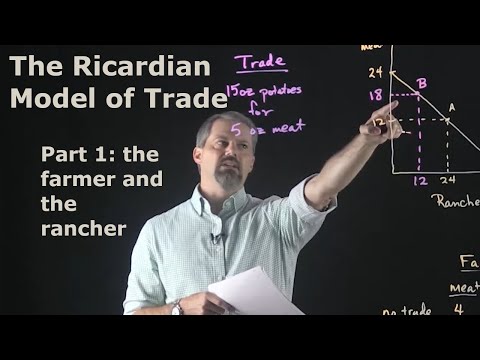
International Economics: The Ricardian Model of Trade: Part 1 - The Farmer and the Rancher
Labor Productivity and Comparative Advantage
Introduction to the Labor Productivity Model
- The video discusses the labor productivity model, also known as the Ricardian model, developed by David Ricardo. This model explains why countries engage in trade based on comparative advantage.
- The initial example presented is familiar to viewers, focusing on two individuals (or countries) that will be analyzed for their trading behaviors.
Understanding Comparative vs. Absolute Advantage
- The discussion begins with a focus on two individuals: a farmer and a rancher, who initially do not trade with each other. Their production capabilities will be compared to illustrate key concepts of trade.
- The farmer can produce meat and potatoes but takes longer than the rancher for both goods, highlighting absolute advantage where one party is more efficient in producing both items.
Production Time Analysis
- For the farmer:
- Produces an ounce of meat in 60 minutes.
- Produces an ounce of potatoes in 15 minutes.
This means if he works for eight hours solely on meat, he can produce 8 ounces; if focused on potatoes, he can yield 32 ounces.
- For the rancher:
- Produces an ounce of meat in 20 minutes.
- Produces an ounce of potatoes in 10 minutes.
In eight hours dedicated to meat production, he can create 24 ounces; for potatoes, he can generate up to 48 ounces. This demonstrates his efficiency over the farmer's output capabilities.
Autarchy and Production Possibilities Frontier (PPF)
- When neither individual trades (autarchy), they must produce everything they consume themselves—this scenario sets up a foundational understanding of their production possibilities frontier (PPF).
- A PPF graph illustrates all possible combinations of goods produced by each individual when dedicating time exclusively to either good—meat or potatoes—showing maximum outputs based on their respective efficiencies.
Production Possibilities Frontier: Farmer vs. Rancher
Understanding the Production Possibilities Frontier (PPF)
- The farmer can produce a maximum of 8 ounces of meat or 32 ounces of potatoes, illustrating their production capabilities on the PPF.
- The PPF represents all possible combinations of meat and potatoes that the farmer can produce, with any point inside the frontier indicating inefficiency.
- By allocating half their time to producing meat and half to potatoes, the farmer achieves a balanced output of 4 ounces of meat and 16 ounces of potatoes, marking a specific point on the PPF.
Comparing Farmer and Rancher Production
- The rancher's PPF is drawn similarly but reflects different endpoints: they can produce up to 24 ounces of meat or 48 ounces of potatoes, indicating greater production capacity.
- If the rancher also splits their time equally between both goods, they will end up with 12 ounces of meat and 24 ounces of potatoes at their midpoint on the PPF.
- The rancher's ability to produce more than the farmer in both categories demonstrates an absolute advantage in production efficiency for both goods.
Implications of Autarky
- In an autarky situation (no trade), both farmers and ranchers are limited to consuming what they can produce within their respective PPFs; thus, consumption cannot exceed production capabilities.
- The rancher's higher endpoint on the PPF signifies that they have an absolute advantage over the farmer in producing both goods, as shown by comparing maximum outputs for each producer.
Exploring Trade Opportunities
- Allowing trade between farmers and ranchers could enable them to consume beyond their individual production possibilities frontiers, leading to improved overall consumption outcomes for both parties.
- A summary table will be created later to illustrate how much each party produces and consumes under autarky conditions before exploring potential benefits from trading arrangements.
Trade Dynamics Between a Rancher and a Farmer
The No-Trade Situation
- The initial scenario describes a situation where the rancher and farmer do not engage in trade, resulting in their production and consumption points being identical.
- The rancher proposes cooperation to the farmer, suggesting that changing their production methods could lead to mutual benefits, despite the farmer's skepticism about potential exploitation.
Production Specialization
- The rancher's plan involves both parties altering their production focus; the farmer will specialize entirely in potatoes.
- The new production point for the farmer is set at producing 32 ounces of potatoes daily, while the rancher adjusts towards meat production.
Engaging in Trade
- After specialization, the rancher's new output includes 18 ounces of meat and 12 ounces of potatoes.
- A proposed trade is established: the farmer will exchange 15 ounces of potatoes for 5 ounces of meat with the rancher.
Analyzing Production and Consumption Points Post-Trade
- Following trade adjustments, the farmer ends up with zero meat but gains 5 ounces from trading, totaling 5 ounces of meat and retaining 17 ounces of potatoes after trading away some.
- This results in a consumption point outside their original production possibilities frontier (PPF), indicating improved outcomes due to trade.
Outcomes for Both Parties
- For the rancher, post-trade results show they retain 13 ounces of meat after trading away some while gaining additional potatoes through trade.
- Surprisingly, even though the rancher is more productive overall, engaging in trade allows them to achieve a consumption point beyond their PPF as well.
Gains from Trade and Comparative Advantage
Understanding Gains from Trade
- The discussion begins with the concept of gains from trade, highlighting that both a farmer and a rancher can benefit by trading despite differing productivity levels.
- The farmer consumes an additional ounce of meat and potatoes, while the rancher benefits even more with three extra ounces of potatoes, illustrating how trade increases consumption for both parties.
- After engaging in trade, the total production increases by two ounces of meat and four ounces of potatoes, demonstrating that the economic pie has expanded.
Absolute vs. Comparative Advantage
- It is crucial to differentiate between absolute advantage (the ability to produce more with the same resources) and comparative advantage (lower opportunity cost).
- Although the rancher has an absolute advantage in producing both goods, what matters is their ability to specialize based on comparative advantages.
Opportunity Cost Explained
- Absolute advantage is defined as requiring less input to produce a unit; however, opportunity cost focuses on what must be sacrificed when choosing one good over another.
- The real measure of cost involves understanding how much less of one good can be produced when allocating resources to another.
Production Possibilities Frontier (PPF)
- The opportunity cost can be visualized through the slope of the production possibilities frontier (PPF), which indicates trade-offs between producing different goods.
- A table will illustrate opportunity costs for both farmer and rancher regarding meat and potatoes.
Calculating Opportunity Costs
- For the farmer, producing one ounce of potatoes costs 1/4 ounce of meat; conversely, producing one ounce of meat costs four ounces of potatoes.
- For the rancher, it costs 1/2 ounce of meat to produce an ounce of potatoes; thus, they sacrifice two ounces of potatoes for each ounce of meat produced.
Conclusion on Specialization
- The analysis concludes that farmers have a lower opportunity cost for potato production while ranchers have a lower cost for meat. This specialization leads to mutually beneficial trade arrangements.
Understanding Comparative Advantage in Trade
The Concept of Comparative Advantage
- Trade allows individuals to specialize in goods where they have a comparative advantage, leading to more efficient production.
- It is impossible for one party to have a comparative advantage in both goods; if one has an advantage in one good, the other must have it in the alternative.
- Every participant must possess a comparative advantage in at least one good; having none is not feasible.
Analyzing Trade Dynamics
- To understand trade implications, we need to analyze opportunity costs and prices involved.
- The farmer received 5 ounces of meat for 15 ounces of potatoes, translating to a cost of 3 ounces of potatoes per ounce of meat.
- This deal benefits the farmer since producing an ounce of meat would cost them 4 ounces of potatoes, making the trade advantageous.
Rancher's Perspective on Trade
- The rancher sells meat at a price that exceeds their production cost; they produce each ounce for 2 ounces but sell it for 3 ounces.
- Both parties benefit from this trade: buyers pay less than self-production costs while sellers receive more than their production costs.
Price Implications and Gains from Trade
- The rancher exchanged 15 ounces of potatoes for 5 ounces of meat, equating to paying only 1/3 ounce of meat per ounce of potato.
- This arrangement is favorable as producing an ounce themselves would require half an ounce of meat. Both parties gain from this transaction.
Generalizing the Model: Ricardian Framework
- The discussed model illustrates how specialization based on comparative advantages leads to gains beyond individual production capabilities.
- This framework will be further developed symbolically and numerically in subsequent discussions.