10 Savremena arhitektura i umetnost PREDAVANJE 11
Introduction to Modern Architecture and Louis Kahn
Overview of Modernism
- The aesthetics of modernism, particularly the international style, are discussed as a significant influence on architecture.
- This modernist aesthetic is noted to have spread globally, especially in Europe and America after World War II.
Influence of Key Architects
- Prominent architects Ludwig Mies van der Rohe and Walter Gropius played crucial roles in American institutions during this period.
- Louis Kahn's education at an institution influenced by Le Corbusier shaped his architectural perspective, making it difficult for him to fully embrace modernist principles.
Kahn's Architectural Philosophy
- Kahn struggled with the acceptance of modernism due to its historical and theoretical influences on his work.
- His career trajectory reflects a tension between tradition and modernism until the 1950s.
Development of Significant Projects
Unexecuted Designs
- Between 1952 and 1957, Kahn worked on an unbuilt project: the City Hall in Philadelphia.
Academic Career
- From 1947 to 1957, Kahn taught at Yale University while remaining relatively unknown as an architect.
Breakthrough Works
Notable Achievements
- After the early 50s, Kahn produced significant works; his expansion of Yale University's art gallery marked a turning point in his career.
Philosophical Growth
- This project represented a shift in Kahn's thinking about architecture, influenced by his time spent in Rome from 1950 to 1951.
Influence of Roman Antiquity
Architectural Maturity
- In Rome, Kahn developed his architectural philosophy through exposure to ancient traditions and layered histories that informed his designs.
Structural Elements
- The structural elements became central themes in Kahn’s contemplations about architecture.
Educational Background
Schooling at Le Corbusier Tradition
- Discusses how Kahn’s formative education at the School of Fine Arts at the University of Pennsylvania was rooted in Bozar tradition.
Comprehensive Education Approach
- The educational approach emphasized observation, copying historical monuments, and studying great architectural works like Santa Maria Novella.
Humanistic Education Principles
Renaissance Influence
- The Bozar system provided architects with extensive theoretical knowledge based on principles from Plato’s Academy.
Artistic Integration
- Emphasizes a holistic understanding across disciplines such as mathematics, astronomy, geometry, arts, literature, music underpinned by philosophy.
Legacy of Louis Kahn's Work
Architectural Significance
- Kahn’s works are described as monumental contributions to architecture—kenotaphic rather than merely functional structures.
Salk Institute Example
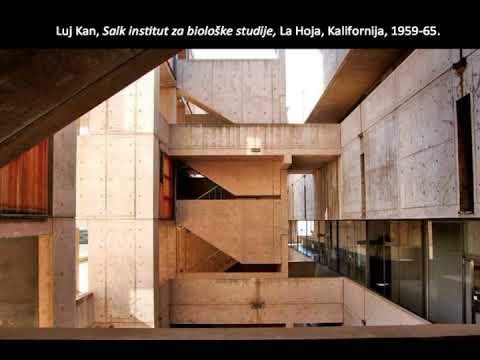
- Highlights one of Kahn's most successful projects—the Salk Institute for Biological Studies—as emblematic of his architectural vision.
Neoclassicism and Its Influence on Architecture
Overview of Neoclassicism
- The discussion begins with the concept of neoclassicism, highlighting Solana in Ark Senan as a notable project that remains unbuilt yet represents an interesting utopian vision.
- Marvin Traktenberg's book "Architecture from Prehistory to Postmodernism" (1986) establishes a division within French neoclassicism, which is more accurately referred to as classicism due to its continuous thread from the Renaissance onward.
Structural Classification by Traktenberg
- Traktenberg introduces a classification system for structural classicism, dividing it into archaeological, radical, and visionary revolutionary classicism phases spanning from 1750 to 1800.
- The emphasis is placed on the continuity of French art and architecture from the 16th to the 19th century, showcasing how various styles maintain classical elements.
Aesthetic Concepts in French Architecture
- All styles emerging within the French tradition strive to preserve this continuity of classicism.
- This reflects a general aesthetic concept supporting balance, harmony, and good taste (bon goût).
Key Works and Theories
- Further insights can be found in my book "Aesthetic Theory: Architecture Markanto Analogia," where I discuss aesthetics and classicism principles established by Abbot Laugier.
- Emil Kaufman later posits that architects Ledoux and Boulay were among the first modernists influencing Le Corbusier's work.
Architectural Imagery and Symbolism
- Many projects by Ledoux and Boulay exist only as beautiful images on paper rather than built structures.
- Their works exhibit fantastic contrasts of light and shadow, embodying a romantic vision where nature plays a significant role.
Mystical Dimensions in Architecture
- Human figures are depicted as small or invisible within these grand designs, suggesting a mystical dimension characteristic of their architectural style.
- Symbolism emerges as one of the most critical features of this visionary classicism.
Revolutionary Aspects Highlighted by Kaufman
- Kaufman identifies modernist aspects in revolutionary architecture through minimal decoration used by Ledoux and Boulay.
- He draws attention to forgotten 18th-century architects like Etienne Louis Boullée and Claude Nicolas Ledoux.
Impact on Modern Architecture
- Kaufman's thesis suggests that modern architecture begins with their works; he published his dissertation titled "From Ledoux to Le Corbusier" in 1933.
- His influential book "Free Revolutionary Architects" was released in 1952, consolidating ideas about these architects' contributions.
Exhibitions Celebrating Revolutionary Architects
- In 1964, an exhibition dedicated to revolutionary architects traveled worldwide after being held at the National Library in Paris.
Artistic Expression Through Design
- Boullée aimed to showcase his poetic strength through drawings that reflect his artistic background as he trained as a painter.
- He sought for his projects to be poetic expressions while analyzing geometric forms extensively.
Shadows as Architectural Elements
- Boullée argued that shadows represent effective architectural tools because they create light-dark effects rather than merely serving three-dimensional shapes.
Dramatic Atmosphere in Designs
- His dramatic drawings feature sharp lighting against stormy skies similar atmospheres are present in Louis Kahn’s Salk Institute for Biological Studies.
Monumentality in Architecture
- Monumentality serves both Kan's architectural expression and Boullée's representation of nature's grandeur.
- For Boullée, spheres symbolize perfect geometric forms representing Newtonian concepts centralizing them within his designs.
Legacy of Classicism
- Kan’s architecture embodies aspirations viewed through artistic lenses influenced heavily by French classical theory linked back to Boullée & Ledoux.
New Monumentality Concept Introduction
- In the 1950’s new monumental concepts emerged reflecting Kan’s interpretations reshaping traditional spatial notions post-modernity discussions began around what constitutes new modernity following WWII debates initiated at MoMA since ’48 questioning rigidity inherent within modernist principles such as “form follows function.”
Architectural Evolution and Kahn's Influence
The Context of Modernism
- The discussion emphasizes the need to consider the vast scale of architectural objects, indicating a shift in perspective regarding modernist architecture.
- It is noted that modernism could not provide endless uniform solutions, often resulting in simplistic designs like glass boxes.
Kahn's Emergence
- Louis Kahn's arrival on the architectural scene in the 1950s marked a significant change in architectural discourse.
- Kahn introduced new developmental lines within modernism, moving beyond previous limitations.
Inspirations and Influences
- In his project for the Newton Richards Laboratories, Kahn drew inspiration from Scottish castles, referencing Charles Rennie Mackintosh and the Glasgow School of Architecture.
- The concept of monumentality emerges as a critical question in architectural theory and criticism.
Monumentality Explored
- Sigfried Giedion wrote one of the most influential essays on monumentality titled "Nine Points of Monumentality" published in 1944.
- Giedion’s essay was included in an anthology edited by Paul Zucker, which also featured Kahn’s own essay on monumental architecture.
Philosophical Underpinnings
- Kahn viewed past architecture as a source of inspiration for future developments, emphasizing historical legacy from Sumer to contemporary times.
- His ideology respected historical traditions while focusing on future possibilities within architecture.
Major Projects and Their Significance
Notable Works
- Among his significant projects is the Salk Institute for Biological Studies, where he collaborated closely with Jonas Edward Salk.
- Salk was known for developing the first polio vaccine and regarded Kahn as his best client due to their strong working relationship.
Design Philosophy
- Kahn’s works are characterized by simplicity, beauty, tranquility, and harmony that evoke a sense of spirituality or religious reverence towards architecture.
Aesthetic Qualities
- His designs convey an overarching aesthetic that enveloped both people and nature through perfect form and beauty without ornamental decoration.
- Despite lacking decorative elements, his structures resonate with ancient Roman or Greek influences that impart a sense of permanence.
Functional Aspects of Architecture
Laboratory Design at Salk Institute
- Unlike smaller laboratories seen elsewhere (e.g., Richard's Center), labs at Salk were designed to function effectively with views overlooking serene ocean landscapes.
User Experience
- Scientists appreciated the thoughtful design that provided pleasant workspaces conducive to research activities.
Materiality and Brutalism
Concrete Usage
- Kahn embraced visible concrete finishes as expressions of perfection; this led some critics to categorize him within brutalist architecture due to heavy concrete use.
Architectural Intentions
- He aimed for materials to endure over time while evoking associations with ancient civilizations such as Egypt or Greece.
Lesser-Known Projects
Fisher House Overview
- One smaller project discussed is Fisher House located in suburban Pennsylvania; it showcases structural geometric forms reminiscent of earlier architects like Boulée.
Unique Features
- The house adapts well to its sloping terrain using robust stone foundations while maintaining visual harmony with its environment.
Exeter Academy Library Insights
- Another example is Exeter Academy Library; externally resembling an industrial building but internally revealing expansive unifying spaces filled with expressive architectural elements.
The Essence of Architecture
Architectural Poetry and Energy
- The project reflects an incredible healing energy, described as a true symphony of architecture.
- It emphasizes the poetic elements in architecture, showcasing how design can evoke emotions.
- Incorporates elements of water and light, enhancing the sensory experience within the space.
Material Mastery
- Utilizes monolithic materials with smooth concrete finishes, achieving perfection in detail.
- Features perfectly flat and smooth surfaces that contribute to the overall aesthetic quality.
Attention to Detail
- Highlights Kahn's meticulous attention to every detail, such as light entry points and roof designs resembling wings.
Artistic Influence on Space
The Role of Art in Museum Spaces
- Discusses how museum spaces provide narratives about time through their exhibits, whether sculptures or paintings.
- Every artwork is seen as a mark in time, echoing Tarkovsky's concept of "sculpting in time."
Energy Infusion into Artworks
- Each piece bears witness to the energy infused by its creator, emphasizing the connection between artist and artwork.
Personal Connections in Architecture
Collaboration and Relationships
- Kahn’s third love, Harriet Pattinson, contributed significantly but was not recognized at the museum opening due to personal dynamics.
Hidden Narratives
- Every architectural work embodies intimate stories that may remain hidden from viewers.
Unfinished Projects: A Legacy
The Hurva Synagogue Project
- Kahn's unfinished project for Hurva Synagogue aimed for monumental dimensions but faced political implications if realized.
Spiritual Aspirations
- Kahn envisioned this synagogue as a unifying spiritual center for Jews worldwide despite never completing any Jewish religious structures.
Nomadic Life and Cultural Understanding
Travels Influencing Design
- Kahn traveled extensively for projects; he believed he would die while traveling due to his age during his last works in India.
Indian Institute of Management
- This project showcases Kahn’s use of circles and arches influenced by local culture while maintaining warmth through material choices.
Spirituality Through Architecture
Light and Silence
- In his final projects for India and Pakistan, Kahn achieved a high level of spirituality reflecting deep cultural understanding.
Nature of Existence
- His work contrasts permanence with ephemerality, capturing beauty through light and shadow while embodying universal themes.
The Architecture of the National Assembly in Dhaka, Bangladesh
Architectural Significance and Cultural Context
- The architecture is perceived differently by Westerners as a material form with specific functions, while Eastern cultures view it as an expression of light, which Kahn considered in his design of this significant work.
- The complex is situated in pristine nature along the Buriganga River in Bangladesh, emphasizing its harmonious relationship with the environment.
- Before the construction of this monumental building, the area was merely fields; nature has always been a constant presence on Earth.
- This structure symbolizes freedom and democracy for one of the world's poorest nations, representing the people of Free Republic Bangladesh who gained independence from Pakistan in 1971.
- During conflicts and bombings, respect was shown towards this remarkable architecture, which remained largely unharmed.
Construction Challenges and Historical Context
- The construction took 23 years to complete; workers manually transported materials like bricks and cement using bamboo scaffolding—a monumental effort comparable to building Egyptian pyramids.
- Thousands of workers were involved over two decades, similar to those engaged in constructing iconic structures like the Taj Mahal.
- The building was completed in 1983, nine years after Kahn's death, marking a significant achievement despite high costs.
Design Elements and Symbolism
- The assembly hall features a dome that resembles a temple; decorations symbolize Bangladesh's independence. Experiencing Kahn's work firsthand reveals its forms, spaces, light interplay, shadows, silence, and tranquility.
- Kahn explored various shapes inspired by church foundations that influenced the design of the National Assembly itself.
Legacy and Philosophical Insights
- Kahn provided something unexpected for the people of Bangladesh—an institution symbolizing democracy and independence where citizens gather around its plaza.
- This project represented Kahn’s largest undertaking in one of the world’s poorest countries; he dedicated his final years to bringing it to fruition despite challenges.
- Ultimately achieving his vision for this architectural masterpiece reflects both ambition and resilience against financial constraints.
Reflections on Urbanism and Environmental Design
- Kahn opposed separating architecture from urban planning or environmental design; he believed these elements should coexist harmoniously rather than exist as distinct lines of creativity.
- While urbanism has gained prominence throughout architectural education since the 20th century—bringing both positive aspects—it also presents challenges that architects must navigate thoughtfully.
- A true architect can create both buildings and cities seamlessly; Kahn exemplified this holistic approach to architecture that respects all developmental paths within its practice.
Conclusion: A Tribute to Louis Kahn's Vision
- In conclusion, this lecture highlights Louis Kahn's fascinating architecture. Viewers are encouraged to explore further through recommended films linked earlier.
Turn any video into a summary like this
YouTube links, meetings, lectures. With transcripts, search, and chat.