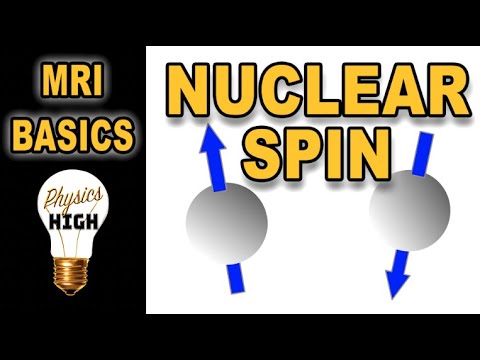
MRI basics: part 1: What is nuclear spin?
Nuclear Spin and Net Spin Explained
Introduction to Nuclear Spin
- The video introduces the concept of nuclear spin, emphasizing its importance in understanding quantum mechanics, particularly for applications like MRI in medical physics.
- The speaker aims to explain spin from a high school perspective, avoiding complex quantum mechanics while providing foundational knowledge.
Properties of Protons
- Protons possess several properties, one being "spin," which is historically termed but does not imply literal spinning.
- A spinning proton generates a magnetic field; the direction of this field can be determined using the right-hand rule.
- The magnetic moment produced by a proton can point either upwards (spin up) or downwards (spin down), with corresponding values of +1/2 and -1/2 in quantum mechanics.
Neutrons and Their Spin
- Neutrons also exhibit spin despite having no charge; they can similarly be classified as spin up or spin down with the same quantum values as protons.
- The speaker clarifies that while neutrons do not have charge, they still possess the property of spin.
Combining Protons and Neutrons
- When protons and neutrons combine in atoms, their spins contribute to what is known as nuclear spin.
- Electrons exist in specific energy levels within an atom's nucleus; similarly, protons and neutrons occupy defined energy levels represented metaphorically as a staircase.
Understanding Net Spin
- In hydrogen (one proton), the nuclear spin equals its net spin since there are no other particles to consider.
- Adding another proton requires one to have a positive (+1/2) and the other negative (-1/2), leading to cancellation of spins resulting in a net spin of 0 due to Pauli Exclusion Principle constraints.
Example: Lithium Nucleus
- With three protons in lithium, two cancel each other's spins out (net 0), leaving one remaining proton contributing +1/2 net spin due to occupying a different energy level.
Case Study: Deuterium
- Deuterium consists of one proton and one neutron; both can coexist with aligned spins because they are different types of particles.
Understanding Nuclear Spin and Its Implications in Helium and Carbon-13
The Concept of Net Spin in Nuclei
- The net spin for protons and neutrons is discussed, highlighting that the deuterium nucleus has a net spin of 1 due to the combination of one proton and one neutron.
- When constructing helium, which consists of two protons and two neutrons, it is noted that the spins must be opposite to maintain stability.
- The summation of spins can lead to different net spin values; in helium's case, the spins cancel out resulting in a net spin of zero.
Exploring Carbon-13's Structure
- Carbon-13 is introduced as an example with 13 nucleons: six protons and seven neutrons. This sets up a framework for understanding its nuclear structure.
- Protons are added sequentially while adhering to pairing rules (spin up/spin down), leading into discussions about energy levels as neutrons are subsequently added.
Determining Net Spin Values
- In carbon-13, every pair cancels out their spins, leaving only the last remaining neutron to determine the overall net spin value.
- The final calculation shows that carbon-13 has a net spin equal to 1/2 due to this unpaired neutron.
Rules Governing Nuclear Spin
- A set of rules is outlined for determining nuclear spin based on atomic mass (A) and atomic number (Z):
- If A is even and Z is odd, then the result is a whole number for net spin.
- If both A and Z are even, then the net spin equals zero.
Summary of Key Insights on Nuclear Spin
- For odd mass numbers (A), combinations yield either an even number of protons with an odd number of neutrons or vice versa, resulting in a half-integer multiple for net spins.
- It’s emphasized that these principles reflect quantum mechanics' nature regarding nuclear structures.