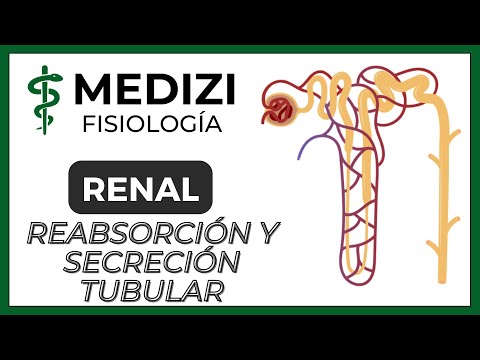
Fisiología Renal - Reabsorción y secreción tubular renal (Introducción) (IG:@doctor.paiva)
Introduction to Renal Physiology
Overview of Tubular Reabsorption and Secretion
- Eduardo Paiva introduces the topic of renal physiology, focusing on tubular reabsorption and secretion.
- The lecture outlines the flow of plasma through the nephron, starting from the glomerulus to various segments including proximal convoluted tubule, loop of Henle, distal convoluted tubule, and collecting ducts.
- It is emphasized that during this journey, certain substances are reabsorbed into peritubular capillaries while others are secreted from blood into tubules.
Key Processes in Urine Formation
- The formula for urine formation is presented: Urine = Filtration - Reabsorption + Secretion.
- A quantitative example illustrates how a 10% decrease in tubular reabsorption can significantly increase urine output from 1.5 liters to 19.3 liters daily.
- The importance of coordination between filtration and reabsorption is highlighted to prevent significant fluctuations in urine volume.
Selectivity in Filtration vs. Reabsorption
- Unlike filtration which lacks selectivity (everything except proteins is filtered), tubular reabsorption is highly selective based on bodily needs.
- Substances like amino acids and glucose are completely reabsorbed unless their threshold is exceeded (e.g., diabetes mellitus).
Mechanisms of Transport
Understanding Reabsorption and Secretion Dynamics
- Reabsorption involves moving substances from tubules back into blood via peritubular capillaries; secretion moves substances from blood into tubules.
Structural Components Involved
- The nephron's structure includes peritubular capillaries surrounding the tubules; two key membranes facilitate transport: basolateral (toward interstitium) and luminal/apical (toward lumen).
Pathways for Substance Movement
- Two pathways for substance movement across epithelial cells are described: paracellular (between cells) and transcellular (through cell membranes).
Transport Mechanisms Explained
Types of Transport Mechanisms
- Various transport mechanisms include diffusion (simple and facilitated), active transport (primary and secondary), with active transport requiring ATP hydrolysis.
Importance of Osmosis
Diffusion and Osmosis: Key Concepts
Understanding Diffusion
- Definition of Diffusion: The process where solutes move from an area of higher concentration to one of lower concentration, favoring a concentration gradient without energy expenditure.
- Types of Diffusion:
- Simple diffusion does not require transport proteins, although some proteins may assist in certain cases.
- Facilitated diffusion requires specific transport proteins to aid the movement across membranes.
Exploring Osmosis
- Osmosis Explained: The movement of solvent (liquid), typically water, through a selectively permeable membrane from a region of lower solute concentration to one of higher solute concentration.
- Equilibrium in Osmosis: Water moves towards areas with higher osmolarity until equilibrium is reached, balancing concentrations across compartments.
Active Transport Mechanisms
- Active Transport Overview: Movement against a concentration gradient (from low to high), requiring energy (ATP). This contrasts with passive diffusion processes.
- Primary vs. Secondary Active Transport:
- Primary active transport directly uses ATP for molecule movement (e.g., sodium-potassium pump).
- Secondary active transport utilizes the energy created by primary transport mechanisms indirectly.
Sodium-Potassium Pump and Its Role
- Functionality of the Sodium-Potassium Pump: Transports three sodium ions out and two potassium ions into cells using ATP, crucial for maintaining cellular ion balance.
- Examples of Primary Active Transporters: Includes hydrogen pumps and calcium pumps that also utilize ATP for their functions.
Secondary Active Transport Dynamics
- Mechanism of Secondary Active Transport: Relies on gradients established by primary active transport; e.g., sodium-glucose co-transporter uses sodium's electrochemical gradient to facilitate glucose entry into cells.
- Transport Types Clarified:
- Co-transport occurs when molecules move in the same direction (e.g., glucose with sodium).
- Countertransport involves molecules moving in opposite directions (e.g., calcium and hydrogen).
Reabsorption Mechanisms in Cells
- Sodium Reabsorption Process: In proximal tubule epithelial cells, sodium is actively transported out, creating a negative intracellular environment that facilitates passive diffusion back into the cell via facilitated diffusion channels.
- Impact on Cellular Potential: The active pumping creates a significant difference in ion concentrations leading to a resting membrane potential around -70 mV, which attracts positively charged ions like sodium back into the cell.
Understanding Sodium and Glucose Transport in the Nephron
Mechanisms of Sodium and Amino Acid Transport
- Sodium and amino acids utilize active transport mechanisms, specifically secondary transport, moving in the same direction during reabsorption. The sodium-hydrogen pump operates as a counter-transport mechanism for secretion.
Glucose Reabsorption Process
- Glucose concentration increases within cells through transporter proteins, facilitating its movement into the interstitial space via facilitated diffusion, influenced by tubular morphology.
Tubular Morphology and Its Impact
- Different nephron segments exhibit varying morphologies; for instance, proximal convoluted tubules have brush borders that significantly increase surface area for absorption.
Maximum Transport Capacity (Tm)
- The maximum transport capacity (Tm) defines the limit of substance reabsorption. For glucose, normal filtration is 125 mg/ml; when it exceeds 250 mg/ml, reabsorption decreases due to transporter saturation.
Threshold vs. Maximum Transport
- It’s crucial to differentiate between threshold (the point at which glucose begins to appear in urine) and maximum transport capacity. A person with normal glucose levels will not excrete glucose until their blood sugar exceeds 200 mg/dl.
Factors Influencing Reabsorption Rates
- Active substances show maximum transport rates while passive substances do not; their transport depends on electrochemical gradients, membrane permeability, and contact time with membranes.
Osmosis and Water Reabsorption Dynamics
- Increased sodium reabsorption leads to osmotic water reabsorption due to solute concentration changes in tubular fluid. This process varies across different nephron segments based on permeability characteristics.
Hormonal Regulation of Water Reabsorption
- In distal tubules and collecting ducts, water reabsorption is regulated by antidiuretic hormone (ADH), which influences permeability to water based on body hydration status.
Electrolyte Interactions During Reabsorption
- As sodium is absorbed, it creates a negative charge in the tubular lumen that promotes passive chloride reabsorption due to electrochemical gradients established by sodium dynamics.
Turn any video into a summary like this
YouTube links, meetings, lectures — with transcripts, search, and chat.