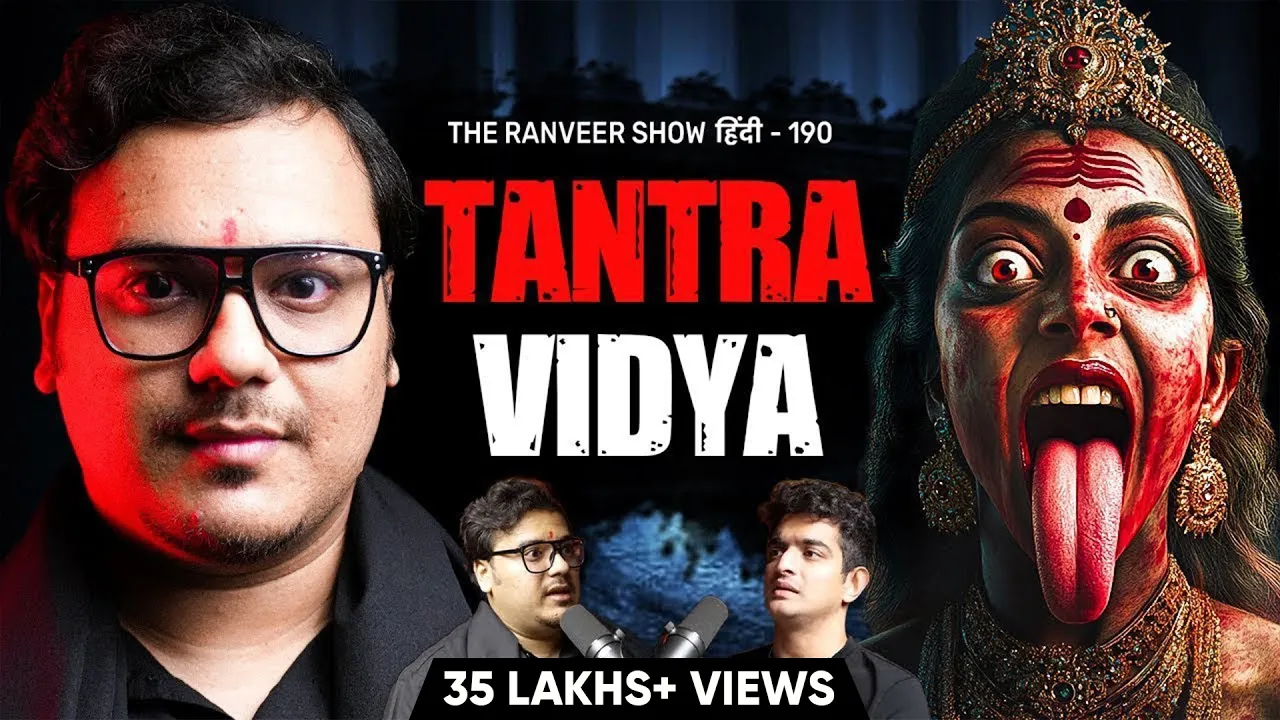
Watch At Your Own Risk - Tantra, Devi, Kaala Jaadu Aur Shaitaan | Parakh Om Bhatt | TRS हिंदी 190
The Importance of Spiritual Wealth
In this section, the speaker discusses the concept of spiritual wealth and its significance in one's life.
Spiritual Wealth
- Spiritual wealth is something that accompanies a person even after death.
- It refers to the power of the soul and its ability to progress on the path of spiritual practice.
- Seekers who possess spiritual wealth are highly respected and sought after by others, such as politicians or celebrities.
- People often attribute their achievements to their spiritual practices, which leads to them gaining money, power, and influence.
Introduction to Tantra
This section introduces the topic of Tantra and sets the stage for further discussion.
Tantra - Scary or Spiritual?
- The speaker acknowledges that some people may find Tantra scary while others consider it a spiritual practice.
- Deep diving into Tantra can evoke both fear and faith.
- Viewers are encouraged to approach this episode with an open mind.
Welcoming Parakh Om
The speaker welcomes Parakh Om, a highly respected Gujarati author with intense personal tantric experiences.
Introducing Parakh Om
- Parakh Om is introduced as a highly respected author from Rajkot, Gujarat.
- He shares his insights and experiences related to Tantra in this two-part special episode.
Shri Vidya Meditation Mantra
The speaker explains the meaning behind the Shri Vidya meditation mantra chanted by Parakh Om.
Shri Vidya Meditation Mantra
- The Shri Vidya meditation mantra is associated with Tripura Sundari, the third Mahavidya in Hinduism.
- It is considered an important part of Shri Vidya, the knowledge that enables one to connect with Mother Adiparashakti.
- The difference between Tantra and devotion is highlighted, with Tantra involving the worship of deities and their merging with the practitioner.
Misconceptions about Tantra
The speaker addresses common misconceptions about Tantra and discusses why people may fear it.
Misuse of Tantra
- People's fear of Tantra may stem from its historical misuse.
- The speaker acknowledges that Tantra has been misused in the past, leading to negative perceptions.
Acceptance into Tantra at a Young Age
The speaker asks Parakh Om why he was accepted into the world of Tantra at such a young age.
Early Acceptance into Tantra
- Parakh Om's acceptance into Tantra at a young age is discussed, but his response is not provided in this section.
New Section Black Magic and Tantra Misconceptions
In this section, the speaker discusses the concept of black magic and the misconceptions surrounding Tantra. They explain how black magic can be used for wrongdoing and harmful actions. The speaker also addresses the misunderstanding that Tantra is solely associated with Panch Makar (meat, fish, grain, sexual intercourse, and alcohol). They highlight that there are six types of Tantra mentioned in scriptures, out of which only three involve Panchmakar. The misuse of Tantra over time has led to impurities creeping into its practice.
Black Magic and Wrongdoing
- Black magic is a form of knowledge that can be used for wrongdoing.
- It encompasses various actions such as earning money through unethical means, killing, attracting or hypnotizing others.
- The misuse of black magic can cause significant harm to people.
Misconceptions about Tantra
- There has been an increase in awareness about Tantra in the last hundred years.
- Crematoriums are considered a source of achievements in Tantra because seekers find accomplishment there.
- There are different types of Tantras mentioned in scriptures such as Rudra Yamal Tantra, Tantra Raj Tantra, Mahanirvana Tantra.
- Panch Makar (meat, fish, grain, sexual intercourse, and alcohol) is mistakenly associated with all forms of Tantra.
- However, only three out of the six types of Tantras involve Panchmakar - Dakshinachar tantra, Divyachar tantra, Samayachar tantra.
- These three tantras do not use Panchmakar but focus on using satvik (pure) elements instead.
Impurities in Tantra
- Over time, impurities have crept into the practice of Tantra due to historical events like Vajrayan coming to India and Buddhist influence.
- Gorakhnath, Matsyendranath, and other Naths worked to remove impurities from Tantra.
- The misconception that Tantra is solely associated with Panch Makar has led to misunderstandings about its true nature.
Personal Journey and Interest in Tantra
- From a young age, the speaker had an interest in books related to Tantra and spirituality.
- Their first Guru, Ravi Trivedi, came into their life when they were twelve years old.
- Ravi Trivedi played a significant role in shaping the speaker's understanding of Tantra.
New Section Predetermined Path and Early Influences
In this section, the speaker reflects on their early experiences and how they believe their path towards Tantra was predetermined. They share anecdotes about their childhood interest in spiritual books and meeting their first Guru, Ravi Trivedi.
Predetermined Path
- The speaker believes that their interest in spiritual books from a young age was predetermined.
- Even as a child, they were drawn to books on Devi Bhagwat and original ancient Maha Indrajal.
- These early interests set them on a path towards exploring Tantra.
Meeting the First Guru
- At the age of twelve, the speaker's father's old friend, Ravi Trivedi, came into their life.
- There had been a long gap between their father and Ravi Trivedi due to living in different countries.
- Ravi Trivedi visited the speaker's home after many years and expressed that finally they had met.
- At that time, the speaker did not fully understand the significance of this encounter.
New Section Influence of First Guru - Ravi Trivedi
In this section, the speaker discusses the influence of their first Guru, Ravi Trivedi, on their spiritual journey. They share how Ravi Trivedi played a significant role in shaping their understanding of Tantra.
Influence of Ravi Trivedi
- Ravi Trivedi was an old friend of the speaker's father and visited their home after many years.
- The speaker's father invited him to stay for 1.5 to 2 months.
- Ravi Trivedi had a profound impact on the speaker's spiritual journey.
- His teachings and guidance helped shape the speaker's understanding of Tantra.
The transcript provided is limited, and these summaries are based solely on the available content.
Durga Saptashati and Diksha
The speaker talks about having the book "Durga Saptashati" in their hand and explains that it contains 700 verses of Durga. They mention being initiated with a mantra during a diksha (initiation) process, but they do not disclose the specific mantra.
Understanding Durga Saptashati and Diksha
- The speaker had the book "Durga Saptashati" in their hand.
- "Durga Saptashati" is a book containing 700 verses dedicated to Goddess Durga.
- The speaker received diksha (initiation) from their Guru, who chose a mantra for them to chant daily.
- The speaker agreed to chant the mantra without knowing much about diksha or mantras at that time.
Faith in Mother and Curiosity about Bhairav
The speaker shares their faith in their mother and recalls a conversation with their Guru about Bhairav, divine security guards associated with temples.
Faith in Mother and Introduction to Bhairav
- The speaker had faith towards their mother but lacked knowledge about spiritual concepts like Gurus, mantras, and the power of mantras.
- One day, while sitting together at around 5 pm, the speaker asked their Guru about Bhairav after learning about Kshetrapal (divine security guards).
- Temples have Kshetrapals associated with them for protection. Examples include Mahakal in Ujjain and Kaal Bhairav in Kashi Vishwanath.
- The speaker expressed curiosity about Bhairav and their form. Their Guru agreed to show them Bhairav.
Visit to the Temple of Kaal Bhairav
The speaker describes their visit to a temple dedicated to Lord Kaal Bhairav, located in a secluded place.
Visit to the Temple of Kaal Bhairav
- The speaker, along with their Guru, Ravi's uncle, the driver, and their father, visited a temple around 6:30 pm.
- The temple was located in a small village called Gogavadar, approximately 30 to 45 minutes away from Rajkot. It had ancient temples from the time of kings.
- The temple was situated in a desolate place that resembled a cremation ground. It was challenging to reach there due to its remote location.
- Upon entering the temple, the speaker felt an overwhelming energy and described it as a powerful shock for their mind and soul.
Description of Lord Kaal Bhairav Idol
The speaker provides details about the idol of Lord Kaal Bhairav present in the temple.
Description of Lord Kaal Bhairav Idol
- Inside the temple, there was a black marble idol of Lord Kaal Bhairav, approximately seven feet tall. The idol held various objects like a skull, mace, and face in its hands. One hand was in Abhay Mudra (gesture of protection).
- The entire temple was pitch black, matching the color of the idol.
- The speaker mentions the divine energy present in the temple and the surrounding darkness, accompanied by the sound of dogs barking.
- Interestingly, attempts to bring electricity to the temple had failed as any installed bulbs or tube lights would automatically explode at midnight.
New Section
This section discusses the establishment of a temple and the disapproval of Kaal Bhairav for certain efforts.
Establishment of the Temple
- Many efforts have been made to establish the temple.
- There was an attempt from someone's side as well.
- However, Kaal Bhairav does not approve of these efforts.
Darkness and Fear
- The temple is in complete darkness.
- Only during the day can one see the idol of God; otherwise, it is pitch black.
- Flashlights are needed to see God in this situation.
- With nightfall, darkness increases, creating an atmosphere of fear.
Aarti and Strange Phenomena
- During Aarti, various sounds can be heard, such as dogs barking and birds arriving.
- The priest blows a conch shell, and smoke comes out of a vent in front of God.
- It is revealed that a sadhna (spiritual practice) has just been completed.
- The Guru starts singing Kaal Bhairav Ashtak, a powerful hymn.
Dogs' Presence
- Dogs suddenly appear and sit in disciplined lines like students prostrating to God.
- They sit in the same posture as prostration.
- Witnessing these phenomena for the first time creates fear.
Conclusion
The beginning of many tantra worshippers' journeys involves similar experiences. Some individuals become corrupt due to their involvement with black magic. The speaker shares personal experiences related to his family's involvement with Tantra worship.
New Section
This section discusses Karna Pishachini, a lower form of divine feminine in Tantra Vidya.
Karna Pishachini
- Karna Pishachini is considered one of the lowest forms of divine feminine.
- It is categorized along with other lower forms like Sabha Mohini.
- These lower forms can be seen as ghosts and can have negative or demonic characteristics.
- A story is shared about a disciple who mastered Karna Pishachini through Vamachar practice within three days.
- The sadhna (practice) involves not bathing for ten days, not brushing teeth, not changing clothes, and being as dirty as possible.
- During the three-day sadhna period, one must consume their own excreta, apply it on their body, drink urine, and chant the mantra of Karna Pishachini.
- On the second day of the sadhna, Karna Pishachini appears to the practitioner in the form of a young girl and attempts to engage in intercourse.
- Some practitioners may get scared and fail to complete the sadhna on their first attempt.
- The disciple mentioned in the story successfully completed the sadhna on his third day and gained mastery over Karna Pishachini by wearing a bone rosary around his neck and chanting with it.
New Section
This section highlights how Vamachar Tantra Vidya can be used to master lower forms of divine feminine such as Karna Pishachini and Sabha Mohini.
Vamachar Tantra Vidya
- Vamachar Tantra Vidya allows practitioners to master lower forms of divine feminine like Karna Pishachini and Sabha Mohini.
- By following specific practices and rituals, one can gain control over these lower forms.
- The sadhna involves intense practices like consuming excreta, drinking urine, and chanting specific mantras.
- Despite the potential health risks involved, some individuals are driven by their desires and blindly pursue these practices in Tantra Vidya.
The transcript has been summarized into two sections based on the content provided.
New Section
This section discusses the concept of mastering Karna Pishachini and its implications for power and influence. It also explores the need to pass on Karna Pishachini before death in order to achieve salvation.
The Power of Mastery (0:29:38s - 0:31:15s)
- People master Karna Pishachini for various reasons, such as power and money.
- Seekers who have mastered Karna Pishachini often appear to have God's blessings.
- Politicians and celebrities often approach seekers with mastery for guidance.
- Seekers with mastery can possess knowledge about a person's past and family, which impresses others.
- Many famous saints in Indian society have mastered these skills, but their true achievements remain unknown to most.
Achieving Mastery (0:31:25s - 0:34:45s)
- Only those who have practiced Tantra Vidya extensively know the specific types of mastery a seeker possesses.
- Tantra is believed to be a medium that accelerates spiritual progress but can lead one astray from salvation.
- Rituals play a significant role in achieving sadhna (spiritual practice) and mastery.
- Passing on Karna Pishachini to a disciple before death is crucial for attaining salvation.
- Without passing on Karna Pishachini, the soul remains trapped in the ghostly matrix after death.
Shaktipat and Previous Birth (0:34:45s - 0:35:15s)
- Shaktipat is a process where a guru activates the spiritual energy within a disciple through touch, leading them into a state of samadhi (deep meditation).
- Only a few individuals possess strong sadhna from their previous birth, allowing them to receive shaktipat.
New Section
This section delves into the concept of sadhna and the importance of a guru in spiritual practice.
The Significance of Sadhna (0:35:15s - 0:36:00s)
- Sadhna refers to spiritual practices aimed at self-realization and enlightenment.
- It is essential to have a guru who can guide and impart knowledge during the sadhna journey.
- A guru helps disciples navigate through challenges, understand rituals, and progress on the path of spirituality.
Guru-Disciple Relationship (0:36:00s - 0:37:10s)
- The disciple must perform the same rituals as their guru to achieve successful sadhna.
- Rituals are integral to sadhna as they create a conducive environment for spiritual growth.
- Only a few individuals possess enough karmic merits from their previous birth to receive shaktipat without performing extensive rituals.
Importance of Guru's Guidance (0:37:10s - 0:38:05s)
- A guru's guidance is crucial in avoiding pitfalls and illusions on the path of sadhna.
- Without proper guidance, seekers may get trapped in worldly desires rather than progressing towards salvation.
- The relationship between a guru and disciple goes beyond mere teachings; it involves trust, surrender, and deep connection.
New Section
This section explores the consequences of not following proper spiritual practices and relying solely on external rituals.
Superficial Rituals vs. True Spiritual Progress (0:38:05s - 0:39.30s)
- Merely performing external rituals without inner transformation does not lead to true spiritual progress.
- Seekers who focus only on superficial rituals may become trapped in illusions and fail to attain salvation.
- True spiritual progress requires inner purification, self-realization, and detachment from worldly desires.
The Role of Intention (0:39:30s - 0:40:15s)
- Merely seeking knowledge or performing rituals without a genuine intention for spiritual growth is insufficient.
- The intention behind one's actions plays a significant role in determining the effectiveness of sadhna.
The Importance of Inner Transformation (0:40:15s - 0:41.00s)
- Inner transformation involves transcending ego, cultivating virtues, and developing a deep connection with the divine.
- External rituals should be accompanied by sincere efforts towards inner transformation for true spiritual progress.
New Section
This section emphasizes the need for self-discipline and dedication in spiritual practice.
Self-Discipline on the Spiritual Path (0:41.00s - 0:42.10s)
- Self-discipline is crucial for maintaining consistency in spiritual practice.
- Regularity, perseverance, and adherence to ethical principles are essential aspects of self-discipline on the spiritual path.
Dedication to Sadhna (0:42.10s - 0:43.20s)
- Dedication involves wholeheartedly committing oneself to sadhna and prioritizing it above worldly distractions.
- A dedicated seeker remains focused on their spiritual goals despite challenges or temptations along the way.
Balancing Spiritual Practice with Daily Life (0:43.20s - 0:44.25s)
- It is important to strike a balance between spiritual practice and daily life responsibilities.
- Integrating spirituality into everyday activities helps maintain harmony and prevents detachment from worldly duties.
New Section
This section discusses the significance of surrendering to the divine and the role of grace in spiritual progress.
Surrendering to the Divine (0:44.25s - 0:45.30s)
- Surrendering involves letting go of ego, control, and attachment to outcomes.
- By surrendering to the divine, seekers open themselves up to receive grace and guidance on their spiritual journey.
The Role of Grace (0:45.30s - 0:46.20s)
- Grace is a divine blessing that supports and accelerates spiritual progress.
- Seekers who cultivate humility, devotion, and surrender are more receptive to receiving grace.
Cultivating Devotion (0:46.20s - 0:47.10s)
- Devotion involves developing a deep love and reverence for the divine.
- Through devotion, seekers establish a personal connection with the divine and experience profound spiritual growth.
New Section
This section explores the importance of self-awareness and introspection in spiritual practice.
Self-Awareness on the Spiritual Path (0:47.10s - 0:48.15s)
- Self-awareness involves observing one's thoughts, emotions, and actions without judgment or attachment.
- Developing self-awareness helps identify patterns, limiting beliefs, and areas for personal growth on the spiritual path.
Introspection for Inner Transformation (0:48.15s - 0:49.20s)
- Introspection involves reflecting upon one's thoughts, motivations, and behaviors with honesty and sincerity.
- Through introspection, seekers gain insights into their inner world and can initiate positive changes for inner transformation.
Embracing Shadow Aspects (0:49.20s - 0:50.00s)
- Embracing shadow aspects refers to acknowledging and integrating suppressed or hidden aspects of oneself.
- By embracing the shadow, seekers can achieve wholeness and balance on their spiritual journey.
[New Section](t=0
New Section
This section tells a story about a woodcutter who encounters a tantrik and has a supernatural experience.
The Woodcutter's Encounter with the Tantrik
- Once upon a time, there was a woodcutter who was cutting down trees in the forest.
- As evening approached, the woodcutter noticed a tantrik carrying a dead body and got scared.
- Out of fear, the woodcutter climbed up a tree while the tantrik performed rituals on the dead body.
- Suddenly, a leopard appeared and attacked the tantrik, killing him but not eating him.
- Confused by what had happened, the woodcutter descended from the tree and sat on top of the dead body.
- He started chanting mantras and Mahakali, an incarnation of Goddess Kali, appeared before him.
The Woodcutter's Question to Mahakali
- The woodcutter asked Mahakali why she appeared before him when he had only chanted seven mantras compared to the tantrik's hours of worship.
- Mahakali explained that in his previous birth, he died after chanting seven mantras. In this birth, as soon as he completed seven chants again, she had to appear before him.
- The story emphasizes that spiritual wealth accumulated from past lives carries forward and can influence one's progress in spiritual practice.
Reflections on the Story
- The narrator mentions reading this story in "Ancient Science of Mantras" by Om Swami and "Aghora" by Robert Svoboda.
- The woodcutter's interest in spirituality at a young age is highlighted, with even his mother being scared of him.
Timestamps are approximate and may vary slightly.
Understanding God and Temptation
In this section, the speaker discusses their understanding of God and addresses the topic of temptation.
Learning from Others (0:41:21 - 0:41:29)
- The speaker learned everything about God from someone they refer to as "her."
- They ask her why she gets scared.
- She responds by saying that the speaker has grown into something else.
Influence of TRS (0:41:29 - 0:41:36)
- The speaker attributes their growth and change in perspective to TRS (possibly a reference to a specific teaching or experience).
- They mention that these episodes have attracted a different set of viewers.
Temptation and Tantra Vidya (0:41:36 - 0:42:00)
- The speaker expresses curiosity about temptation.
- They mention their knowledge of Tantra Vidya and its rituals.
- Not all worshippers get tempted, but some famous people and big saints do.
- These individuals are enticed by the benefits, power, and money associated with these rituals.
Passing the Test (0:42:00 - 0:42:24)
- At the age of twelve, the speaker's teacher left them after attaining Nirvana.
- Since then, they did not have any guru.
- They visited many ashrams, read numerous books on spirituality, including scriptures like Mahabharata and Ramayana.
Lack of Attraction to Money (0:42.24 - 0.43.28)
- The speaker mentions that money has never attracted them.
- They share that if someone offers them money for ethically right work, they accept it; otherwise, they are not interested in money.
- Their needs are minimal compared to their dedication to spiritual practices.
Devotion to Mother and Ethical Choices
In this section, the speaker discusses their devotion to the divine mother and how it influences their ethical choices.
Devotion to Mother (0:43:28 - 0:44:11)
- The speaker considers Adiparashakti, the divine mother, as residing within them.
- They believe that their actions should not betray this connection with the divine.
- They prioritize maintaining a clear conscience when facing temptations.
Blessings from Mother (0:44:11 - 0:45:07)
- The speaker acknowledges the blessings they have received from the divine mother since childhood.
- These include mantra diksha (initiation into mantras) and guidance from a good guru.
- They feel grateful for all they have received upfront in their spiritual journey.
Serving Others (0:45.07 - 0.45.26)
- The speaker believes that if others could receive what they have been blessed with, many people's problems and sorrows would diminish.
- They question why they should work solely for personal gain when they have been chosen by the divine for a greater purpose.
Nature and Circumstances
In this section, the speaker reflects on their nature and how circumstances may have shaped their character.
Nature vs. Circumstances (0:45.26 - 0.46.03)
- The speaker ponders why they are different from others in terms of their lack of attraction to money.
- They speculate that it might be due to their inherent nature or influenced by past circumstances.
- Character development is also seen as an outcome of one's life experiences.
Lalita Sahasranam Verse (0:46.03 - 0:46.15)
- The speaker mentions a verse from Lalita Sahasranam, a sacred text.
- They refer to the three types of granthi (glands/nodes) within humans: Brahma granthi, Vishnu granthi, and Rudra granthi.
Desire for Creation (0:46.15 - 0:46.31)
- The Brahma granthi is associated with the desire to create something.
- People have various desires and aspirations.
Conclusion
The speaker shares their understanding of God, discusses temptation and ethical choices, emphasizes their devotion to the divine mother, and reflects on their nature and circumstances. They express gratitude for the blessings they have received in their spiritual journey and prioritize serving others over personal gain.
Despertar da Kundalini e os Chakras Visão Geral
Visão Geral da Seção: Nesta seção, o palestrante discute o despertar da Kundalini e a importância dos chakras no processo espiritual.
Despertar da Kundalini e os Chakras
- Antes de adorar a mãe divina, é necessário despertar a Mooladhara, que é o primeiro chakra.
- O Brahma granthi (nó de Brahma) precisa ser rompido para permitir o despertar da Kundalini.
- A mãe divina desperta a Kundalini ao perfurar o Brahma granthi, permitindo que ela avance em sua jornada.
- O chakra Manipura abriga o Vishnu granthi (nó de Vishnu).
- O desejo de sustentar as conquistas alcançadas é chamado de Vishnu granthi.
- Mesmo sabendo que a morte é inevitável e que tudo será levado um dia, ainda tentamos sustentar nossas conquistas.
- Ao prosseguir no caminho espiritual, a mãe divina também perfura esse nó do Vishnu granthi.
- O Rudra granthi (nó de Rudra) está localizado no chakra Ajna.
- O Rudra granthi representa o ego, a inveja e a ganância.
- Todas as nossas más qualidades estão relacionadas ao Rudra granthi.
- A mãe divina se une ao Senhor Shiva no chakra Sahasrara.
- No chakra Sahasrara, há a presença do Somras (néctar), que proporciona uma sensação única durante o Samadhi.
- Durante o despertar da Kundalini no chakra Sahasrara, ocorre a união de Shiva e Shakti.
- A mãe divina oferece um néctar mais poderoso do que todas as drogas do mundo durante esse processo de união.
- O objetivo é usar as bênçãos recebidas para trabalhar em prol das pessoas e resolver seus problemas.
- Políticos e profissionais da indústria cinematográfica consultam especialistas em Tantra com frequência.
- Existem rituais específicos, como Maran Kriya, para matar, atrair ou hipnotizar alguém usando práticas tântricas.
- Maran Kriya é usado para matar alguém através de rituais tântricos complexos. É necessário ter expertise nesse campo para realizar esses rituais com sucesso.
- O uso de fantasmas ou entidades espirituais também pode estar envolvido nesses rituais.
- Alguns indivíduos têm mais influência em uma sociedade do que outros.
Consultas a Especialistas em Tantra Visão Geral
Visão Geral da Seção: Nesta seção, o palestrante discute a consulta frequente de políticos e profissionais da indústria cinematográfica a especialistas em Tantra.
Consultas a Especialistas em Tantra
- Políticos e membros proeminentes da indústria cinematográfica consultam regularmente especialistas em Tantra para tomar decisões importantes.
- Essas consultas envolvem determinar o momento certo para tomar decisões e realizar rituais específicos com base no almanaque astrológico.
- Maran Kriya é um exemplo de ritual tântrico usado para matar alguém. Há rumores de que esse ritual foi usado contra Shankaracharya por ser contra as práticas tântricas.
- Aqueles que realizam esses rituais devem ter confiança em sua expertise, pois há riscos envolvidos. Caso contrário, os resultados podem ser negativos.
- Fantasmas ou entidades espirituais podem desempenhar um papel nesses rituais complexos.
Note that the summary has been divided into two sections based on the content of the transcript. Each section has a clear and concise title, followed by an overview of the section. The bullet points provide key insights and information from the transcript, with each bullet point linked to the corresponding timestamp in the video.
The Ghostly Matrix
In this section, the speaker discusses the existence of powerful and less powerful souls and creatures. They explain that certain tasks are carried out by these powerful souls and emphasize the importance of expertise when dealing with such entities.
Souls and Their Power
- Some souls and creatures are more powerful than others.
- These powerful souls are responsible for getting certain tasks done.
- Expertise is necessary when dealing with these powerful entities.
Different Names for Powerful Entities
- Powerful entities can be referred to as Brahmarakshas, ghosts, or Pishaach.
- These terms are used interchangeably to describe them.
Maran, Mohan, Vashikaran
- Maran refers to causing harm or destruction.
- Mohan is related to hypnosis and attraction towards someone.
- Vashikaran involves creating love in someone's mind through Tantra Kriya.
Sthambhan - Immobilization
- Sthambhan is a technique that makes a person immobile.
- It can be compared to sleep paralysis but has specific effects like preventing speech or movement.
Misuse of Cemetery and Universal Existence
- The speaker mentions that bending the laws of nature exists in every culture and religion.
- Various cultures have their own specific forms of Tantra practices.
- Such practices are not limited to India but occur worldwide.
Codex Giga - A Mysterious Book
The speaker shares an example of Codex Giga, a book believed to have been written by the devil in one night. This story highlights the power associated with certain mystical practices.
Codex Giga - Devil's Book?
- Codex Giga is a large book said to have been written by the devil in one night.
- The book's dimensions are significant, but exact measurements are not mentioned.
- It is believed that the author sought help from the devil to complete the task.
Global Existence of Tantra Practices
The speaker emphasizes that Tantra practices exist worldwide and are not limited to India. They mention that spirituality and open-mindedness play a role in discussing these practices openly.
Tantra Practices Worldwide
- Every culture and religion has its own specific form of Tantra practice.
- Africa, South America, Gulf countries, Europe all have their unique traditions.
- These practices continue to exist globally.
Openness in India
- In India, there is more openness about discussing spiritual practices.
- Spirituality leads to rational thoughts combined with emotional thoughts.
- However, this does not mean such practices do not occur elsewhere.
Example of Codex Giga
- The speaker refers back to the example of Codex Giga as evidence of mystical practices existing beyond India.
Timestamps may vary slightly depending on the source video.
The Codex Giga
The Codex Giga, also known as the Devil's Bible, is a book that is considered to be satanic. Some of its pages are missing today.
- The Codex Giga is a book with a dark reputation and missing pages.
- It is believed that an otherworldly energy was involved in its creation.
Demons in Hinduism
Hinduism has its own entities similar to Satan or demons.
- In Hinduism, terms like Pishaach, Preth, and Brahmarakshas are used instead of Satan or Lucifer.
- There are many demonic entities in Hinduism, such as Mahishasur, Bhandasur, Bakasur, and Ravan.
Existence of Demons Today
While there may be influences from demonic entities on people's minds, physical existence of demons in the present world is unlikely.
- In ancient times, gods and goddesses coexisted with demons on Earth.
- However, in modern times it is unlikely for demons to physically exist on Earth.
Realms in Hinduism
Hinduism mentions different realms or lokas where souls go based on their actions.
- There are 7 Adhuloks (downward realms) and 6 Urdhvaloks (upper realms) mentioned in Hinduism.
- Adhuloks are realms where souls face misery based on their sins, while Urdhvaloks offer salvation for virtuous souls.
Atonement and Salvation
Hinduism allows for atonement of sins and the possibility of salvation.
- Souls can find salvation by atoning for their sins, allowing them to start anew.
- Examples like Ashwatthama show that even those who have committed grave sins can find salvation in future incarnations.
Freedom from Past Actions
Hinduism offers the opportunity to be free from past actions and start afresh.
- In Hinduism, if one has atoned for their sins, they can start with a clean slate without any baggage.
- This freedom allows individuals to become gods or demigods and achieve anything.
Note that these summaries are based on the given transcript and may not capture the full context or details of the video.
The Concept of Ashwatthama and Shri Vidya
In this section, the speaker discusses the concept of Ashwatthama and Shri Vidya in relation to the Mahabharata.
The Concept of Ashwatthama
- The concept of Ashwatthama having five faces, with one being cut off by Lord Shiva.
- The remaining four faces gave rise to the four Vedas.
- Speculation on what would have happened if a Veda emerged from his fifth face.
- Exploring the idea that the universe's darkest secrets are written in that Veda.
- The speaker mentions writing a 5-part novel based on this concept, with two parts already released and three more to come.
Mention of Ashwatthama in Scriptures
- Discussion about whether Ashwatthama is mentioned anywhere else apart from the Mahabharata.
- Uncertainty about other scriptures mentioning Ashwatthama.
- Cultural experts suggesting that the Mahabharata took place around 3000-5000 BC.
Ashwatthama's Journey and Shri Vidya
- Speculation on what Ashwatthama might have done for five thousand years after the Mahabharata.
- Possibility of him adopting Tantrism and practicing to clear his karma.
- Reference to a book by Gauri Lakshmibai, which mentions an incident involving Lord Parshuram and Ashwatthama's pain reduction solution.
- Parshuram advises Ashwatthama to be in the company of Ved Vyas to alleviate his suffering.
- Connection between Ved Vyas, Padmanabhaswamy temple, and belief in their coexistence.
Understanding Shri Vidya
- Explanation that Shri Vidya is considered the highest Tantra Vidya (knowledge).
- The belief that Ashwatthama achieved Shri Vidya and freed himself from pain and suffering.
Mahabharata Timeline and Ashwatthama's Pain
This section focuses on the timeline of the Mahabharata and an incident related to Ashwatthama's pain.
Timeline of the Mahabharata
- Discussion about the estimated timeline of the Mahabharata, ranging from 3000-5000 BC.
- Mention that it happened around 3000 BC according to popular belief.
Ashwatthama's Pain Reduction Solution
- Reference to an incident where Lord Krishna pulled a gem from Ashwatthama's forehead, causing him immense pain.
- Ashwatthama seeks a solution from Lord Parshuram to reduce his suffering.
- Parshuram advises him that where there is knowledge, there is no pain.
- Explanation that wisdom comes from exploration, not just book knowledge.
- Connection between Ved Vyas, Padmanabhaswamy temple, and belief in their coexistence as a means to alleviate pain.
Ved Vyas and Ashwatthama at Padmanabhaswamy Temple
This section explores the presence of Ved Vyas and Ashwatthama at the Padmanabhaswamy temple in Thiruvananthapuram.
Presence of Ved Vyas and Ashwatthama at Padmanabhaswamy Temple
- Observation that both Ved Vyas and Ashwatthama are installed beside Lord Padmanabha at the temple.
- Curiosity about why Ashwatthama is consecrated there.
- Information obtained from a priest who wrote a book on this topic.
- Gauri Lakshmibai's book, written by a princess of the Travancore royal family, provides insights into this matter.
- Mention of Ashwatthama's pain and his quest for a solution from Lord Parshuram.
Shri Vidya and Freedom from Pain
- Connection between Ashwatthama's achievement of Shri Vidya and his liberation from pain and suffering.
- Explanation that Shri Vidya is considered the highest Tantra Vidya.
The transcript has been summarized in a clear and concise manner, using timestamps to indicate the corresponding parts of the video.
Understanding the Verses of Deities and Mother
In this section, the speaker discusses the verses of deities and the mother, explaining that mantras are associated with deities while Vidya is associated with the mother.
Verses of Deities and Mother
- The verses of the deities are called mantras, while the verses of the mother are called Vidya.
- Shri Yantra, which has nine coverings, represents Shrividya. The presiding deity of Shrividya is Mother Lalita Maha Tripura Sundari.
- To simplify this concept, the speaker introduces a slightly different terminology.
- There is Adi Shakti and Aadi Parashakti. Both have equal importance but serve different purposes.
- Shakti can be considered as Chamunda Mother or any other incarnation such as Nav Durga (Nine Durgas). Adishakti or Mahashakti refers to Mother Parvati herself in different forms.
The Emergence of Tridev and Adi Parashakti
This section explores the emergence of Tridev (Brahma, Vishnu, Mahesh) and their connection to Adi Parashakti.
Power and Emergence
- Tridev (Brahma, Vishnu, Mahesh) are responsible for the emergence of Adi Parashakti. They appeared in their corporeal forms through the power of Adi Parashakti.
- Adi Parashakti, also known as Mother Lalita Maha Tripura Sundari, is responsible for creating, maintaining, and destroying the universe.
The Significance of Mother Lalita Maha Tripura Sundari
This section highlights the significance of Mother Lalita Maha Tripura Sundari and her association with Sri Yantra.
Mother Lalita Maha Tripura Sundari
- Mother Lalita Maha Tripura Sundari is considered the embodiment of Sri Mata, Sri Yantra, and Sri Chakra. She creates the universe in the form of Brahma.
- The mother takes different forms to fulfill various roles such as Sangharini (destroyer) in the form of Rudra.
- A beautiful verse in Lalita Sahasranam describes Mother Adi Parashakti as Lalita Maha Tripura Sundari who is Srividya herself.
The Dot and Creation
This section explores the significance of a dot in Shriyantra and its connection to creation.
The Dot and Creation
- In Shriyantra, there is a dot in the middle called Sarvanandamaya Chakra where Mother resides. It represents her house or palace known as Chintamani gruh.
- Everything starts from a dot, including the creation of life through male and female seeds (Shukra beej and Shonit beej).
- The presence of seeds is essential for creation and the existence of nature.
Mother Lalita Maha Tripura Sundari as a Point
This section discusses the concept of Mother Lalita Maha Tripura Sundari as a point before the Big Bang.
Mother Lalita Maha Tripura Sundari as a Point
- Before the Big Bang, Mother Lalita Maha Tripura Sundari existed as a point. She represents the manifestation of her corporeal form in a formless state.
Understanding Adi Shakti, Adishakti, and Aadi Parashakti
This section clarifies the concepts of Adi Shakti, Adishakti, and Aadi Parashakti.
Differentiating Adi Shakti, Adishakti, and Aadi Parashakti
- Adi Shakti refers to power in general, while Adishakti or Mahashakti represents Mother Parvati herself in different forms. Aadi Parashakti encompasses Brahma, Vishnu, and Mahesh who are responsible for her emergence. All three have equal importance but serve different purposes.
The Appearance of Mother Lalita Maha Tripura Sundari
This section discusses the story of the appearance of Mother Lalita Maha Tripura Sundari and the need for her to defeat the demon Bhandasur.
The Story of Bhandasur
- Bhandasur, a powerful demon, caused chaos in all three worlds.
- Even gods like Indra were defeated by him.
- The gods sought a solution from Brahma, Vishnu, and Mahesh on how to defeat Bhandasur.
- It was revealed that only the divine feminine could defeat him.
- A plan was made for all the gods to put a part of their power in a fire pit to manifest the corporeal form of Mother Lalita Maha Tripura Sundari.
The Manifestation of Shri Mata
- All the gods and goddesses gathered at the Agni Kund (fire pit).
- They sacrificed a part of their bodies into the fire.
- From this sacrifice, Shri Mata, also known as Shri Maharagni, appeared.
- Shri Mata is considered the empress of the universe and Adi Parashakti.
- She is associated with Shri Vidya and can be worshiped through mantra, tantra, and yantra.
Invitation to Deities and Appearance of Shri Mata
This section describes how deities were invited to witness the manifestation of Shri Mata and introduces some aspects related to her divine nature.
Invitation to Deities
- Various deities including Indra, Surya, Agni, Vayu, Varuna, Ganesh, Brahma, Vishnu, Mahesh were invited.
- Each deity cut a part of their body as an offering to the fire pit.
Appearance of Shri Mata
- Through the sacrifice of divine body parts, Shri Mata appeared.
- The first verse in Lalita Sahasranam is dedicated to her.
- Shri Mata is associated with Chidagni, the mind in the form of fire, and Devkarya Samudyata, completing the work of the gods.
- She is considered Mother Adi Parashakti and represents Shri Vidya.
Shri Vidya and Worship Methods
This section explains the significance of Shri Vidya and different methods of worship associated with it.
Shri Vidya and Worship Methods
- Shri Vidya encompasses Panchdashi mantra (15-lettered mantra) and Shodashakshari mantra (16-lettered mantra).
- It can be worshiped through mantra, tantra, and yantra.
- The speaker's Guru is Om Swami, who will be discussed later in detail.
Misconceptions about Shri Yantra
This section addresses misconceptions about using Shri Yantra for seeking Maa Lakshmi's blessings.
Misconceptions about Shri Yantra
- People often believe that installing a small version of Shri Yantra at home can bring Maa Lakshmi's blessings.
- However, they may not realize the profound impact it can have on their lives.
- The speaker emphasizes that there is much more to understand about the power and significance of Shri Yantra.
Timestamps are provided for each section based on available information from the transcript.
New Section Introduction to Shri Vidya and Tantra
In this section, the speaker introduces the concepts of Shri Vidya and Tantra.
Understanding Shri Vidya and Different Methods of Worship
- The speaker explains that there are different methods of worship in Shri Vidya, such as dakshinachar and vamachar.
- By invoking the mother through these different methods, one can accomplish their goals.
The Power of Shri Vidya
- The speaker mentions that there is a verse in Shri Vidya that is considered equal to the entire practice.
- They chant the verse that describes the mother as the creator of countless universes.
- Another verse highlights how just by blinking her eyes, the mother creates numerous universes.
Conclusion and Next Steps
- The speaker concludes this episode with a greeting.
- They express gratitude for watching and mention that there is more to come in future episodes.
- Viewers are encouraged to watch other Tantra-themed episodes with Rajshree Nandi Sir.
- The team signs off, thanking viewers for their support.
This summary provides an overview of the content covered in this section. For detailed information, refer to the corresponding timestamps in the transcript.