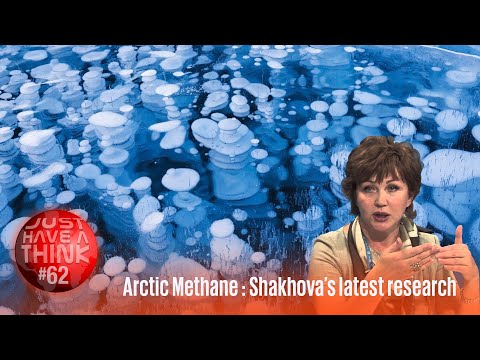
Methane: The Arctic's hidden climate threat : Natalia Shakhova's latest paper.
The East Siberian Arctic Shelf and Methane Release
This section introduces the East Siberian Arctic shelf, a region that has been either just above or below sea level depending on how much of the planet's water has been locked up in ice at any given time. The organic matter from dead plants and animals deposited in the ground over long periods of time produces methane, which is currently locked up in permafrost.
Introduction to the East Siberian Arctic Shelf
- The East Siberian Arctic shelf is a region that has been either just above or below sea level depending on how much of the planet's water has been locked up in ice at any given time.
- When it's been above sea level, plants have grown and animals have roamed around on the ice shelf just like any other terrestrial landmass.
- Dead organic matter from these plants and animals has been deposited in the ground and built up layer by layer over long periods of time.
- This dead organic matter produces methane, which is currently locked up in permafrost.
Natalia Shakova's Research on Methane Release
This section discusses Natalia Shakova's research on methane release from the East Siberian Arctic shelf. Her team has conducted 40 annual expeditions over two decades to study this issue.
Natalia Shakova's Research
- Natalia Shakova is an expert on methane release from the East Siberian Arctic shelf.
- Her team has conducted 40 annual expeditions over two decades to study this issue.
- She highlights previous research papers that underplay or completely ignore the impact of methane when producing predictive models of future global warming.
- In her latest paper, Shakova gives a detailed analysis of the mechanisms that allow methane release from the East Siberian Arctic shelf.
Dynamics of Methane Release in the Arctic
This section explains how methane is captured and released as a result of the relationships between land and sea temperature and pressure, physical barriers like sea ice and permafrost, and other factors.
Methane Release Mechanisms
- Methane is captured and released as a result of the relationships between land and sea temperature and pressure, physical barriers like sea ice and permafrost, and other factors.
- Permafrost is defined as a thick subsurface layer of soil that remains below freezing point throughout the year occurring chiefly in polar regions.
- The period just after the last ice age about 12,000 years ago is known as the Holocene. Air temperatures increased by about 6 to 7 degrees Celsius during that time.
- The temperature of water covering the East Siberian Arctic shelf is on average about minus 1 degree Celsius which is much warmer than surrounding air which tends to be about -10 degrees Celsius.
Ice Shelf and Methane Hydrates
This section discusses the warming of ice shelves due to various mechanisms, resulting in permafrost that is warmer under water than on land. The sedimentary basins can be as much as 800 meters thick, allowing for the production of methane in the shelf region.
Ice Shelf Warming Mechanisms
- Ice shelf has been warmed by various mechanisms including geothermal heat from below the seabed via natural fault lines loss of ice from the sea water itself and from warmer water flowing down into the sea from rivers on land.
- Part of the submerged shelf closest to coastline gets majority of relatively warm river run-off water, causing mean annual temperature at bottom of coastal sections to be above 0 degrees Celsius.
- Sediment either from rivers or coastal erosion falls into sea, causing bits of permafrost at bottom to thaw out due to rising temperatures.
Sedimentary Basins and Methane Production
- More than 20 million tons of land-based organic carbon finds its way into East Siberian Arctic shelf every year.
- Methane hydrate is locked up as a hydrate below permafrost layer which acts as an impermeable layer keeping everything in place.
- Permafrost hydrate system is formed as a result of repetitive fall and rise of sea levels over hundreds of thousands of years.
Hydrate Stability Zone
- Scientists call this zone where methane hydrates are stable between 450 meters to 200 meters deep.
- As small localized patches of permafrost start to melt, salty seawater gets under surface and increased salt content lowers freezing point of permafrost hydrate system.
- Natural process is being seriously accelerated by the rapid warming that human CO2 emissions are now causing.
Open Arctic Sea and Increased Risk of Storms
- Temperature in the Arctic has risen by more than twice as much as the rest of the planet, predicted to increase by about another 8 degrees Celsius during this century.
- Longer periods of open Arctic sea mean an increased risk of storms which churn up water and allow more methane to escape into atmosphere.
Methane Release in the Arctic
The East Siberian Arctic shelf has become about five times more prevalent on the East Siberian Arctic shelf allowing methane releases all year round. This section discusses the potential for the release of substantial amounts of methane from the East Siberian Arctic shelf and its impact on climate change.
Increase in Polynyas
- Polynyas have become about five times more prevalent on the East Siberian Arctic shelf, allowing methane releases all year round.
- Destabilization of these hydrates could result in a massive release of methane.
- Until recently, it was believed that this effect was negligible on a decadal or century timeline.
Impact on Climate Change
- The continental shelf of the Arctic Ocean hasn't been considered as a source of methane into the atmosphere.
- Over 80% of subsea permafrost and associated permafrost methane hydrates exist in the East Siberian Arctic shelf.
- More than 1400 billion tonnes of methane is preserved in its seabed currently about 17 million tonnes of that methane is escaping into our atmosphere every year.
- Methane is about 80 times more powerful than carbon dioxide as a greenhouse gas over a 5 to 10 year period.
- If we do get an earthquake then a large amount of that available 1,400 billion tons
of methane could escape into the atmosphere as one big burst and that'll add a degree or more warming to our atmosphere in a very short space of time.
Urgency for Action
- The potential for release must mean that it has to be factored into existing climate models produced by bodies like the IPCC to inform policymakers of the level of urgency they need to ascribe to climate change.
- Shakova's team are urging governments to throw some big funding into new research programs to refine the data and experimental techniques.
- There are gaps in research knowledge and there aren't enough datasets available for full calibration which makes modeling extremely difficult.
Conclusion
This section concludes that there is a potential for substantial amounts of methane release from the East Siberian Arctic shelf, which must be factored into existing climate models. The paper also points out that there's growing evidence for higher levels of methane release all over the Arctic region in recent years.
Urgency for Action
- The potential for release must mean that it has to be factored into existing climate models produced by bodies like the IPCC to inform policymakers of the level of urgency they need to ascribe to climate change.
- Shakova's team are urging governments to throw some big funding into new research programs to refine the data and experimental techniques.
- There are gaps in research knowledge and there aren't enough datasets available for full calibration which makes modeling extremely difficult.
Growing Evidence
- There is growing evidence for higher levels of methane release all over the Arctic region in recent years not just in the East Siberian Arctic.
Conclusion and Farewell
In this section, the speaker concludes the video and bids farewell to the audience.
- The speaker thanks the audience for watching.
- The speaker wishes the audience a great week.
- The speaker encourages the audience to take some time to think.
- The speaker says goodbye and promises to see the audience in the next video.