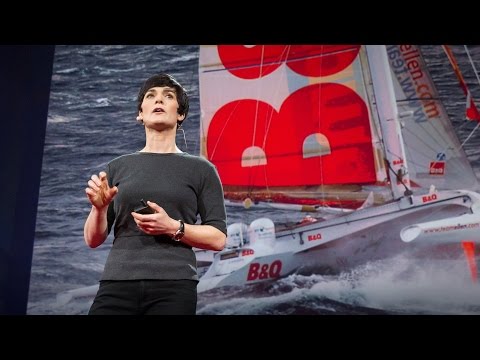
The surprising thing I learned sailing solo around the world | Dame Ellen MacArthur
When Dreams Come True New Section
In this section, the speaker reflects on the sense of possibility and freedom they felt as a child and their determination to sail around the world.
Childhood Dreams
- As a child, anything and everything is possible. The challenge is holding onto that mindset as we grow up.
- At four years old, the speaker had their first sailing experience, which sparked a deep sense of adventure and freedom.
- The speaker made up their mind at that young age to one day sail around the world.
Pursuing the Dream
- The speaker took steps in their life to get closer to their dream, such as saving money from school dinner change and buying a small dinghy.
- They immersed themselves in learning about sailing through books and left school at 17 to pursue an apprenticeship in sailing.
Making the Dream a Reality
- After several years, the speaker found themselves sitting in a boardroom with someone who could make their dream come true. They were granted the opportunity to design a boat for solo nonstop circumnavigation.
- From that initial meeting to crossing the finish line of the race, it was everything they had ever imagined. There were both amazing moments and challenging ones along the way.
Setting New Goals
- After finishing second in a race around the world, the speaker decided to attempt another solo nonstop circumnavigation but this time aiming for speed records. A larger and more powerful boat was needed for this endeavor.
- The speaker affectionately called their new boat "Moby," and it was a multihull. They faced the challenge of surpassing a Frenchman's record-breaking feat.
The Dangers of Solo Sailing
- Sailing in the Southern Ocean presented extreme challenges and dangers. The speaker describes the treacherous conditions, including high winds, massive waves, and isolation from land.
- Despite the risks, the speaker pushed forward, constantly making critical decisions while battling exhaustion and physical strain. There were moments of both despair and awe-inspiring beauty during their journey.
Achieving Highs and Lows
- After enduring hardships, such as being on the brink of capsizing in a storm, there were also moments of triumph when they surpassed records or experienced breathtaking sights in nature.
- The speaker emphasizes that when embarking on such an adventure, everything you take with you is all you have, and your boat becomes your entire world.
No experience in my life could have given me a better understanding of the definition of the word "finite."
The speaker reflects on their experience sailing and how it led them to realize the finite nature of resources in our global economy.
Realization of Finite Resources
- The speaker had a profound realization about the concept of "finite" when they broke a sailing record.
- This understanding extended beyond sailing to the global economy, which is also dependent on finite materials.
- They made a choice to learn more about this issue rather than continue with their dream job of sailing.
Our global economy is no different.
The speaker draws parallels between their personal realization and the state of our global economy.
Dependency on Finite Materials
- The global economy relies entirely on finite materials that exist only once in human history.
- The speaker compares this realization to finding something unexpected under a stone and having two choices: learning more about it or ignoring it.
I put it to one side and I began a new journey of learning.
The speaker describes their decision to explore and understand how the global economy works.
Curiosity and Learning
- Instead of continuing with sailing, the speaker chose to set aside their previous path and embarked on a journey of learning.
- They engaged with experts from various fields to gain insights into economics, science, and other relevant areas.
- This exploration took them to extraordinary places, including visiting a coal-fired power station.
Coal: Fundamental material with personal significance.
The speaker shares their fascination with coal as both an essential material for energy needs and a connection to their family history.
Personal Connection
- Coal holds significance for the speaker as their great-grandfather was a coal miner who spent a significant portion of his life underground.
- The speaker shares a photo of their great-grandfather and reminisces about the stories they heard about mining camaraderie and the care for ponies underground.
Finite materials and the urgency to change.
The speaker highlights the finite nature of valuable materials and the rapid increase in their consumption, leading to price volatility.
Finite Materials
- A scientific study revealed that valuable materials like copper, tin, zinc, and silver are finite resources.
- Despite their limited availability, the speed at which these materials are being used has exponentially increased.
- This rapid consumption has led to price declines in basic commodities being erased within a decade.
The need for change and rethinking our economy.
The speaker reflects on the need for change in our economic system due to its fundamental flaws and unsustainability.
Flaws in the Current System
- The linear economy, where materials are extracted, used, and discarded with minimal recycling efforts, is fundamentally flawed.
- With finite resources available, building an economy that depletes these resources creates waste and is unsustainable.
- The speaker emphasizes that even if individuals change their behavior, it won't solve the problem without addressing systemic flaws.
Transitioning towards a circular economy.
The speaker introduces the concept of a circular economy as a solution for long-term sustainability.
Circular Economy
- Drawing inspiration from natural systems, a circular economy aims to use resources effectively rather than deplete them.
- By designing products with recycling or reuse in mind from the start (cradle-to-cradle design), we can create an economy that works in harmony with finite resources.
- The Ellen MacArthur Foundation was established with this vision in mind.
Exploring alternative models for sustainable economies.
The speaker mentions various models and concepts that influenced their thinking towards a sustainable economy.
Alternative Models
- Industrial symbiosis, performance economy, sharing economy, biomimicry, and cradle-to-cradle design are among the models that informed the speaker's vision for a sustainable economy.
- These models offer different perspectives on how to create an economic system that operates within the limits of finite resources.
The transcript provided does not cover the entire video.
New Section
In this section, the speaker discusses the potential of the circular economy and how it can address resource constraints and rebuild natural capital.
The Potential of the Circular Economy
- The speaker suggests that instead of buying light fittings, we could pay for the service of light, allowing manufacturers to recover materials and change fittings when more efficient products are available. Packaging could be made nontoxic and dissolve in water, eliminating waste.
- Engines could be re-manufacturable, allowing for the recovery of component materials and reducing energy demand. Circuit board components could be reused, with materials recovered through a second stage. Food waste and human waste could be turned into fertilizer, heat, and energy.
- Cars could become a service rather than something we own, providing mobility without needing to own the materials within them.
- These ideas are not just theoretical but are already being implemented in various ways as part of the circular economy.
New Section
This section explores how to shift from a linear economy to a circular one.
Shifting from Linear to Circular
- The speaker proposes collaborating with top universities, leading businesses, major platforms, and governments to work on transitioning to a circular economy.
- Working with analysts, they aim to answer questions such as whether the circular economy can decouple growth from resource constraints or rebuild natural capital. They also explore if it can replace current chemical fertilizer use.
- The answer is yes to decoupling growth from resource constraints and replacing current fertilizer use by 2.7 times.
- The speaker highlights that one inspiring aspect of the circular economy is its ability to engage young people who see new opportunities for creativity and knowledge in rebuilding the entire system.
New Section
This section reflects on what is possible within a lifetime based on past technological advancements.
Possibilities within a Lifetime
- The speaker believes that achieving the circular economy in our lifetimes is possible.
- They draw inspiration from the rapid technological advancements witnessed within their great-grandfather's lifetime, such as the invention of cars, flight, computers, and mobile phones.
- With the internet now available, there are endless possibilities for innovation and progress.
- The speaker emphasizes the importance of having a plan and taking action to accelerate the transition to a circular economy.
New Section
The speaker concludes by expressing gratitude for having a plan to achieve a circular economy.
Having a Plan
- The speaker expresses gratitude for now having a plan to transition to a circular economy.
- They acknowledge that with this plan, anything is possible.
- The speaker concludes by thanking the audience.
Turn any video into a summary like this
YouTube links, meetings, lectures. With transcripts, search, and chat.