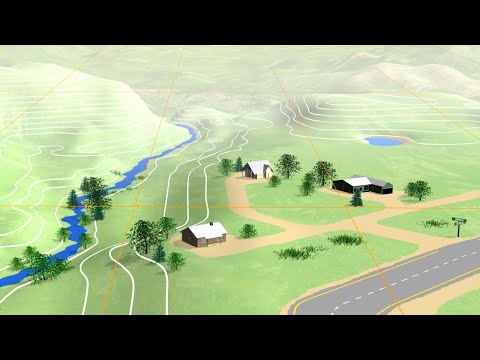
¿Qué son los datums geodésicos?
What is a Datum and Why is it Important?
Understanding the Concept of Datum
- A datum refers to a point, group of points, or standard reference plane used in surveying measurements. It serves as a foundational starting point for various measurements in cartography and land surveying.
- The concept of a datum can be likened to using a known location, such as an intersection or landmark, to guide someone to your home. In surveying, this starting point is typically a fixed leveling point nearby.
Types of Datums
- There are two main types of national datums used in the United States: horizontal and vertical. These datums generally operate independently from one another.
- Horizontal datums measure distances and directions on the Earth's surface, with most defining a zero line at the equator for north-south measurements and another at the Greenwich Meridian for east-west measurements.
- Vertical datums are utilized for measuring elevations and water depths. They often use "mean sea level" as the basic reference plane for elevation changes.
Evolution of Datums
- Due to variations in sea level along coastlines, multiple tide gauge stations were previously used until 1988 when they transitioned to using a single station for defining vertical datum.
- Modern technologies like GPS have revolutionized how we understand datums by providing geometric datums that integrate latitude, longitude, elevation, and time into one cohesive system.
Current Datums Used in North America
- The North American Datum of 1983 (NAD 83) serves as the primary horizontal datum in the U.S., offering information on latitude, longitude, and sometimes elevation.
- The North American Vertical Datum of 1988 (NAVD 88), which provides elevation data based on mean sea level reference surfaces. Different regions may utilize varying vertical datums.
Importance of Consistent Datums
- Historical maps were created using different starting points; thus current modifications aim to enhance accuracy across various datasets.
Turn any video into a summary like this
YouTube links, meetings, lectures. With transcripts, search, and chat.