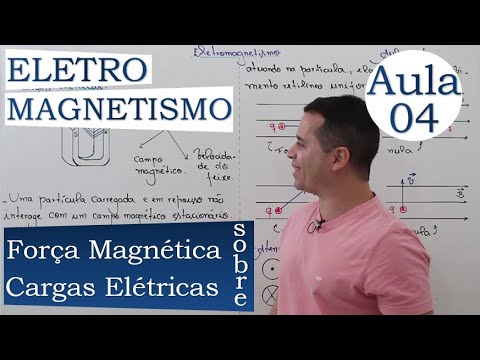
ELETROMAGNETISMO - AULA 04 (FORÇA MAGNÉTICA SOBRE CARGAS ELÉTRICAS)
Understanding Magnetic Force on Electric Charges
Introduction to the Lesson
- The instructor welcomes viewers and introduces the fourth lesson in a series on electromagnetism, encouraging them to start from the first lesson for foundational understanding.
- Today's focus is on magnetic force acting on electric charges, with future lessons planned to cover magnetic forces related to electric currents.
Conceptual Framework of Magnetic Forces
- The lesson emphasizes that this session will be conceptual, laying down basic theories before delving into more complex applications in later classes.
- A visual representation of a U-shaped magnet is introduced, illustrating how an electron beam interacts with it.
Interaction of Electric Charges with Magnetic Fields
- The instructor describes a scenario where an electron beam is directed towards a magnetic field created by the U-shaped magnet.
- As the electrons pass through the magnetic field, they experience deflection due to the influence of the magnetic force.
Understanding Deflection Mechanism
- The deflection direction (upward or downward) of electrons is explained as being influenced by their interaction with the magnetic field between the north and south poles of the magnet.
- This section clarifies that when charged particles move through a uniform magnetic field, they are subject to changes in direction due to magnetic forces.
Key Takeaways about Magnetic Forces
- It’s crucial for students to grasp that moving electric charges interact with magnetic fields, leading to observable effects like deflection.
- The concept of uniform magnetic fields is reiterated; these fields are static and can be represented visually for better understanding.
Summary of Core Concepts
- Students learn that when charged particles traverse a uniform magnetic field, they experience forces that alter their trajectory—this phenomenon is termed "magnetic force."
- Emphasis is placed on recognizing that this force arises specifically because of motion within a magnetic field; stationary charges do not interact with it.
Conclusion and Next Steps
- The instructor encourages students to take notes on these fundamental concepts regarding how electric charges behave in relation to magnetic fields.
Understanding Magnetic Forces and Particle Motion
Introduction to Magnetic Forces
- The speaker discusses the initial confusion regarding magnetic forces, suggesting that something is happening with charged particles in motion.
- Researchers begin experiments by firing particles within a magnetic field, specifically from south to north.
Observations on Particle Behavior
- It is noted that the velocity of the particles remains constant as they traverse the magnetic field, indicating uniform motion without acceleration.
- The absence of acceleration implies no net force acting on the particles, referencing Newton's second law (force equals mass times acceleration).
Interaction with Magnetic Fields
- A key point is made about charged particles at rest not interacting with a uniform magnetic field; this sets a foundation for understanding particle dynamics.
- When moving through a magnetic field, charged particles will be deflected unless they move parallel to the field lines.
Conditions for Deflection
- If a charge moves parallel to the magnetic field, it experiences no deflection; this principle applies regardless of whether the field is horizontal or vertical.
- The speaker emphasizes that if there are no other significant forces acting on a particle (like gravitational force), it will maintain rectilinear uniform motion.
Visualizing Magnetic Fields
- An illustration using diagrams helps clarify how charged particles interact with magnetic fields and reinforces concepts discussed earlier.
- The importance of understanding angles between particle movement and magnetic fields is highlighted; different angles can lead to varying interactions.
Summary of Key Concepts
- The speaker reiterates that when charges are parallel to the magnetic field lines, there’s no interaction or resultant force.
Understanding Gravitational and Electromagnetic Forces
The Nature of Gravitational Force
- The gravitational force is independent of the pilot's characteristics, relying solely on mass. Regardless of color or other attributes, if an object has mass and is near Earth's surface, it will fall when released.
- Objects in a gravitational field experience a force directed towards the center of the Earth. This force acts uniformly regardless of individual preferences or conditions.
Electromagnetic Forces Explained
- Electric forces arise from charged particles creating an electric field around them. When another charge (test charge) enters this field, it experiences either repulsion or attraction based on its relation to the source charge.
- Magnetic forces have unique characteristics; they require moving charges to generate effects. A particle must not be at rest and cannot move parallel to the magnetic field for these forces to manifest.
Visual Representation in Physics
- Symbols are used in physics to represent vectors and directions since drawing arrows directly on paper can be impractical during exams or lectures.
- Creative symbols help convey complex ideas succinctly; for instance, using specific shapes can indicate multiple directional forces without cluttering visual space.
Simplifying Complex Concepts
- In practical scenarios, such as teaching or illustrating concepts, one might wish for visual aids like arrows pointing in various directions but must rely on symbolic representation instead.
- Understanding that certain symbols represent multiple vectors allows students to grasp concepts without needing extensive drawings that may not fit within their notes.
Magnetic Fields Around Earth
Understanding Earth's Magnetic Field and Solar Interactions
The Importance of Earth's Magnetic Field
- Earth's magnetic field protects the planet from cosmic rays, which are highly energized particles. Without this field, many of these particles would directly impact Earth.
- The intensity of the magnetic field varies, being stronger at the equator. This variation plays a crucial role in how solar emissions interact with our atmosphere.
Solar Explosions and Their Effects
- Solar explosions can release massive amounts of energy into space, sometimes directed towards Earth. These events are visually stunning and can be observed through various media platforms.
- When solar winds collide with Earth’s magnetic field, they can lead to interactions that produce beautiful light displays known as auroras.
Auroras: Nature's Light Show
- The interaction between charged particles from solar winds and atmospheric gases (like oxygen and nitrogen) creates auroras—specifically the aurora borealis in the northern hemisphere and aurora australis in the southern hemisphere.
- The term "aurora" was historically noted by Galileo, highlighting its significance in scientific observation.
Classroom Dynamics and Learning Engagement
- The speaker encourages active participation from students during lessons, emphasizing engagement for better understanding.
- Students are prompted to visualize concepts related to charged particles moving within a magnetic field to grasp fundamental physics principles.
Understanding Magnetic Forces
- A scenario is presented involving charged particles moving between two poles of a magnet. It illustrates how movement through a magnetic field generates forces on those particles.
- Only moving charges will interact with a magnetic field; stationary charges do not experience any force due to magnetism.
Key Concepts in Magnetism
- For charged particles to experience a magnetic force, their direction must not be parallel to the lines of induction created by the magnetic field.
- Misconceptions about particle movement relative to magnetic fields are clarified; only non-parallel movements result in observable forces acting on them.
Understanding Magnetic Forces and Motion
Introduction to Magnetic Forces
- The discussion begins with the formation of an angle between a moving object and a magnetic field, emphasizing that the magnetic force is not null in this scenario.
- Clarification on the relationship between velocity and magnetic fields; if the velocity is parallel to the field, it affects the resulting magnetic force.
Symbols and Directions
- Explanation of symbols used in diagrams: a specific symbol indicates movement out of the plane (represented by a dot).
- The velocity vector's direction is discussed, noting that it is neither parallel nor perpendicular to the magnetic field, which influences the resultant force.
Analyzing Force Magnitude
- The speaker emphasizes that if certain conditions are met (like being parallel), then the magnetic force can be considered null; otherwise, it has significant implications.
- A visual representation shows how uniform magnetic fields interact with charged particles moving towards an observer.
Directional Relationships
- Discussion on how both velocity and magnetic fields must be analyzed for their directional relationships to determine forces acting on charged particles.
- Reiteration that when vectors are not aligned (not parallel), there will be a non-null magnetic force acting on them.
Conclusion and Future Learning
- The session concludes with plans for future lessons focusing on calculations involving Newton's laws related to magnetic forces.