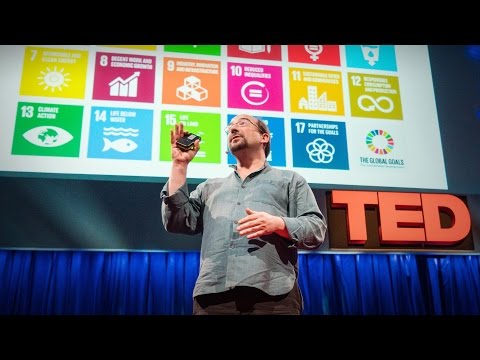
How We Can Make the World a Better Place by 2030 | Michael Green | TED Talks
The World's Future
In this section, the speaker raises questions about the future of the world and whether it will become a better place in the next year or decade. The speaker also mentions the new set of Global Goals agreed upon by world leaders at the UN.
Can We Achieve a Better World?
- The speaker questions if the world will be a better place in the next year or decade.
- The new set of Global Goals for development until 2030 has been agreed upon by world leaders at the UN.
Possibility of Achieving Global Goals
- The speaker presents that according to their analysis, there is a possibility of achieving these goals.
- However, achieving these goals requires moving away from business as usual.
Skepticism and Past Success
- Skepticism arises due to negative news and skepticism towards grand announcements from the UN.
- The Millennium Development Goals set in 2001 were not only achieved but exceeded, showing that progress is possible.
Achieving Success
This section explores how success was achieved in reducing global poverty and discusses economic growth as a key factor.
Reduction of Poverty
- Economic growth played a significant role in reducing poverty, particularly in countries like China and India.
- While global poverty has decreased, there are still many challenges to address. However, pessimists claiming that progress is impossible are proven wrong.
Benchmarking Progress
The speaker introduces the Social Progress Index as a tool to benchmark progress towards the Global Goals.
Complexity of Global Goals
- The Global Goals consist of 17 goals, 169 targets, and hundreds of indicators, making it challenging to measure progress.
- Some goals are specific, while others are more vague in nature.
The Social Progress Index
- The Social Progress Index is a tool that measures various aspects of society related to the Global Goals and provides an aggregate score for benchmarking progress.
- It assesses three fundamental questions about a society's basic needs, building blocks for a better life, and opportunities for improvement.
Diversity in Performance
- Countries exhibit diverse performance on the Social Progress Index, with Norway scoring highest at 88 and the Central African Republic scoring lowest at 31.
- Globally, the average human being lives at a level of social progress similar to Cuba or Kazakhstan (score of 61).
Conclusion
This section highlights the current state of social progress and poses the question of what needs to be achieved to reach the Global Goals.
Current State and Future Goals
- The world's current level of social progress is at 61 out of 100.
- To achieve the Global Goals, progress needs to be made from the current state towards the desired targets.
New Section
In this section, the speaker discusses the target score of 75 out of 100 for human well-being and its alignment with the Global Goals. The Social Progress Index is introduced as a tool to calculate progress without relying on economic indicators.
Target Score and Global Goals
- A score of 75 out of 100 is considered a significant advancement in human well-being and aligns with the Global Goals target.
- The Social Progress Index does not include economic indicators like GDP or economic growth in its model.
Relationship Between Economic Growth and Social Progress
- The absence of economic indicators in the Social Progress Index allows for understanding the relationship between economic growth and social progress.
- A chart is presented to illustrate this relationship, with social progress on the vertical axis and GDP per capita on the horizontal axis.
- As countries become wealthier, social progress tends to improve, but each additional dollar of GDP yields diminishing returns in terms of social progress.
Building a Forecast
- The information about the relationship between GDP and social progress can be used to create a forecast.
- In 2015, global social progress was at a score of 61 with a GDP per capita of $14,000.
- The goal is to reach a score of 75 by 2030 when per capita GDP is projected to be around $23,000.
Impact of Economic Growth on Social Progress
- Economists at Deloitte estimate that if average global wealth increases from $14,000 to $23,000 per year by 2030, social progress will only increase from 61 to 62.4.
- This suggests that economic growth alone may not significantly contribute to achieving the Global Goals.
Factors Influencing Social Progress
- The speaker suggests two factors that may explain the limited impact of economic growth on social progress.
- Firstly, easy wins from economic growth have already been achieved, and now society is facing more complex challenges.
- Secondly, economic growth comes with costs such as environmental issues and health problems like obesity.
GDP is Not Destiny
- The regression line between GDP and social progress represents the average relationship but there is considerable variation around this trend line.
- Some countries underperform in terms of social progress relative to their wealth, while others overperform.
- Examples are given of countries with high social progress despite modest GDP (e.g., Costa Rica) and countries with significant wealth but social problems (e.g., Russia).
Solutions Beyond GDP
- The existence of countries achieving high levels of social progress despite lower GDP demonstrates that solutions to many Global Goals already exist in the world.
- This highlights that societies are not solely dependent on GDP for progress.
New Section
...
Can we achieve the Global Goals?
The speaker discusses the possibility of achieving the Global Goals by analyzing different scenarios and factors that contribute to social progress.
Scenarios for Achieving the Global Goals
- If underperforming countries improve their social progress, it would raise the global score to 65.
- If every country improves at turning wealth into well-being, the score would increase to 67.
- If all countries prioritize human well-being like Costa Rica, the score would reach nearly 73.
Challenges in Achieving the Global Goals
- Economic growth alone is not sufficient to achieve the Global Goals.
- Social progress needs to be prioritized and scalable solutions implemented worldwide.
Holding Leaders Accountable
- The world's leaders have promised to deliver on the Global Goals.
- Holding leaders accountable requires tracking progress over the next 15 years.
- The People's Report Card provides a framework for accountability, grading performance on a scale from F to A.
Demanding Change
- Achieving the Global Goals requires doing things differently and demanding change from our leaders.
- Rejecting business as usual and choosing a different path is necessary.
Using the People's Report Card for Action
The speaker explains how private citizens can use the People's Report Card as a tool to create pressure for action towards achieving the Global Goals.
Universal Application of Global Goals
- Unlike previous Millennium Development Goals, which focused on poor countries, the new Global Goals apply universally to every country.
Creating Pressure for Action
- The People's Report Card will be produced for every country in 2016.
- Private citizens can use the report card to hold their leaders accountable and create pressure for action.
- Demanding change from leaders is essential to achieving the Global Goals.
Conclusion
The speaker emphasizes the need for a different approach to achieve the Global Goals, holding leaders accountable, and demanding change. The People's Report Card serves as a tool for tracking progress and creating pressure for action towards fulfilling the promise of the Global Goals.
Turn any video into a summary like this
YouTube links, meetings, lectures. With transcripts, search, and chat.