High Yield Neurology Review for Step 2 CK & Shelf Exam
Stroke Overview
This section provides an overview of stroke, its types, and risk factors.
Types of Stroke
- There are three types of stroke: ischemic, hemorrhagic, and TIA.
- TIAs are strokes that last for less than 24 hours and are reversible.
- A key sign for TIAs is amaurosis fugax which causes transient blindness.
- The most common place to find a stroke is the MCA.
Risk Factors
- The two greatest risk factors for stroke are age and hypertension.
- These risk factors should be remembered as they are commonly asked in exams.
Diagnosis
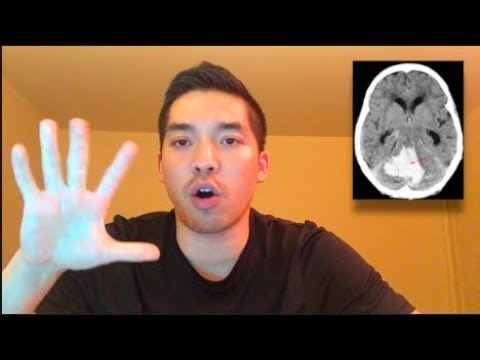
- The first step in diagnosing a stroke is to do a head CT without contrast to rule out hemorrhage.
- 85% of strokes are ischemic while the other 15% are hemorrhagic strokes.
- If it's along the middle then that's the ACA if it's along the sides then that's the MCAS.
Treatment
- The main treatment for an ischemic stroke is TPA which dissolves clots but also increases bleeding risks.
- Hemorrhagic strokes usually happen from ruptured berry aneurysm and arterial venous malformation.
Homunculus and Language Areas
This section covers homunculus, language areas of the brain, and their relation to strokes.
Homunculus
- The middle parts of the brain along the sagittal suture control lower extremities while the outer parts control upper extremities.
- The main arteries that supply this should be known as they are commonly asked in exams.
Language Areas
- The left MCA supplies language areas of the brain such as Broca's area and Wernicke's area.
- Broca's area is located in the left inferior frontal lobe while Wernicke's area is in the temporal lobe.
- A classic left MCA stroke will present as some sort of language deficit.
Subarachnoid Hemorrhage
This section covers subarachnoid hemorrhage, its symptoms, and treatment.
Symptoms
- Subarachnoid hemorrhage will be classically the worst headache of someone's life.
- Symptoms include papilledema, nausea, projectile vomiting, and increased ICP.
Diagnosis and Treatment
- If subarachnoid hemorrhage is unclear on CT then lumbar puncture should be done to show red blood cells.
- Surgical clipping is used to treat subarachnoid hemorrhages caused by berry aneurysms.
Stroke and Intracranial Pressure
In this section, the speaker discusses the factors that predispose to a thrombus and lead to an embolus. They also explain how an EKG can help diagnose atrial fibrillation, which increases the risk of developing a thrombus. The speaker then goes on to discuss lacunar stroke, its causes, and symptoms. Finally, they talk about how to lower intracranial pressure and treat strokes.
Factors Predisposing to Thrombus Formation
- Stasis in areas inside heart chambers promotes hypercoagulable states.
- Virchow's triad of hypercoagulability includes endothelial damage, stasis, and hypercoagulable state.
- EKG can diagnose atrial fibrillation where the atrium is not contracting well leading to thrombus formation.
Lacunar Stroke
- Hypertension causes arteriolosclerosis leading to narrowing of arteries and poor perfusion in deep parts of the brain.
- Over time, lagoons form in distal parts of untick yellow striate arteries causing lacunar stroke.
- Pure motor stroke or pure sensory stroke are two types of lacunar strokes based on infarction location.
Lowering Intracranial Pressure
- Signs of increased intracranial pressure include papilledema, projectile vomiting, headache, nausea.
- Three treatments for lowering ICP are hyperventilation - mannitol - raising head of bed.
Treatment for Stroke
- TPA is given if it's within three hours after onset.
- Aspirin is given if it's outside three-hour window for ischemic stroke treatment.
- Carotid endarterectomy is done if carotid stenosis is greater than 70% occlusion with symptoms like syncope or TIA.
Neurological Disorders Overview
In this section, the speaker provides an overview of various neurological disorders and their diagnosis and treatment.
Tourette's Syndrome
- Tourette's is diagnosed by observing motor and phonetic tics for at least one year.
- Clonidine is used to treat Tourette's.
Familial Intention Tremor (Central Tremor)
- Central tremor worsens with movement and improves at rest.
- It usually has a family history.
- Symptoms improve with alcohol consumption.
- Beta-blockers are used to treat central tremors.
Friedreich's Ataxia
- Friedreich's Ataxia presents as a triad of scoliosis, nystagmus, and dorsal column problems.
- It is caused by GAA trinucleotide repeat disorder.
Hypertrophic Obstructive Cardiomyopathy (HOCM)
- HOCM causes interventricular septum thickening which can lead to sudden cardiac death in young people who play sports due to poor perfusion to the brain.
Delirium
- Delirium usually occurs in elderly patients due to infection or polypharmacy.
- Benzodiazepines and anti-muscarinic medications like Benadryl are notorious for causing delirium.
- Delirium is characterized by waxing and waning consciousness and sundowning.
- Haloperidol is the first-line treatment for agitated delirium.
Multiple Sclerosis
- Multiple sclerosis is an autoimmune condition that affects upper motor neurons.
- It spreads through space and time, affecting any upper motor neuron throughout the body.
- Symptoms come and go, making diagnosis difficult.
- MRI can be used to diagnose periventricular plaques, while a lumbar puncture will show oligoclonal bands specific to multiple sclerosis.
- Interferon is used as a disease-modifying treatment, while steroids are used for acute flares.
Guillain-Barre Syndrome (GBS)
- GBS is a peripheral nervous system autoimmune disease that causes ascending paralysis.
- Weakness is more common than sensory loss in GBS patients.
- IVIG and plasmapheresis are used to treat GBS.
Myasthenia Gravis
- Myasthenia gravis occurs when antibodies attack the neuromuscular junction, causing ptosis, head weakness, swallowing problems, and muscle weakness that worsens throughout the day.
- Reflexes will be normal in myasthenia gravis patients.
The speaker provides an overview of various neurological disorders such as Tourette's syndrome, familial intention tremor, Friedreich's ataxia, hypertrophic obstructive cardiomyopathy, delirium, multiple sclerosis, Guillain-Barre syndrome and myasthenia gravis. The speaker explains the diagnosis and treatment of each disorder.
Neurological Disorders
In this section, the speaker discusses various neurological disorders and their associated symptoms.
Myasthenia Gravis
- Myasthenia gravis is often associated with something called the fine moma which produces those autoimmune antibodies.
- A CT of the thorax should be done to diagnose it.
- If you find a thymoma, it might even show up on a CT scan where if you look around at the thymus so just posterior to the sternum.
Duchene and Bakula Muscular Dystrophy
- The kid who shows the Gower signs which is where they can't get up on their own but still have to push off with their hands and then use their hands to push themselves off their lip off their legs like they're gonna be climbing up their legs with their arms to help extend their back in Dushane this happens at like age 5 whereas Becker is more like 18 to 20 year olds.
- It's x-linked recessive and remember this is where you have the dystrophin missing dystrophin.
Tuberous Sclerosis
- Ashley Ashley sports sherry attaches heart rhabdomyosarcoma z' um L I can't remember epilepsy angio myeloma of the kidneys and facial fibromas.
Sturge-weber Syndrome
- Once you have ort Weinstein's on the face with retardation, this is sturge-weber.
Von Hippel-Lindau Disease
- The triad of renal cell carcinoma pheochromocytoma and cavernous hemangiomas of the brain.
Arnold-Chiari Formation
- The triad of myelomeningocele syrinx and on Tolu herniation.
- Loss of pain and temperature along the arms bilaterally, the Cape like distribution that's a searing sand it usually happens in the cervical region of the spinal cord.
Brown Sicard
- Usually caused by a stab wound that hits the side of the spinal cord so like you just get transection of one half of the spinal cord sort.
- Understanding how the three big tracts of the spinal cord work is key here.
Tracts in Spinal Cord
- Corticospinal tract controls motor control of your body.
- Dorsal column tract senses pressure proprioception vibration and touch.
- Spinal ceramic which will come feed into the spinal cord through the posterior horns it'll synapse once and then it'll cross at that level see how the other ones they cross higher-ups this one will cross in the spine wherever it comes in it'll come up through contralateral side.
Polio
- Damage to anterior horn cells that's where remember cortical spinal tract synapses this will actually only affect nuclei of lower motor neuron and beyond.
Neurological Disorders
This section covers various neurological disorders and their symptoms.
Lou Gehrig's Disease, BPPV, Meniere's Disease, Acute Labyrinthitis
- Lou Gehrig's disease is a combination of upper and lower motor neuron deficits.
- Benign paroxysmal positional vertigo (BPPV) causes a spinning sensation when moving the head suddenly. It can be treated with meclizine.
- Meniere's disease presents with tinnitus, vertigo, and hearing loss due to pressure problems in the ear.
- Acute labyrinthitis may occur after a viral infection and cause hearing loss.
Syncope
- Syncope can be caused by basal vagal syncope, orthostatic hypotension, arrhythmia, seizures or obstruction.
- Arrhythmia-induced syncope occurs suddenly in older people who faint out of nowhere. They will not have a postictal state.
- Seizure-induced syncope patients wake up confused with urinary incontinence tongue biting and convulsions.
- Vasovagal syncope is the most common cause and is caused by increased blood pressure that will profuse your carotid sinuses but for some reasons in baselessness repeats this reflex doesn't work well. Emotional stressor causes tachycardia followed by bradycardia and hypotension.
- Orthostatic hypotension occurs when venous return is slow due to volume depletion causing fainting.
- Aortic stenosis causes syncope with exertion.
Seizures
- The key to differentiating between complex partial seizures and absence seizures is the postictal state.
- Absence seizures are characterized by lip-smacking and staring out into space without confusion.
- Lewy body dementia can be confused with Alzheimer's, but hallucinations occur before memory loss in Lewy body dementia.
Parkinson's Disease
- Parkinson's disease is characterized by a slow shuffling gait, pill rolling tremor, and dull-like faces.
Tic Douloureux and Tabes Dorsalis
In this section, the speaker discusses two medical conditions: Tic Douloureux (also known as Trigeminal Neuralgia) and Tabes Dorsalis.
Tic Douloureux
- Tic Douloureux is a condition where patients feel intense pain in their face while performing everyday activities such as brushing their teeth or chewing.
- The pain is caused by electricity killing mostly times these three dermatome.
- It can also be triggered by wind.
- Treatment for Tic Douloureux involves using carbamazepine, which is a sodium channel blocker.
Tabes Dorsalis
- Tabes dorsalis is a condition that results from damage to the dorsal columns of the spinal cord.
- This damage affects pressure-cook reception vibrations touch and is usually secondary to syphilis, specifically tertiary syphilis.
- Symptoms include dorsal column saw problems as well as corticospinal tract problems leading to upper motor neuron injuries.
- Treatment for Tabes dorsalis involves using penicillin.
Subacute Combined Degeneration
In this section, the speaker discusses subacute combined degeneration, which is a condition that results from B12 deficiency.
- Subacute combined degeneration leads to macrocytic anemia with neutrophils having extra lobes.
- Patients with this condition will have dorsal column saw problems as well as corticospinal tract problems leading to upper motor neuron injuries.
- Treatment for subacute combined degeneration involves using B12 supplements.
That concludes the chapter.