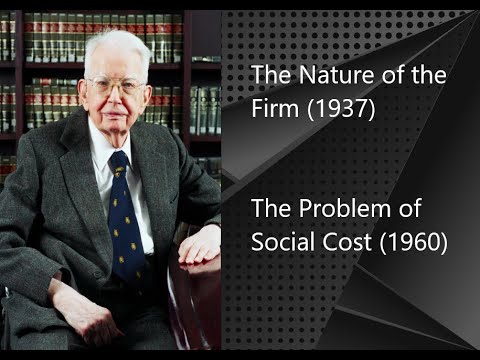
Los aportes de Ronald Coase. Parte 1
Introduction to the Class
Overview of Today's Class Objectives
- The class aims to review contributions and main ideas from two significant papers by economist Ronald Coase, a Nobel Prize winner in 1991.
- Coase studied at the London School of Economics and later taught at prestigious institutions like the University of Chicago, where he made substantial contributions to economics.
Key Contributions of Ronald Coase
- Coase's work focuses on transaction costs, the emergence of firms, law and economics, and externalities. His prolific writing continued until late in his life.
- The discussion will center around two influential papers: one from 1937 titled "The Nature of the Firm" and another from 1960. These are among his most cited works.
The Nature of Firms
Historical Context and Economic Theory
- "The Nature of Firms," written before World War II, shares insights with Hayek regarding economic systems as organisms coordinated through price mechanisms.
- The existence of a price system allows for rational economic decisions by providing knowledge about costs and returns on production. This leads to effective economic calculations.
Dispersed Knowledge and Market Coordination
- The concept of dispersed knowledge refers to individual knowledge that is time-specific and place-specific; this is crucial for market coordination via prices.
- Firms emerge as entities that plan within markets, acting as islands of conscious power that operate under different organizational criteria than those dictated by market prices.
Firms vs Independent Contractors
Mechanisms for Resource Allocation
- Firms arise voluntarily when agents establish contracts; they seek optimal planning within an economy using hierarchical authority rather than solely relying on market prices for resource allocation.
- A comparison is drawn between firms and independent contractors operating under perfect competition—where each worker would be self-employed without dependency relationships—highlighting why firms are necessary despite potential high transaction costs associated with hiring specific jobs repeatedly.
Transaction Costs in Economic Operations
- Transaction costs include discovering relevant prices and negotiating contracts for specific tasks; these can become prohibitively high if every job requires a new contract with different individuals. Thus, firms provide a solution to reduce these costs through internal organization structures instead of constant external contracting processes.
Understanding Firm Growth and Transaction Costs
The Role of Employment Contracts in Reducing Red Tape
- Firms aim to simplify operations by replacing multiple contracts with a single employment relationship contract, reducing information search costs.
- Workers, viewed as production factors, agree to follow directives for remuneration, leading to the formation of firms that incorporate market transactions into administrative management.
Limits on Firm Growth
- Firms face bureaucratic and administrative costs that limit their growth; larger firms may struggle with resource allocation due to increased organizational complexity.
- As firms grow, they encounter higher administrative rigidity and costs associated with managing diverse activities.
Marginal Costs and Organizational Efficiency
- A firm will expand until the marginal cost of internal transactions equals the marginal cost of conducting those transactions in the market.
- This balance indicates the efficiency threshold for a firm's growth; beyond this point, it becomes more efficient to outsource rather than manage internally.
Organizational Costs vs. Market Transactions
- Increasing organizational costs can lead to inefficiencies as firms grow; activities may become less productive when managed within a large organization.
- Department heads may prefer autonomy over being part of a larger entity due to incentives tied to personal performance versus collective output.
Implications for Economic Theory
- Traditional economic theories fail to explain why firms exist or their limits; they often treat firms as black boxes without addressing underlying transaction costs.
- Understanding firm behavior requires examining how marginal revenue relates to marginal cost across different market structures like monopolies.
The Impact of Administrative Improvements on Firm Size
- Firms with decreasing marginal costs tend toward monopoly status but must consider organizational efficiencies when expanding into new areas.
- Enhancements in communication and administrative methods can lead to larger firms by reducing operational inefficiencies.
Case Study: Outsourcing Services
- Improvements in market transaction efficiency can lead companies to downsize by outsourcing services previously handled internally (e.g., cleaning services).
- The shift from hiring full-time employees for specific tasks (like cleaning) towards contracting specialized service providers illustrates changing dynamics in transaction costs.
Social Costs in Chicago: A 1960 Perspective
Overview of Social Costs
- The discussion transitions to a significant time jump, moving forward 23 years to the year 1960.
- It is noted that Chicago was already facing challenges related to social costs, indicating a lag behind other regions in the U.S.
- The concept of social costs is introduced as a critical issue during this period, highlighting its relevance and impact on society.
- This segment references a widely cited text regarding social costs, suggesting its importance in academic and policy discussions.