Connaître les objets IOT (partie 1) #05
Introduction to the Internet of Things (IoT)
Overview of IoT Evolution and Applications
- The course has previously covered the evolution of the Internet towards the Internet of Things (IoT), including its historical context.
- Key application domains discussed include Smart Cities, Smart Transportation, Health Care, Home Automation, and Agriculture with smart objects.
- Definitions of key concepts were explored, particularly focusing on IoT definitions and related terms such as M2M (Machine to Machine) communication.
Components of a Connected Object
Structure and Functionality
- Today's focus is on connected objects within IoT; understanding their composition and functionality is essential.
- A complete system for a connected object generally integrates four remote components: sensors, connectivity, information processing, and an interface for interaction.
Architecture in IoT Systems
Basic Elements
- In an IoT architecture, the physical object serves as the foundational layer from which all other functionalities are built.
- The connected object includes communication channels, software for data processing, operational management components, and data handling capabilities.
Detailed Breakdown of Connected Objects
Key Components Explained
- An IoT device typically consists of a Power Unit that manages battery life and energy consumption during different operational modes (active vs sleep mode).
- Processing units like CPUs or MCUs handle data captured by sensors; this processing unit is analogous to a computer's CPU but miniaturized for embedded systems.
Memory and Connectivity in IoT Devices
Essential Features
- Volatile memory is allocated for both sensors and actuators within an IoT device to facilitate real-time operations.
- Connectivity features include various network protocols such as Wi-Fi, Zigbee, RFID, LTE etc., crucial for enabling communication between devices.
Example: Smart Lamp as a Connected Object
Functional Analysis
- A smart lamp serves as an example; it operates through networks like Wi-Fi or Bluetooth to become part of the IoT ecosystem.
- The housing refers to the physical structure enclosing electronic components like microcontrollers (e.g., Raspberry Pi or Arduino).
Sensors and Actuators in Action
Interaction Mechanism
- Sensors capture environmental data (e.g., motion detection), while actuators respond based on this input—transforming signals into actions like lighting LEDs based on temperature thresholds set by microcontrollers.
- For instance, if temperature exceeds 20°C, specific LED indicators will light up according to predefined conditions managed by the microcontroller's logic.
Understanding Microcontroller and Sensor Integration
Overview of Microcontroller Components
- The microcontroller consists of an electrical board for data preprocessing and a communication transmission device, which will be discussed in detail later.
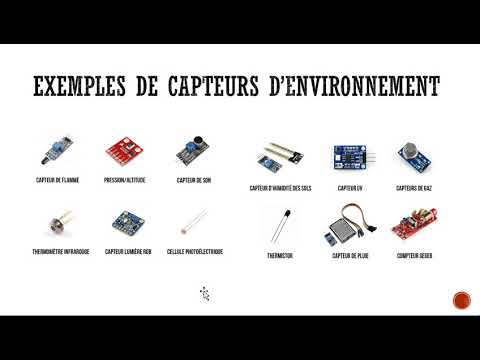
- Various types of sensors are introduced, including environmental sensors that capture different aspects of the surroundings.
Types of Sensors
Environmental Sensors
- Sound sensors and pressure/altitude sensors are commonly used in barometers and aircraft to measure altitude or underwater conditions.
- Infrared thermometers and RGB light sensors detect temperature variations and color compositions (red, green, blue), essential for image processing.
Specialized Sensors
- Photovoltaic cells harness solar energy; soil moisture sensors aid in risk management, farming solutions, and smart irrigation systems.
- Gas sensors are prevalent in kitchens for gas leak detection; rain sensors help monitor weather conditions.
Multi-functional Sensor Applications
- Different parameters such as sound, altitude, pressure, smoke, and temperature can be measured simultaneously using various sensor types within a single object.
Motion Sensors
- Motion sensors like smartwatches track physical activity; flexion sensors are utilized in vehicles. Other motion-related devices include piezoelectric angle detectors and obstacle detectors used in robotics.
Advanced Detection Technologies
Ultrasonic & Seismic Sensors
- Ultrasonic sensors detect movements through sound waves; seismic sensors capture minor vibrations to assess movement intensity or direction.
Thermal Imaging & Biometric Sensors
- Thermal cameras detect movement based on heat signatures; biometric readers include fingerprint scanners and iris recognition systems used primarily in healthcare monitoring.
Functionality of IoT Devices
Example: Smoke Detector System
- A smoke detector system includes a temperature sensor that measures heat levels. This data is transmitted to a control center for analysis.
Control Mechanism
- The control center processes the information to determine if an alarm should trigger the sprinkler system to extinguish flames. This illustrates how IoT devices integrate sensing capabilities with actuators for responsive actions.
IoT Architecture and Sensor Functionality
Overview of IoT Data Processing
- The discussion begins with the distinction between local data handling and cloud processing in IoT architecture, emphasizing that initial stages involve only the object itself without internet connectivity.
- An example is provided regarding forest fire detection, where sensors continuously monitor environmental factors like temperature and CO2 levels, relaying risk assessments to a central system for user alerts.
Sensor Types and Their Functions
- The speaker introduces "dust sensors," miniature devices that measure environmental data and transmit it to processing centers using routing protocols.
- Focus is placed on the basic components of an IoT device: sensors, actuators (if applicable), and information processing units that determine whether to send data based on specific conditions.
Energy Management in IoT Devices
- The importance of energy management within IoT devices is highlighted, noting that while some components are represented in examples, power management units are often overlooked.
Understanding Sensors vs. Actuators
- A clear differentiation is made between sensors (transducers converting physical energy into electrical signals) and actuators (which convert digital instructions back into physical actions).
- Sensors detect various forms of energy such as temperature or light, converting them into digital information (binary format), while actuators perform the opposite function by generating physical responses based on received instructions.
Practical Examples of Transducer Functionality
- The role of transducers is further elaborated; sensors convert environmental data into numerical formats while actuators respond to these inputs by producing physical outputs like light or vibrations.
- Real-world applications are discussed, such as smartphones vibrating upon receiving calls—showcasing how digital signals translate into tangible actions through actuators.
Microcontroller's Role in IoT Systems
- The microcontroller acts as the brain of an IoT device, managing data conversion from physical to electrical forms and ensuring connectivity with networks. Its functionality varies significantly depending on the size and type of object being monitored or controlled.
Data Processing in Sensor Networks
Local vs. Remote Data Analysis
- Information detected by sensors is sent to a processing and control center, which can be very small, such as a microcontroller.
- The analysis of data can occur locally on the object itself or remotely, integrating information from multiple sensors for broader system analysis.
- Local processing involves immediate data handling on the device (e.g., a lamp), while remote processing requires sending data to larger centers for further analysis.
- For remote data transmission, a microcontroller is essential on the object to facilitate communication and ensure effective data transfer.
- Understanding the distinction between local and remote processing is crucial for designing efficient sensor networks and systems.