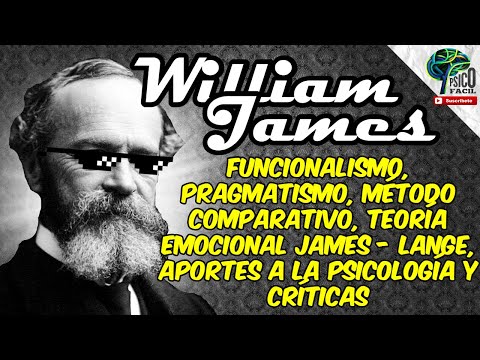
WILLIAM JAMES | FUNCIONALISMO (PSICOLOGÍA) Y PRAGMATISMO |TEORÍA RESUMIDA FÁCIL FT. @infomaniaco6181
Introduction to William James and Functionalism
Overview of William James
- William James is introduced as a multifaceted individual: writer, physician, polyglot, philosopher, psychologist, professor, and father. He achieved this despite suffering from neurosthenia and comorbid depression.
- Recognized as the "father of modern psychology," he contributed significantly to functionalism, pragmatism in philosophy, religious psychology, and cognitive approaches.
Personal Background
- James comes from an intellectual family; his brother was a renowned novelist and his sister a notable diarist.
The Evolutionary Perspective of Psychology
Influences on James' Theory
- His theory is rooted in evolutionary perspectives influenced by Darwin's writings. A transformative expedition with Louis Agassiz in Brazil shaped his views on psychological conditions.
Adaptive Functions of the Mind
- James posits that cognitive abilities like consciousness and creativity exist for survival purposes. These functions help humans find food, avoid danger, and care for offspring.
Functionalism vs. Structuralism
Key Concepts of Functionalism
- Focuses on studying mental functions rather than structures. Emphasizes understanding how mental processes aid survival over dissecting their components.
Critique of Structuralism
- Compares human consciousness to a flowing river; isolating elements (like structuralists do with water molecules) loses the essence of its function in life adaptation.
Methodology in Psychological Research
Multi-Level Analysis Approach
- Advocates for multiple levels of analysis in studying the mind—rejecting absolutist views that limit understanding to single perspectives.
Research Methods
- Suggests using diverse methodologies such as observation, introspection, experimentation, and comparative methods involving animals or pathological cases.
Contributions to Psychophysiology
Laboratory Work
- Although not primarily focused on psychological experiments, he conducted physiological demonstrations related to perception at Harvard before establishing a formal psychology lab.
Theory of Emotion
Understanding Emotions and Physiological Responses
Theoretical Foundations of Emotion
- Common sense suggests that stimuli evoke fear, leading to a physiological response such as running. However, the theory posits that we run first and then experience the emotion, indicating emotions arise from bodily changes.
- The physiological activation is triggered by visual stimuli directed to the thalamus, which relays information to the limbic system, resulting in organic reactions via the hypothalamus and autonomic nervous system.
- These bodily reactions prepare us for action (e.g., running), increasing heart rate. Conscious emotional experiences are generated when these responses reach the cerebral cortex.
Critiques of Early Theories
- This theory was significant as it linked emotions not just to psychological states but also to physical conditions. However, it faced critiques from notable figures like Cannon.
- One critique highlighted that animals with severed nerves still exhibited normal emotional responses, suggesting a disconnect between physiological reactions and emotional experiences.
- Another point raised was that physiological responses accompanying different emotions are often too similar (e.g., fear and anger), complicating differentiation between them.
Alternative Perspectives on Emotion
- Cannon's alternative theory proposed simultaneous processing of sensory information in both the cerebral cortex (emotional experience) and limbic system (bodily reactions), suggesting independence yet interrelation of physical and cognitive experiences.
- Following these critiques, researchers like Carol Izard defended earlier theories through experimental hypotheses about facial feedback influencing emotional states.
Facial Feedback Hypothesis
- An experiment demonstrating facial feedback shows that smiling can enhance feelings of happiness; this supports the idea that part of our emotional experience derives from facial muscle activity.
- While smiling may not cure depression, it indicates a potential for mood modulation through expression. A meta-analysis confirmed significant effects of facial feedback on emotional states.
Cognitive Interpretation in Emotional Experience
- Current understanding integrates cognitive interpretation into emotion processing: interpreting environmental stimuli followed by internal bodily signals due to autonomic activation.
- This model emphasizes a feedback loop where cognitive appraisal complements physical sensations in forming complete emotional experiences.
Pragmatism in Psychology
- The discussion touches on pragmatism's role in psychology—valuing practical utility over abstract ideas—and how this perspective influences psychological research methodologies.
- Pragmatism evaluates concepts based on their social functionality or real-world applicability rather than purely theoretical merit.
The Impact of the Scientific Method in Psychology
Overview of Psychological Principles
- The discussion highlights the importance of the scientific method in psychology, emphasizing evidence-based studies.
- A significant work mentioned is "Principles of Psychology," which served as a comprehensive guide for students and included various psychological theories and findings.
- The author later published a condensed version titled "Psychology: A Brief Course," which became widely used in educational settings, often referred to as "the James" or "the gym."
Key Contributions to Psychology
- Four main points summarize the author's contributions:
- Psychological processes have real-world consequences influenced by individual responses to situations.
- These processes serve important adaptive functions.
- Emphasis on applied scientific psychology is crucial.
- Various methodological approaches in research are acknowledged.
Legacy and Influence
- The speaker expresses gratitude for the author's foundational role in evidence-based psychology and highlights the connection between physical brain aspects and psychological phenomena.
- It is noted that functionalism did not disappear but rather integrated into behaviorism, with Watson claiming behaviorism was a consistent form of functionalism.
Conclusion and Next Steps
- The video concludes with an introduction to future content about James's life and work, inviting viewers to explore more through related channels.
Turn any video into a summary like this
YouTube links, meetings, lectures — with transcripts, search, and chat.