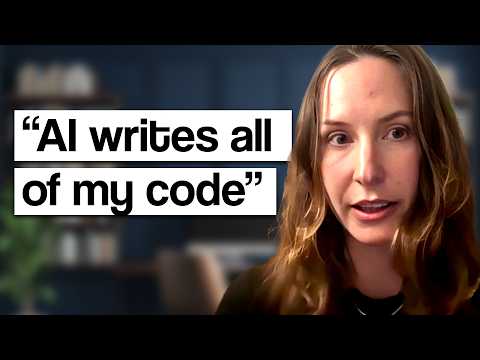
She Makes 6-Figures Per Project With AI | Founder Interview
Head Start: Building an AI-Driven Business
Introduction to Nicole and Head Start
- Nicole, founder and CEO of Head Start, discusses her ability to deliver fully functional applications from scratch in just four weeks.
- She emphasizes the value of tackling hard problems as a proprietary business advantage.
- Nicole shares insights on how she utilizes Claude projects to manage her entire business operations.
The Genesis of Head Start
- Nicole started her agency shortly after the launch of ChatGPT in November 2022, having left her job in October.
- Early access to OpenAI models allowed her to use GPT-3 for coding before it became widely known.
- Despite skepticism about GPT-3.5's coding capabilities, she successfully used it for Ruby on Rails projects.
Evolution of Services Offered
- With the launch of GPT-4 in April 2023, significant advancements were made in AI technology that impacted her business model.
- Initially focused on consulting and coding services, the integration of AI became a natural progression as client demands evolved.
Client Needs and Project Types
- Clients often sought chatbots and RAG (retrieval augmented generation) implementations; however, needs have shifted over time.
- Many clients approach Head Start after unsuccessful attempts at implementing AI solutions themselves.
Proprietary Data Structures
- Nicole highlights the importance of transforming unstructured data into structured formats through document processing and web scraping.
- She believes proprietary data structures hold immense value alongside proprietary data itself due to their role in software product development.
Understanding Data Structuring
- The advent of large language models (LLMs) has changed how data is processed and generated, making structuring increasingly valuable.
Understanding Data Integration and Company Growth
The Importance of Data Mapping
- Discusses the significance of mapping common data structures across multiple integrations, which facilitates easier data management and transfer.
- Emphasizes that the normalization process is crucial for leveraging data effectively, making it as important as the data itself.
Head Start's Evolution
- Describes the initial phase of Head Start, where it was just one person (the speaker) for a year and a half, relying on inbound referrals to find clients.
- Highlights the flexibility in project selection due to expertise in AI, allowing for a broad range of projects without technology restrictions.
Scaling with AI
- Explains how AI enabled scaling without hiring additional staff initially since it handled coding tasks, allowing focus on multiple projects simultaneously.
- Acknowledges that while they have now hired employees, their growth strategy remains heavily influenced by AI capabilities.
Unique Advantages and Skills
- Questions about unique advantages beyond AI coding; emphasizes that communication and hard work are critical components of success.
- Clarifies that while AI coding is powerful, effective communication and understanding client needs are essential for delivering successful outcomes.
Product Development Focus
- Stresses the importance of product development as a key aspect of their service; they act as thought partners rather than mere implementers.
- Mentions architecting solutions for scalability as another vital component facilitated by AI's ability to handle coding tasks efficiently.
Team Structure and Skill Sets
- Confirms current team size at three members: a co-founder (the speaker’s brother), an engineer, and another engineer joining soon.
Hiring Trends in Engineering
Importance of Communication Skills
- The hiring focus has shifted towards candidates with strong written and verbal communication skills, essential for effectively utilizing AI in engineering tasks.
- Engineers are expected to understand code quality but may not necessarily need to write it themselves.
Client Engagement and Project Management
- Typical client engagements last from two weeks to two months, often starting with a pilot project that leads to further collaboration based on user testing results.
- Revenue is not contractually recurring but becomes reoccurring due to positive client experiences leading them to seek additional projects.
Scaling the Team
- The company is currently managing client communications while engineers focus on product development and internal tools, aiming for scalability.
- Average client engagement lasts about four to six weeks, emphasizing quick delivery which justifies premium pricing.
Growth and Hiring Plans
Business Expansion
- The business is bootstrapped and has successfully hired a team of highly paid engineers based in New York.
- Plans include hiring five more engineers by January and another five by May, expanding from three current employees to fourteen within seven months.
Defining Hiring Profiles
- There’s an ongoing effort to define the ideal hiring profile for new graduates with computer science backgrounds who can be trained in specific coding practices.
Client Communication Strategies
Technical vs. Non-Technical Language
- Communication style varies between technical discussions with clients versus engineers; clarity is prioritized while maintaining technical depth.
- Engaged clients appreciate detailed explanations about technology, fostering a better understanding of its applications.
Contractual Insights
Minimum Contract Values
- The minimum contract value fluctuates; however, mid-six figures are charged for short-term contracts reflecting high demand.
Project Efficiency
- Initial flat fees started at $10K but have increased due to demand; efficiency allows rapid project completion—entire applications can be built within four weeks.
Institutional Knowledge Development
Learning from Projects
Understanding the Use of LLMs in Project Management
The Importance of Input Quality
- The quality of input data significantly affects the output from language models (LLMs). Good inputs lead to better outputs, emphasizing the need for high-quality information.
Utilizing Internal Wikis for Knowledge Management
- An internal Wiki is created to document processes and conventions. This serves as a reference for future projects, allowing teams to refine their methods over time.
Contextualizing Projects with Markdown Files
- Each project utilizes markdown files that contain relevant context and instructions. These files are essential for guiding LLM responses during project execution.
Preference for Claude Over Cursor
- The speaker expresses a strong preference for Claude projects due to their explicit containment of context, which enhances clarity in prompts compared to other tools like Cursor.
Handling Large Codebases Efficiently
- When working with large codebases, engineers focus on specific files rather than reviewing everything. Relevant files are included in cloud projects to streamline coding tasks and improve efficiency.
Collaboration and Security Features in Cloud Projects
- Cloud projects allow team sharing while ensuring enterprise-level security. This feature is crucial when uploading sensitive code into the system.
Flattening Repositories for Better AI Interaction
- A script is used to flatten repositories, making it easier to upload them into Claude. This process helps maintain file structure clarity when interacting with AI.
Practical Applications of AI in Development Tasks
Working with Design Files and Code Generation
Managing Client Designs
- The speaker discusses working with clients who have varying levels of design assets, from extensive designs to none at all. In cases where no designs exist, the system generates everything needed automatically.
File Management and Code Review
- The process involves navigating to specific files in the repository (e.g.,
settings page.tsx) and making necessary adjustments without deep reading of the code initially. This approach is more about functionality than thorough understanding during initial coding.
Component Creation and Routing Issues
- After creating files, attention shifts to ensuring proper routing within the application sidebar. The speaker emphasizes checking for TypeScript errors before finalizing changes.
Utilizing Figma Designs for Code Generation
- When using Figma designs, the speaker explains a method of sequentially inputting screens into the system to generate corresponding code snippets efficiently.
Generalization of Components
- The discussion highlights how engineers can identify common components across different screens based on their experience, allowing them to request generalized components from AI tools effectively.
AI Tools in Coding: Pros and Cons
Comparison of AI Tools
- The speaker compares different AI tools like Cursor and Claude, noting that Claude often produces better code outputs due to its system prompt capabilities.
Limitations of Current Tools
- There are concerns regarding Cursor's performance in generating complete code structures; it sometimes fails to capture everything needed when editing long files or complex projects.
Future of IDE Usage with AI Integration
The Importance of File Structures and Human Language in Coding
The Role of File Structures
- Discussion on the significance of proper component structures and file organization in coding, suggesting a positive outlook for their persistence.
- Emphasis on the importance of human language over computer language, highlighting that structural organization is crucial for effective coding.
Perspectives on File Structures
- Introduction of a counter-opinion that file structures are merely human conventions, indicating machines do not rely on these conventions.
- Agreement with the notion that large language models (LLMs) operate based on human conventions, underscoring the value of proficiency in human language for better interaction with LLMs.
Evolving Communication Skills
- Personal reflection on how strong communication skills have facilitated successful interactions with LLMs, hinting at an evolution towards more intuitive usage.
Case Study Insights from AI Implementation
Utilizing Claude Projects
- Mention of a case study published by Anthropic regarding innovative uses of Claude projects within client work.
- Expression of high satisfaction with Claude projects, indicating its critical role in business operations and overall effectiveness.
Trust and Efficiency in AI Usage
- Insight into differing trust levels among engineers when using AI tools; personal approach involves significant reliance on generated code.
- Description of maintaining traditional engineering practices like code reviews while leveraging AI to expedite processes.
Innovative Tools and Feedback Loops
Custom Evaluation Tools
- Development of an evaluation tool to assess prompts used for AI implementation, creating a feedback loop to refine prompt generation.
Building Efficient Systems
- Creation of an AI agent capable of generating pull requests (PR), functioning similarly to a junior engineer, enhancing productivity across projects.
Integration and Testing Processes
AI Development Stack and Business Insights
Overview of AI Development Tools
- The speaker discusses their AI development stack, highlighting tools like Cloud projects, Cursor, ChatGPT, and GitHub as essential components.
- They utilize React Native for mobile applications and Vercel for new projects to enhance deployment speed.
- The backend typically involves Node.js or Python, depending on the project requirements; they adapt to clients' existing codebases when necessary.
Business Operations and Costs
- The business model includes paying engineer salaries plus a minimal monthly fee per employee for AI services; clients cover their own AI costs.
- The speaker expresses amazement at the affordability of OpenAI's technology, noting that API costs are negligible compared to overall expenses.
Approach to Projects
- They emphasize a willingness to tackle challenging projects that others might deem impossible, viewing this as a unique value proposition.
- Confidence in handling difficult tasks is highlighted as a core aspect of their strategy; they believe it enhances learning and strengthens the business.
Company Values and Client Focus
- Core values include simplicity, patience, and compassion, inspired by philosophical texts. These guide their approach to client relationships and project execution.
- Client satisfaction (NPS - Net Promoter Score) is prioritized alongside operational efficiency; tracking revenue per employee is crucial for growth.
Future Aspirations
- The speaker envisions growing in an "AI native" manner by hiring strategically without directly correlating hires with client work volume.
The Future of AI in Business
The Inevitable Integration of AI
- The speaker believes that the integration of AI into business operations is inevitable, regardless of whether it happens in two years or ten.
- Emphasis is placed on the importance of effectively utilizing and implementing AI to ensure continued business growth.
Internal Product Development Strategy
- Currently, the focus is on developing internal products that enhance efficiency within their own operations rather than creating products for external clients.
- The intention is to be the primary users of these products, ensuring they meet internal needs before considering broader applications.