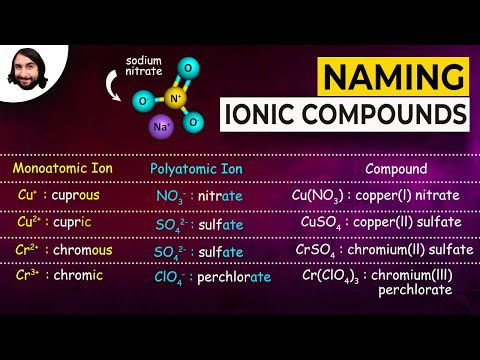
Naming Ionic Compounds
Naming Ionic Compounds and Understanding Ions
Introduction to Ionic Compounds
- Professor Dave introduces the concept of ionic compounds, explaining that atoms can become ions by gaining or losing electrons.
- Cations (positively charged ions) bond with anions (negatively charged ions) to form neutral compounds based on their charge ratios.
Charge Ratios and Common Ions
- Elements in Group 1 typically lose one electron, forming 1+ cations; Group 2 elements tend to form 2+ cations.
- Halogens gain one electron to become 1- anions, while other groups may form higher negative charges (e.g., 2-, 3-).
Forming Neutral Compounds
- To create a neutral compound, combine ions so that total positive and negative charges equal zero. For example, sodium chloride is formed from Na+ and Cl−.
- Magnesium (2+) requires two chloride ions for neutrality; similarly, magnesium and nitrogen require specific ratios based on their charges.
Naming Conventions for Ionic Compounds
- The naming convention involves listing the cation first followed by the anion. Monatomic anions use the suffix "-ide" (e.g., sodium chloride).
- Transition metals may have multiple oxidation states indicated by Roman numerals; e.g., copper(I) is cuprous and copper(II) is cupric.
Polyatomic Ions and Their Naming
- Polyatomic ions are named using suffixes: "-ate" for more oxygen atoms and "-ite" for fewer. Examples include nitrate (NO₃⁻) vs. nitrite (NO₂⁻).
- Prefixes "per-" and "hypo-" are used when there are variations in oxygen content among similar polyatomic ions.
Memorization of Ion Names and Charges
- While understanding chemistry reduces memorization needs, knowing names and charges of common polyatomic ions requires some rote learning.
From Names to Chemical Formulas
- When converting from name to formula unit, such as iron(II) phosphate, determine the necessary ratio of iron(2+) to phosphate(3-) for neutrality.
Binary Covalent Compounds
- In binary covalent compounds containing only two elements, different prefixes indicate the number of atoms present in each molecule (e.g., carbon monoxide vs. carbon dioxide).
Turn any video into a summary like this
YouTube links, meetings, lectures — with transcripts, search, and chat.