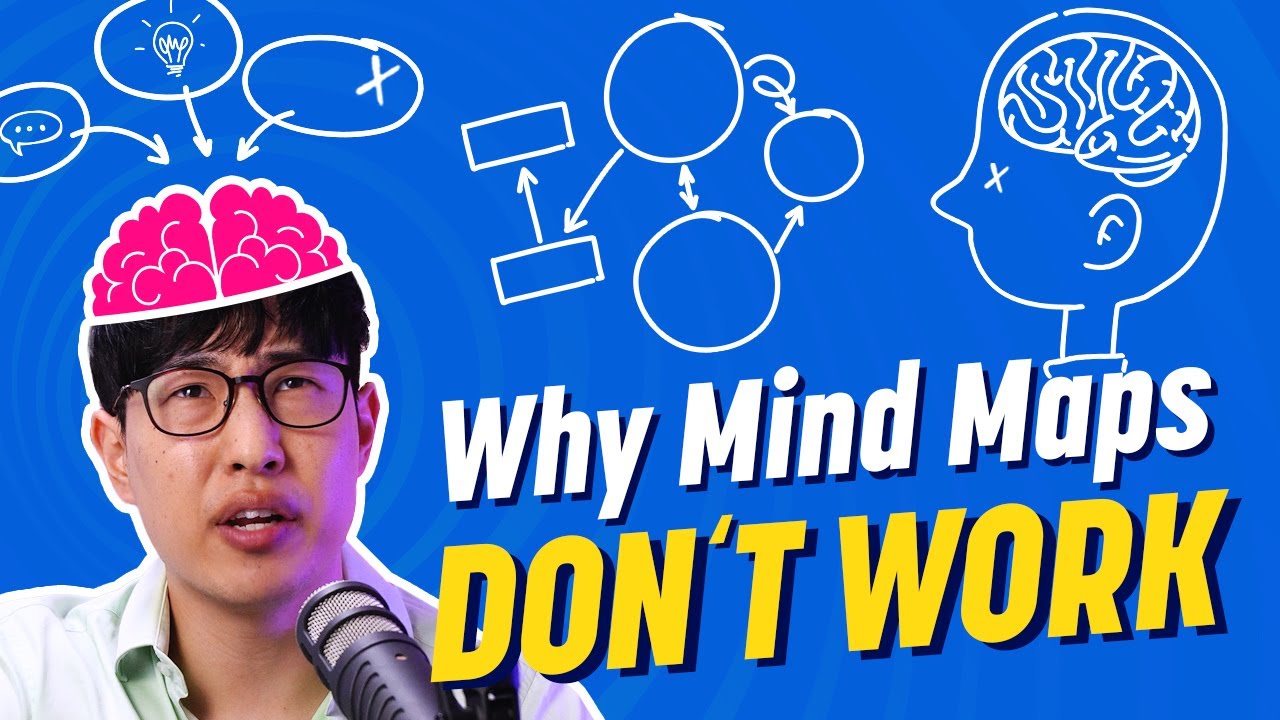
Are Mind Maps a WASTE OF TIME?
Introduction and Mind Maps
In this section, Dr. Justin discusses the effectiveness of mind maps as a study technique and introduces the concept of different methods and approaches to mind mapping.
The Limitations of Mind Maps
- Many people know Dr. Justin as the "mind map guy," but he acknowledges that mind maps don't always work effectively.
- A student once asked for an alternative technique to mind maps because it didn't work for her.
- Dr. Justin realizes that this is a common concern among students who have tried mind maps without success.
Understanding Mind Maps
- Dr. Justin introduces himself as a former medical doctor turned learning coach, specializing in teaching effective learning strategies.
- He emphasizes that mind mapping is not a single technique but rather has various methods and approaches taught by different experts.
- Most of these methods lack evidence or theoretical support, often based on personal preferences rather than scientific research.
The Importance of Brain Processing
- The appearance of a mind map on paper is not as crucial as what happens in the brain during the process.
- It's about how information is processed and how note-taking techniques facilitate thinking and understanding.
- Dr. Justin compares mind maps to city maps, where the organization and clarity of pathways determine their effectiveness.
Cognitive Architecture and Knowledge Mastery
In this section, Dr. Justin explains how cognitive architecture relates to learning and knowledge mastery.
Organized Pathways for Effective Learning
- Just like organized city streets make navigation easier, clear cognitive pathways enhance learning efficiency.
- The quality of connections between concepts determines the depth of understanding and knowledge mastery.
Levels of Thinking and Knowledge Mastery
- Different levels of thinking exist when it comes to understanding relationships between concepts or facts:
- Knowing that two ideas are related
- Understanding the nature of their relationship
- Being explicit about the importance and significance of that relationship
- These levels of thinking correspond to different levels of knowledge mastery and affect the ability to retrieve information.
Human Cognitive Architecture
- Dr. Justin mentions that these concepts fall under the field of human cognitive architecture, which explores how learning works.
- By analyzing students' mind maps, coaches can identify patterns and signs that indicate specific cognitive processes used during studying.
Variations in Cognitive Pathways
In this section, Dr. Justin discusses the variation in cognitive pathways between individuals and even within the same person on different days.
Analyzing Mind Maps for Insights
- Coaches analyze mind maps to understand students' cognitive processes by observing patterns and signs.
- Different variations exist between individuals, topics, and even on different study sessions for the same person.
Conclusion
Dr. Justin highlights the importance of understanding that mind mapping is not a one-size-fits-all technique. The effectiveness of mind maps depends on individual preferences, methods used, and alignment with cognitive processing. It's crucial to focus on how information is processed in the brain rather than solely relying on visual representations on paper.
Retention and Understanding of Information
This section discusses the importance of understanding information in depth and how small differences can have significant impacts on learning outcomes.
The Significance of Nuances in Learning
- Understanding subtle differences in information can greatly impact retention.
- Programming students are encouraged to share their experiences regarding the significance of nuances in learning.
Grouping Information for Better Understanding
- Grouping information is not a simple checklist task but requires cognitive activation and evaluation.
- The way we group information affects the quality of learning.
- Different methods of grouping can be valid, such as historical significance or different perspectives.
- Each method involves different types of thinking and exploration.
Impact on Encoding and Retrieval
- The way we think about groups affects how we process and encode information.
- Flow-on effects occur when grouping one part affects the grouping of other parts.
Challenges with Linear Structures
- Linear formats like textbooks make it difficult to show relationships between multiple pieces of information.
- Explaining interrelated concepts requires additional effort due to the limitations of linear structures.
New Section
In this section, the speaker discusses the limitations of traditional methods of organizing information and introduces the concept of cognitive architecture for effective learning.
The Limitations of Traditional Information Organization
- Memorizing information word for word from a textbook does not indicate true expertise.
- True expertise involves fluently utilizing concepts to solve real-world problems and manipulating information to find relationships.
- Grouping words in a way similar to how they are presented in a textbook may seem organized, but it lacks meaningful cognitive effects.
The Ineffectiveness of Mind Maps
- Mind maps can be created by rearranging grouped words, but this process requires little brain power and adds no significant value.
- Mind maps often end up disorganized and difficult to follow when attempting to represent complex relationships between ideas.
- The appearance of organization on paper does not guarantee effective cognitive organization.
New Section
In this section, the speaker emphasizes that effective organization is not about visual appearance but rather about creating meaningful connections within one's mind.
Insufficient Cognitive Organization
- If an organizational structure appears disorganized on paper, it likely reflects a lack of cognitive organization as well.
- Different colors and spatial arrangements can be used in mind maps, but they do not necessarily improve cognitive organization significantly.
Importance of Internal Cognitive Processes
- Effective organization lies in the internal cognitive processes that create meaningful connections and relationships between ideas.
- Mind maps should be a reflection of well-organized thoughts and understanding, rather than just a visual representation.
New Section
In this section, the speaker highlights the importance of actively engaging with information to enhance cognitive organization.
Active Learning for Cognitive Organization
- Actively engaging with information through reading, thinking, and making connections helps in creating meaningful cognitive organization.
- Taking time to understand concepts deeply and reflecting on their relationships improves cognitive organization.
- Regular revision and practice reinforce cognitive organization by strengthening connections between ideas.
The Role of Technology
- Technology tools can assist in organizing information effectively, but they should complement active learning rather than replace it.
- Using technology mind mapping tools can provide flexibility in rearranging and revising information as understanding deepens.
New Section
In this section, the speaker emphasizes the need for intentional practice to develop effective cognitive organization skills.
Developing Effective Cognitive Organization Skills
- Intentional practice is necessary to develop effective cognitive organization skills.
- Regularly challenging oneself with complex problems that require synthesizing multiple ideas enhances cognitive organization abilities.
- Seeking feedback from others can help identify areas for improvement in cognitive organization skills.
Continuous Improvement
- Developing effective cognitive organization skills is an ongoing process that requires continuous learning and refinement.
- Reflecting on one's own cognitive organization strategies and seeking new approaches can lead to further improvement.
The above summary is based on the provided transcript and may not capture the entirety of the video content.
The Importance of Active Learning
In this section, the speaker emphasizes the importance of active learning and how it leads to better encoding and memory retention.
Engaging the Brain for Effective Learning
- Active learning involves more thought, processing, and effort.
- Many people avoid active learning because they perceive it as a negative thing.
- Effortful learning actually saves time and enhances memory.
- Passive learning without engagement does not lead to deep knowledge mastery.
Tips for Effective Learning
The speaker provides tips for effective learning and highlights the need for consistent effort in the learning process.
No Shortcut to Success
- Learning is a complex process that requires more than just tips alone.
- A comprehensive program can help retrain oneself in effective learning techniques.
- The provided tips serve as solid starter steps but require dedication and effort.
Mind Mapping for Reflecting Thought Process
- Mind maps should accurately reflect one's thought process and order of thinking.
- Deep thinkers naturally engage in higher levels of deep processing.
- Mind maps provide visual cues to identify areas of disorganized thinking.
Facilitating the Right Type of Thinking
- Writing notes thoughtlessly hinders cognitive effects.
- Prioritize thinking about what to write down and how to structure it effectively.
Conclusion: Embrace Effortful Learning
The speaker concludes by emphasizing the importance of embracing effortful learning for achieving depth of knowledge mastery.
No Magic Hack or Shortcut
- There are no secret shortcuts or magic hacks for effective learning.
- Achieving desired results requires putting in consistent effort and work.
By following these tips, learners can enhance their understanding, retention, and application of knowledge.
New Section
In this section, the speaker discusses the importance of aligning our thinking and organizing our mind maps to improve learning and retention.
Aligning Thinking and Mind Maps
- It is crucial to ensure that our mind map is a true reflection of our thoughts.
- Disorganized mind maps are difficult to follow and hinder comprehension.
- The brain learns better through networked thinking rather than linear lists.
- Logical and intuitive organization helps the brain make sense of information.
- Existing knowledge structures can aid in understanding new concepts.
- Repetition alone may indicate a lack of relevance or understanding.
- Effort should be invested in finding ways to integrate new information into existing memory networks.
New Section
This section emphasizes the importance of engaging in effortful thinking processes to clean up and organize information for better comprehension.
Effortful Thinking and Organization
- Avoiding effortful thinking hinders effective learning.
- Aim for simplicity, logicality, and intuitiveness in organizing information.
- Brain's perception of relevance is crucial for retention.
- Integration with existing knowledge schemas enhances understanding.
- Repetition alone does not guarantee comprehension or retention.
- Investing time and effort in finding intuitive angles saves overall study time.
New Section
This section highlights the benefits of investing time and effort into making information more intuitive and aligned, leading to improved mastery and reduced study time.
Investing Time for Intuitive Alignment
- Making information feel more intuitive requires effort and energy.
- Reading, reviewing notes, asking questions, and seeking clarification are necessary steps.
- Finding connections that make sense within existing knowledge structures is essential.
- Improved alignment leads to better retention and mastery.
- Effort invested in alignment saves time in the long run, especially for complex topics.
New Section
In this section, the speaker demonstrates a side-by-side comparison of two mind maps, highlighting the difference between passive and effortful thinking processes.
Side-by-Side Comparison
- The second mind map, created with effortful thinking, took longer but resulted in a more organized and aligned representation.
- Active engagement with the material during organization leads to better comprehension.
- Time spent on intuitive alignment pays off in terms of improved understanding and reduced study time.
The Structure of Mind Maps
In this section, the speaker discusses the structure of mind maps and how they reflect the thinking process of an individual. The significance of different ways to group information in mind maps is also highlighted.
Understanding the Structure of Mind Maps
- Mind maps with a lot going on may indicate a more structured approach by someone with expertise.
- More time is spent on thinking and understanding rather than writing.
- Different mind maps may look similar to an untrained eye but have significant differences in grouping and relationships.
- There are multiple valid ways to group information in mind maps based on individual intuition and knowledge structures.
- The effectiveness of mind mapping depends on personal processing and effort invested.
Interviews with High-Achieving Students
This section introduces two high-achieving students, Archer and Derek, who share their experiences with mind mapping. Their success stories demonstrate the effectiveness of efficient studying techniques.
Archer's Achievements and Efficiency
- Archer achieved top results in Australia during his final year of high school.
- He excelled in multiple subjects, including university-level papers, while maintaining a perfect GPA in medical school.
- Archer's efficiency in studying allowed him to work more than full-time hours while pursuing his education.
Derek's Success Story
- Derek obtained one of the highest International Baccalaureate (IB) grades globally during his final year of high school.
- He surpassed grade boundaries by 20 to 30 percent, showcasing exceptional performance.
- Derek is currently excelling in medical school as well.
Insights from High-Achieving Students
- The interviews provide additional perspectives on mind mapping from students who have experienced its benefits firsthand.
- These insights can help individuals who are considering adopting mind mapping techniques or seeking validation for its effectiveness.
More Interviews and Conclusion
The speaker invites viewers to express their interest in watching more interviews with students who have used mind mapping techniques. Sharing the video, subscribing, and leaving feedback are encouraged.
Availability of Additional Interviews
- The speaker mentions having hundreds of students willing to share their experiences through interviews.
- Viewers can express their interest in watching more interviews by commenting on the video.
Conclusion and Call to Action
- Viewers are encouraged to share the video with friends, subscribe to the channel, and leave feedback.
- The speaker expresses gratitude for tuning in and promises more content based on viewer interest.
Initial Experience with Mind Mapping
In this section, Archer discusses his initial experience with mind mapping during Year 11.
Introduction to Mind Mapping in Year 10
- Archer's first encounter with mind mapping was during Year 10 as a task assigned by his teacher.
- Initially, it was perceived as a simple task without much significance.
Timestamps were not provided for some sections of the transcript.
New Section
The speaker discusses their initial experience with mind maps and how they found them to be useless. However, after learning the proper technique, they realized that the benefit of mind mapping lies in the cognitive effort required to create a well-structured map.
Reorganizing Information
- The speaker initially found mind maps to be useless as they only consisted of topic headers and sentences underneath.
- They realized that the physical act of writing things down is not as important as the cognitive process of creating a mind map in their mind.
- Creating a high-quality mind map requires thinking about how things relate, organizing chunk structures, and comparing different flows.
- The benefit of mind mapping comes from the cognitive effort involved in creating it.
Mind Maps Before vs After
- Previously, creating mind maps was easier and more enjoyable for the speaker, but they didn't have a deep understanding of the content.
- After learning proper mind mapping techniques, it became more challenging but more effective.
- The speaker now focuses on embracing the cognitive load and discomfort as a way to improve their understanding.
- Their current mind maps may have fewer words but clearer relationships, indicating a deeper level of knowledge.
Importance of Prioritization
- People often assume that having more content in a mind map means better understanding. However, it's actually about having a deeper level of knowledge and being able to prioritize effectively.
- Overcompensating with excessive arrows and words indicates gaps in understanding that need to be filled.
New Section
The speaker shares their experiences with different types of visual note-taking techniques such as cloud-based mind maps and concept mapping. They discuss their initial dislike for these methods but later realize their effectiveness when properly structured.
Initial Dislike for Mind Maps
- The speaker's first encounter with mind maps involved a cloud in the center representing the main idea, with arrows pointing to different topics.
- They found this approach pointless and preferred having information written out neatly on a page.
- The use of colors and decorations in mind maps was unappealing to them.
Introduction to Concept Mapping
- The speaker later learned about concept mapping, which involved linking ideas together using action verbs placed in squares.
- While concept mapping was more structured than cloud-based mind maps, it became messy and crowded due to numerous arrows and words.
Importance of Clear Structure
- The speaker realizes that the appearance of a mind map does not reflect its organization or their understanding.
- When they can prioritize, see the big picture, and understand how things relate, their mind map reflects a clear structure that accurately represents their knowledge.
Timestamps are provided for each section.
New Section
In this section, the speaker discusses the importance of having well-organized notes for studying and achieving top grades.
Importance of Typed Out Notes
- Having neatly typed out notes with diagrams and terminology can give the impression of being diligent in studying.
- This practice is preferred by those who aim for top grades.
- It is important to create comprehensive notes that cover all relevant information.
[Music]
Turn any video into a summary like this
YouTube links, meetings, lectures. With transcripts, search, and chat.