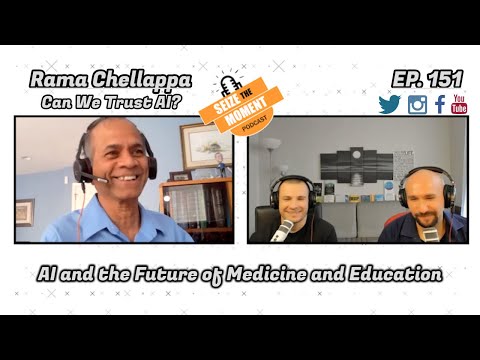
Rama Chellappa - AI and the Future of Medicine and Education | STM Podcast #151
Introduction
In this section, the host introduces Dr. Ramachalapa as a pioneering researcher and inventor in the fields of artificial intelligence, computer vision, and machine learning. The host also mentions Dr. Ramachalapa's new book called "Can We Trust AI?".
Introducing Dr. Ramachalapa
- The host introduces Dr. Ramachalapa as a pioneering researcher and inventor in the fields of artificial intelligence, computer vision, and machine learning.
- The host mentions that Dr. Ramachalapa is a Bloomberg distinguished professor in electrical computer and biomedical engineering at John Hopkins University.
- The host lists some of Dr. Ramachalapa's achievements such as being a fellow of the Association for the Advancement of Artificial Intelligence and holding eight patents.
- The host mentions that Dr. Ramachalapa has written a new book called "Can We Trust AI?".
Shout Out to Suleiman Jenkins
In this section, the host gives a shout out to Suleiman Jenkins who works at John Hopkins University.
Shout Out to Suleiman Jenkins
- The host gives a shout out to Suleiman Jenkins who works at John Hopkins University.
Early Days of AI
In this section, Dr. Ramachalapa talks about his early days working on pattern recognition and image processing which led to his career path combining artificial intelligence with sensors, cameras, microphones that would ultimately allow computers to see.
Early Days of AI
- Dr. Ramachalapa talks about his early days working on pattern recognition and image processing.
- Dr. Ramachalapa talks about how his work led to a career path combining artificial intelligence with sensors, cameras, microphones that would ultimately allow computers to see.
Real World Applications of AI
In this section, Dr. Ramachalapa talks about the real-world applications of AI such as identifying images of people and objects or understanding voice instructions.
Real World Applications of AI
- Dr. Ramachalapa talks about how pattern recognition enables computers to search through enormous sets of data to connect the dots on otherwise impossible-to-perceive patterns that could be useful in real-world applications.
- Dr. Ramachalapa gives examples of real-world applications such as Apple Siri, Amazon's Alexa personal assistance, Google's translate app, and automated speed cameras that capture the license plate number from a fast-moving car.
Misconceptions About AI
In this section, the host and Dr. Ramachalapa discuss common misconceptions about AI.
Misconceptions About AI
- The host mentions his misconception about AI being robots like in Rocky 3 or Terminator.
- Dr. Ramachalapa talks about how robots have been around since the mid-'70s but are more complex than just caricatures like in movies.
Introduction to AI and its Applications
In this section, the speaker discusses the various applications of AI and how it is already present in our daily lives.
AI in Recommender Systems
- AI is present in recommender systems such as Netflix and Amazon.
- These systems suggest movies or books based on previous purchases or views.
AI in Geolocation
- AI can be used for geolocation by feeding it various places' data.
- It can predict locations with reasonable accuracy when given a fresh image.
AI in Medicine
- AI has been used to detect sepsis, which is sometimes hard even for doctors.
- Electronic health records can lead to personalized medicine instead of being part of a group.
How Can AI Help Health?
In this section, the speaker talks about how AI can help healthcare professionals diagnose patients and deal with pandemics like COVID-19.
Personalized Medicine
- Electronic health records will lead to personalized medicine instead of being part of a group.
Detecting Sepsis
- Professor Suchi Saria has used machine learning to understand sepsis and detect it early, which is sometimes hard even for doctors.
Continuous Data Processing
- AI can continuously process data from electronic health records and look for any issues that may have been missed by physicians.
AI and Technology for Healthy Aging
In this section, the speaker talks about how AI can be used to detect Alzheimer's and dementia, prevent falls, and provide reminders for medication and exercise protocols. The speaker also discusses the potential benefits of robots in nursing homes.
AI for Healthy Aging
- AI can be used to detect Alzheimer's and dementia.
- Wearable sensors can be used for fall prevention.
- Robots can visit nursing homes with late-stage dementia patients.
- Robots can remind elderly people to take their medications or exercise.
Privacy Concerns
- The medical field has figured out how to protect patient data through HIPAA laws.
- Non-health AI companies can learn from the medical field's privacy practices.
Human-AI Interaction
- Human-AI interaction is necessary in situations like driving on a freeway with both automated and non-automated cars.
- Humans and AI should work together rather than against each other.
Doctors Misdiagnoses and the Role of AI in Medicine
In this section, the speakers discuss how doctors' misdiagnoses are common and how AI can help improve accuracy rates.
Doctors Misdiagnoses
- Doctors' misdiagnoses are common, with accuracy rates lower than what people think.
- The speaker shares a personal experience of being misdiagnosed with type 1 diabetes by a doctor who misread the blood test results.
- Human error is possible, but AI can help correct errors made by humans.
Role of AI in Medicine
- The more interesting thing about AI is that it can be trained to correct human errors.
- Domain shift is a big challenge for AI in medicine. Different labs train their samples differently, which affects performance when data from one lab is used to train an algorithm for another lab.
- Assuming it's properly trained, AI can help doctors with tumor growth diagnoses where they may disagree on particular tumor growths.
- AI has the ability to analyze multi-dimensional data and provide additional intelligence needed to make better decisions in medicine.
Future Possibilities of AI in Medicine
- Integrating with AI could lead to possibilities such as generally intelligent or conscious AI with creativity that could write novels or prepare technical papers.
Understanding AI and its Limitations
In this section, the speaker discusses the limitations of AI and how it is constrained by the data it has been given. The speaker also explains that AI can only predict things that are within the neighborhood of where it has seen.
How AI Works
- AI is purely data-driven and anything it says will be somewhat constrained within what it has been given.
- AI summarizes all the data into certain parameters so it can predict and make decisions.
- A deep learning machine can only predict things that are kind of within the neighborhood of where it has seen.
Examples of AI Limitations
- The website "thispersondoesnotexist.com" generates a beautiful face, but there may not be a person like that. However, this new face is still in the same neighborhood as faces that have been trained on.
- Although AI may produce something new, we should not worry about AI going crazy because it is still being done with constraints.
Challenges with Developing Better AI
In this section, the speaker discusses some challenges with developing better AI such as domain shift and hacking into systems.
Challenges with Developing Better AI
- Domain shift occurs when an AI system encounters data that is different from what it was trained on. This problem has been known since pattern recognition in the 50s and 60s.
- Domain adaptation involves managing differences between two datasets to ensure an algorithm works well on both datasets.
- Domain generalization involves learning as much as possible about a domain to prepare for when an AI system encounters something totally new.
- Hacking into AI systems is a concern because it is still software and can be hacked just like cell phones and computers.
The Impact of AI on Personal Privacy
In this section, the speakers discuss how AI can impact personal privacy and how people can be more aware of what they share with social media platforms.
Trusting Professionals with Personal Information
- As a psychotherapist, people often don't want to interact with the speaker because they think she knows more about them than they would like her to know.
- People are scared of having an actual system knowing them better than they know themselves.
- Trust is important when sharing personal information with professionals like therapists or doctors.
Social Media Platforms and Personal Data
- Social media platforms use limited data to make recommendations that surprise users.
- It's important to be careful about what information is shared on social media platforms.
- Companies have fine print agreements that allow them access to user data.
- Apple has implemented checks and balances by allowing users to choose whether or not they want their data tracked by social media platforms.
Introduction to AI and Deep Learning
The speaker explains that AI deep learning is a hierarchical non-linear regression model that can capture information and make predictions. Trust is important when working with AI, as it may not always be accurate.
Understanding AI and Deep Learning
- Prediction systems use statistics to output a function of many inputs, which allows for making predictions.
- AI deep learning is a hierarchical non-linear regression model that captures information and makes predictions.
- Trust is important when working with AI, as it may not always be accurate.
Echo Chambers Online
The speakers discuss the issue of echo chambers online, where AI feeds users information they are most likely to look at or search through. This can lead to confirmation bias and polarization.
Polarization and Confirmation Bias
- Echo chambers online refer to the phenomenon where AI feeds users information they are most likely to look at or search through.
- Users can end up in an echo chamber even if they start by looking at one type of content but then get recommendations for other types of content.
- This leads to confirmation bias and polarization.
Combating Misinformation
The speakers discuss how misinformation spreads quickly due to the fast network we have now. They also talk about how humans are responsible for using technology for bad purposes.
Spreading Misinformation
- Misinformation has been spread before, but it was slower due to limitations in printing and distribution.
- Humans are responsible for using technology for bad purposes, and AI is often blamed for what humans do.
- We should be smart enough to verify information and examine our own beliefs to combat misinformation.
Deep Fakes
The speakers briefly touch on the topic of deep fakes, which are generated by generative adversarial networks. They mention that they are working on some of these problems.
Generative Adversarial Networks
- Deep fakes are generated by generative adversarial networks.
- No further bullet points provided.
Trustworthy AI Systems
In this section, the speaker discusses the importance of developing trustworthy AI systems that work everywhere and for everyone. The speaker emphasizes that these systems should be interpretable, resilient, and protect ethics and privacy.
Importance of Trustworthy AI Systems
- Trustworthy AI systems should work anywhere and everywhere without bias against any group of people.
- These systems should be interpretable so that users can understand how they reached a decision.
- Resilience is important to ensure that the system does not fail when attacked.
- Ethics and privacy must be protected in the development of these systems.
Bias in Facial Recognition
In this section, the speaker discusses biases in facial recognition technology. The speaker explains how their team tested their own system for bias based on skin tone and gender. They also discuss methods to reduce bias while maintaining performance.
Biases in Facial Recognition Technology
- Facial recognition technology may have biases towards certain minorities or genders.
- Testing showed clear bias towards men compared to females and skin tone was also biased.
- Two options were available: start fresh or analyze how much bias exists through retraining using standard machine learning methods.
Reducing Bias While Maintaining Performance
- Retraining using adversarial training or knowledge distillation methods can reduce bias without losing much performance.
- Training with a large number of identities (e.g., 3.5 million), can help generalize features across demographics.
Importance of Proper Data Curation
- Proper data curation is important to avoid bias in AI systems.
- Algorithms can fail, and it's important to give a set of conditions where the algorithm should not be used.
The Importance of Continuous Improvement in Technology
In this section, the speaker discusses the importance of continuous improvement in technology and how it can be probed and fixed.
Technology Needs to Be Continuously Improved
- Most technologies have issues when they are first introduced.
- Technology needs to be continuously improved.
- Any technology that doesn't work for everybody in society immediately needs to be grabbed and fixed.
The Impact of Social Media on Democracy
In this section, the speaker talks about the impact of social media on democracy and how we need to take control of it.
Social Media's Impact on Democracy
- We see the impact of social media on our democracy.
- Responsibility rests with us as well as with social media platforms.
- If we care enough about our country and democracy, then we have to be careful about what information we digest and promote.
Free Speech Issue
- The Free Speech issue is complex.
Personal Experience with Social Media Platforms
In this section, the speaker shares his personal experience with social media platforms.
Personal Experience with Facebook
- Social media likes to have me on their platform as I have a Facebook account.
- The speaker follows his son's advice not to say anything other than nice things on Facebook.
- Even a simple reaction on Facebook can cause upset.
Exercising Control and Judgment
In this section, the speaker emphasizes the importance of exercising control and judgment over social media platforms.
Exercising Control and Judgment
- We have a choice, we have control over it.
- Let's exercise that control and judgment so this won't be more challenging for our democracy.
Responsibility in Critical Thinking
In this section, the speakers discuss the responsibility of critical thinking when it comes to understanding news and information. They also talk about how social media platforms can influence what people see and hear.
Understanding Nuance
- It is important to use critical thinking when consuming news and information.
- One should not immediately accept one perspective or story without considering other options.
- Social media platforms have a responsibility to provide accurate information.
Influence of Social Media Platforms
- The speakers suggest a radical idea of only using social media platforms if they play certain songs.
- Companies are nervous about false information on their platforms and have people working to remove it.
- There is a balance between revenue and providing accurate information on social media platforms.
AI in Education
In this section, the speakers discuss how AI can be used in education to help students with learning disabilities and improve learning outcomes.
Advancements in Education with AI
- The speaker suggests that AI could revolutionize education by having one physical teacher and 30 AI teachers in a classroom.
- The National Science Foundation has an AI Institute for Education that focuses on how AI can help students with learning disabilities.
- AI can summarize content for students, helping them learn better and quicker.
AI and its Impact on Society
In this section, the speaker discusses how AI can be used to improve various aspects of society, such as indoor navigation and communication for people with speech impediments. The importance of educating children about the potential dangers of technology is also emphasized.
AI's Potential Benefits
- AI can be used for indoor navigation and emotional analysis.
- AI can help people with speech impediments communicate better.
- AI has the potential to improve various areas of society.
Educating Children About Technology
- Children should be educated about the potential dangers of technology.
- Parents should monitor their children's use of technology and provide controls to prevent access to harmful content.
Preventing Misuse of Technology
In this section, the speaker emphasizes the importance of being aware of potential scams and malicious use of technology. He also discusses how humans are responsible for misusing technology, not the technology itself.
Being Aware of Scams
- People should be aware of email scams that ask for personal information or money.
- Humans are responsible for misusing technology, not the technology itself.
Optimistic vs Pessimistic Views on AI
In this section, different perspectives on AI are discussed. Some individuals have a pessimistic view on AI due to concerns about regulation and control, while others have an optimistic view on its potential benefits.
Different Perspectives on AI
- Some individuals have a pessimistic view on AI due to concerns about regulation and control.
- Others have an optimistic view on AI's potential benefits.
- The reality is somewhere in between, and caution should be taken to guide the development of AI.
AI Bias and its Limitations
In this section, the speaker discusses how AI can be biased but it is easier to detect and fix than human biases. The current data-driven AI is limited by the data it has been trained on and cannot produce totally weird results.
Detecting and Fixing AI Bias
- AI can be biased, but it will tell you if it is biased, making it easier to detect and fix.
- Humans may not even know they have a bias, making it harder to detect and fix.
- Children are not born with biases; they learn them from their surroundings.
- Companies like cftx invest in ensuring that AI does not become bad.
Limitations of Data-driven AI
- The current data-driven AI is based on the data it has been trained on and cannot produce totally weird results outside of what the data already has.
- There is no form of AI that can transcend everything it has been told and think weird stuff humans are capable of doing.
Human Creativity vs. Data-driven AI
In this section, the speaker compares human creativity to data-driven AI. He explains that human creativity is not constrained by what we have been taught or how we have been trained.
Human Creativity vs. Data-driven AI
- Human invention comes from thinking outside of what we have been taught or how we have been trained.
- Data-driven AI is limited by the data it has learned from, while human creativity is not constrained by what we have been taught or how we have been trained.
Self-supervised Learning
In this section, the speaker discusses self-supervised learning and how it can help AI learn from large amounts of data without requiring manual annotation.
Self-supervised Learning
- Self-supervised learning is a way for AI to learn from large amounts of data without requiring manual annotation.
- Self-supervised learning is important in computer vision because it allows AI to learn from traffic cameras and other sources of data without requiring manual annotation.
Self-Supervised Learning and Synthetic Data
In this section, the speaker discusses self-supervised learning and synthetic data. He explains how these techniques can be used to train AI systems with less data.
Self-Supervised Learning
- Eigenfaces is a workable system that doesn't require labels once it understands what a face representation is.
- Dogs can figure out patterns without being explicitly taught, such as when to fetch a ball based on the distance it's thrown. This is an example of self-supervised learning.
- Self-supervised learning is useful in medicine where data collection for specific diseases may be difficult.
Synthetic Data
- Synthetic data is becoming more prevalent in training AI systems because it doesn't raise privacy concerns.
- Synthetic data can be used as a form of data augmentation to teach AI systems with less real-world data.
Deployable Systems with AI
In this section, the speaker talks about how AI is being deployed across various sectors such as health, transportation, and misinformation reduction.
Deployable Systems with AI
- The FDA has already approved close to 120 things that depend on AI for various situations.
- The speaker believes that AI will become more prevalent in society but isn't worried about it becoming bizarre.
- The speaker wonders if we'll ever have nano machines or other systems inside our bodies monitoring our health and making recommendations.
Wearable Technology and AI in Healthcare
In this section, the speaker discusses the potential of wearable technology and AI in healthcare. He talks about how a pad that carries all your data can give you early diagnostics by injecting different medications into your body when needed. The speaker also mentions how AI works well when the mapping between data and label is unambiguous but requires more knowledge and common sense when there are ambiguities.
Wearable Technology for Health Monitoring
- Insulin pumps for type 1 and type 2 diabetes patients can measure A1C levels and suggest insulin doses based on blood sugar levels.
- Apple Watch, Fitbit, and other wearables have features like fall prevention alerts that use AI to monitor gait, posture, walking pose, etc.
- However, all such devices need to be cleared by FDA before being used on humans.
AI in Personalized Medicine
- Deep learning algorithms can determine calorie information from pictures of food items taken by a camera.
- Such algorithms can help people monitor their diet better, especially those with diabetes who need to monitor their blood sugar levels.
- Drug companies will produce products only if there's a large enough market for it. However, as an experimental thing or research problem, all these things are possible.
Precision Medicine Analytic Platform (PMAP)
- PMAP is a platform at Hopkins that keeps all patient data safely and allows running machine learning algorithms to figure out personalized medicine solutions.
Following Rama's Work
In this section, the speaker provides information on where one can follow his work and buy his book.
Following Rama's Work
- Rama has a lab at Hopkins called AIM (aiem.jhu.edu) that focuses on engineering and medicine.
- His website has links to his papers, podcasts, and other information about his work.
Purchase the Book
In this section, the guest speaker provides a discount code for purchasing his book and shares the link to order it.
Discount Code
- The guest speaker provides a discount code "Hai30" for 30% off when purchasing his book.
- The book is called "Can We Trust AI".
- To order, visit press.jau dot uh edu slash books and enter Hai30 at checkout.
Conclusion
In this section, the hosts thank the guest speaker and provide links to follow their podcast on social media.
Thank You Message
- The hosts thank the guest speaker for joining them on the show.
- They express their enjoyment of talking with him.
Follow Us on Social Media
- To follow their podcast, search for "Seize the Moment Podcast" on Facebook, Instagram, and Twitter.
- On Twitter, their handle is sees underscore podcast.
- They encourage viewers to like, subscribe, and hit the bell on YouTube.
Music Recommendation Algorithm
In this section, one of the hosts suggests an idea for telling social platforms which songs they like in order to improve music recommendation algorithms.
Music Recommendation Algorithm Idea
- One host suggests that they should tell social platforms which songs they like so that they can improve music recommendation algorithms.
- They want to see how long it takes for these platforms to go back and play only those songs that they liked.
End of Show Message
In this section, one of the hosts realizes that it's time to end the show and thanks viewers for watching.
End of Show Message
- One host realizes that it's time to end the show.
- He thanks viewers for watching and expresses his happiness to be back.
- The show ends with music playing in the background.
Turn any video into a summary like this
YouTube links, meetings, lectures. With transcripts, search, and chat.