Metabolic Pathways
Understanding Metabolism
In this video, we learn about metabolism and how it works in the human body. We explore the two main types of metabolic pathways, catabolic and anabolic, and how they work together to turn food into energy.
Catabolic and Anabolic Pathways
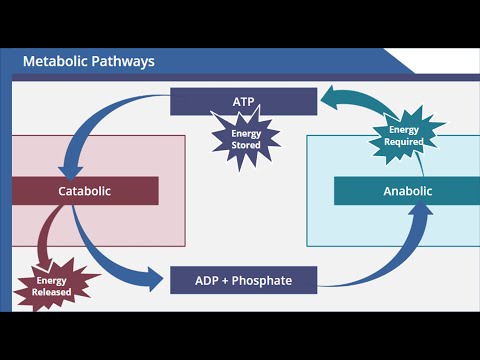
- Catabolic reactions break down large molecules into simpler ones, releasing energy. Examples include digesting food.
- Anabolic reactions build complex molecules from simpler ones, requiring energy. Examples include forming new cells and tissues.
- The energy for anabolic reactions is provided by catabolic reactions.
ATP Production
- Energy can be stored in cells as Adenosine Triphosphate (ATP).
- Cells use ATP as energy for various processes.
Aerobic Metabolism
- Humans rely on breaking down glucose to provide energy for cells.
- Aerobic organisms use glycolysis, the Krebs cycle, and the Electron Transport chain to accomplish this.
- Glycolysis is the first step in digestion to turn food into energy.
- The Krebs cycle produces building blocks for other important body processes.
- The Electron Transport Chain takes place in the Mitochondria and transfers electrons to create ATP.
Fermentation
- When oxygen or other electron acceptors aren't available, organisms can't complete respiration.
- Humans use fermentation when we need a large amount of energy quickly.
- Some organisms survive by fermentation alone.
Overall, metabolism is a complex process that involves breaking down food into usable components and using them to produce ATP for various cellular processes. Catabolic and anabolic pathways work together to achieve this goal. Aerobic metabolism relies on glycolysis, the Krebs cycle, and the Electron Transport chain to produce ATP, while fermentation is used when oxygen isn't available.
Turn any video into a summary like this
YouTube links, meetings, lectures. With transcripts, search, and chat.