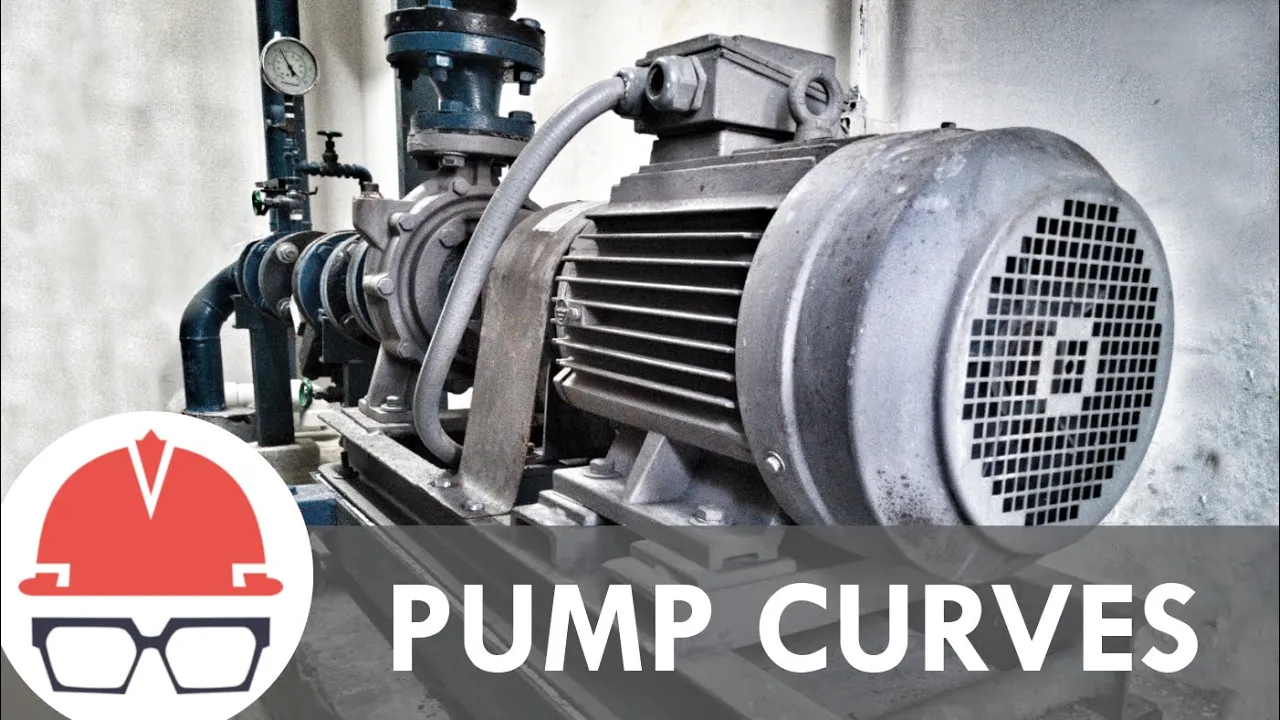
Do Pumps Create Pressure or Flow?
New Section
This section introduces the topic of pumps and their function in fluid flow systems. It also highlights the importance of understanding the relationship between pressure and flow rate.
How Pumps Work
- Pumps create flow in a fluid, and resistance to that flow generates pressure in a pipe. However, this is not the complete explanation.
- Similar to the misconception about electrical safety, where voltage and current are interrelated, pressure and flow rate in pipe systems go hand in hand.
- Understanding how pumps work is crucial for engineers designing pump systems.
How Pumps Work
The host expresses his enthusiasm for pumps and explains that engineers primarily focus on pump performance rather than the physics behind them. He emphasizes the importance of selecting the right pump for a specific application.
Importance of Pump Selection
- Engineers prioritize choosing the appropriate pump for a given system as it significantly impacts performance.
- While small-scale applications may not require meticulous selection, larger systems demand careful consideration due to potential life-or-death consequences.
- The episode will cover considerations engineers use when selecting pumps and provide tips for choosing one.
Centrifugal Pumps
Centrifugal pumps are commonly used in civil engineering and everyday life. This section explains their operation using an impeller connected to a motor to accelerate liquid into the discharge line.
Flow Rate vs Pressure
- Centrifugal pumps are often listed according to their flow rate capacity.
- However, changing vertical distance or discharge pressure affects the pump's flow rate.
- The relationship between pressure and flow rate can be visualized through characteristic curves unique to centrifugal pumps.
System Curves
System curves describe the relationship between flow rate and pressure in a network of pipes. Understanding system curves is crucial for selecting the right pump.
Importance of System Curves
- Every pump connected to a network of pipes has its own characteristic curve, while the network itself has a system curve.
- The system curve varies based on factors such as constriction and elevation.
- Plotting the pump's characteristic curve on top of the system curve reveals their intersection point, indicating the operating pressure and flow rate of the pump.
Efficiency and Pump Selection
Pump selection involves considering factors beyond flow rate and pressure, such as efficiency. This section highlights that pumps should operate efficiently within their performance range.
Efficiency Considerations
- Pump curves may also provide information about efficiency.
- While pumps can operate at extreme ranges, they are usually less efficient in doing so.
- Efficient pump operation is essential for optimal performance.
Timestamps have been associated with bullet points where available.
Pumps: Flow vs Pressure Understanding the Relationship
In this section, we explore the relationship between flow and pressure in pumps. We discuss the importance of considering efficiency and scale, as well as the differences between centrifugal and positive displacement pumps.
Efficiency and Scale
- When dealing with large pumps that require a lot of energy or run continuously, it is important to consider efficiency.
- Small inefficiencies may not matter for small-scale applications like fish tank pumps, but they can add up quickly when delivering water to millions of customers.
- It is often more cost-effective to use multiple pumps instead of a single pump that can handle a wide range of flow rates, allowing for operation in the most efficient part of each pump's characteristic curve.
Centrifugal Pumps
- Centrifugal pumps operate by imparting kinetic energy to fluid through an impeller.
- A pump curve shows the relationship between flow rate and pressure for a centrifugal pump.
- Raising the tube above its maximum pressure causes the liquid to reach maximum head and stop flowing. While some may argue that this is not creating flow, it is creating pressure.
Positive Displacement Pumps
- Positive displacement pumps trap a fixed volume of fluid and force it into the discharge line.
- Unlike centrifugal pumps, positive displacement pumps directly couple the motor to a fixed volume regardless of discharge line pressure.
- The characteristic curve for positive displacement pumps is a flat line since they deliver fluid at a constant rate.
Pump's Role in Flow and Pressure
- Some people claim that pumps only create flow and not pressure, specifically referring to positive displacement pumps.
- However, if there would be no pressure without the pump, it can be argued that the pump created it.
- The properties of flow rate and pressure depend on both the characteristics of the pump (as shown by its characteristic curve) and the system to which it is connected.
Conclusion
- Pumps impart flow and pressure to a fluid according to their characteristic curve and the corresponding system curve.
- Understanding this relationship is crucial for efficient pump operation.
- Consideration of efficiency, scale, and the specific type of pump being used is essential in designing effective pumping systems.
Nebula: Ad-Free Streaming Service Supporting Independent Creators
In this section, we learn about Nebula, an ad-free streaming service that supports independent creators like MinutePhysics, Real Engineering, Wendover Productions, and others.
Nebula and Independent Creators
- Nebula is a streaming service built by and for independent creators.
- It offers a platform for creators to try new ideas that may not work on advertiser-supported platforms like YouTube.
- Videos are published on Nebula one day before they go live on other platforms, with no ads or sponsorships.
Partnership with CuriosityStream
- Nebula is partnered with CuriosityStream, a service that provides thousands of documentaries and non-fiction titles.
- CuriosityStream supports independent creators and wants to help them grow their platform.
- By signing up at CuriosityStream.com/practicalengineering, users can get free access to Nebula as part of a bundle deal.
Benefits of Subscribing
- Subscribers gain access to both awesome long-form content on CuriosityStream and ad-free videos from independent creators on Nebula.
- The bundle deal offers a discounted annual plan price for a limited time.
Conclusion
In summary, understanding the relationship between flow and pressure in pumps is crucial for efficient operation. Efficiency considerations become more important at larger scales. Centrifugal pumps operate differently from positive displacement pumps. While some argue that pumps only create flow or pressure depending on the type, it can be contended that both are created by the pump. Additionally, Nebula provides an ad-free streaming service that supports independent creators and offers a bundle deal with CuriosityStream for access to a wide range of documentaries and non-fiction titles.