Capitulo III Clasificacion de metodos - centrifugacion (video 2)
Classification of Methods for Biomolecule Separation
Overview of Separation Methods
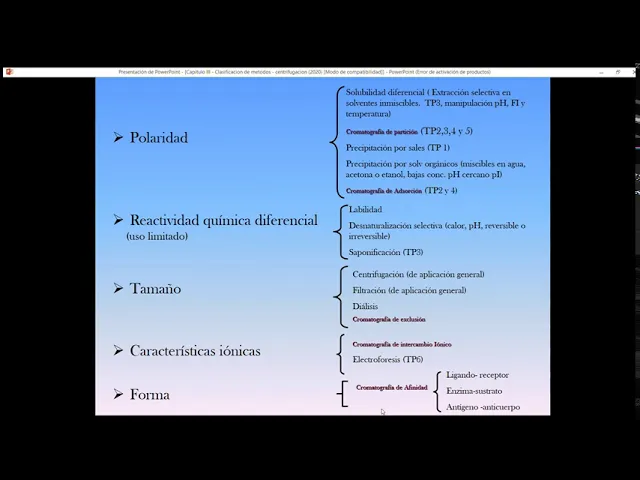
- The video discusses the classification of methods for separating biomolecules, emphasizing categorization based on differential physicochemical properties.
- Various separation techniques exploit differences in solubility, size, charge, volatility, chemical reactivity, and affinity to isolate organic compounds from complex mixtures.
Techniques in Biochemistry
- Centrifugation is highlighted as a method to separate solvent phases from insoluble sediments using differential or density gradient centrifugation.
- Combining multiple techniques often yields better results; the choice of purification method should align with the final assay system's specificity requirements.
Importance of Method Selection
- The concentration range of the substance under study must be appropriate to avoid interference from contaminants during assays.
Solubility-Based Separation Methods
Differential Solubility Techniques
- Common procedures for isolating specific compounds leverage solubility differences among major molecular groups by manipulating pH or using benign aqueous solvents.
- Differences in solubility can concentrate desired components while separating them from contaminants; an example includes extracting free fatty acids from lipids using bicarbonate solution.
Extraction Process Example
- Free fatty acids are separated from specified fatty acids in petroleum ether through extraction with a 1% bicarbonate solution to suppress acid group ionization.
Additional Purification Strategies
Selective Precipitation Techniques
- Selective removal of impurities can be achieved by altering solution composition via changes in pH, ionic strength, or temperature.
Organic Solvent Precipitation
- Organic solvents like ethanol and acetone precipitate water-soluble proteins without denaturing them; this occurs at low concentrations near the protein's isoelectric point.
Absorption and Reactivity-Based Techniques
Absorption Methods
- Molecules are absorbed onto a solid stationary phase based on polarity and chemical nature; elution can occur with organic or saline solutions.
Chemical Reactivity Techniques
Chemical Reactivity and Separation Techniques
Limitations of Differential Chemical Reactivity
- The use of differential chemical reactivity is limited to specific applications, as only a few molecules are inert enough to withstand the strong reagents needed for removing other compounds.
Methods Utilizing Differential Stability
- A common method involves organic matter destruction through combustion, leaving inorganic phosphorus as residue for subsequent colorimetric identification.
- Two prevalent methods involve temperature and pH adjustments that selectively denature proteins without losing their activity in some cases.
Saponification Process
- Saponification separates total lipid predictions into saponifiable and non-saponifiable portions using normal potassium hydroxide solution, releasing fatty acids from phospholipids or triglycerides.
Size-Based Separation Techniques
Centrifugation and Filtration
- Centrifugation will be discussed in detail; filtration techniques can serve as alternatives for adequate separation based on material type and available time.
- Modern filtration employs fine disc filters with strictly controlled pore sizes to selectively remove extremely small particles like bacteria.
Dialysis and Chromatography
- Dialysis separates compounds through semipermeable membranes based on molecular size, while exclusion chromatography uses gel matrices to separate molecules by size during passage.
Ionic Characteristic-Based Techniques
Ion Exchange Chromatography
- Ion exchange chromatography separates molecules based on charge by binding them to a matrix with an opposite charge, with elution occurring via pH changes or ionic strength variations.
Electrophoresis
- Electrophoresis separates charged particles under an electric field; migration speed varies under specific conditions, allowing analytical applications across various materials.
Affinity Chromatography
- Affinity chromatography separates particles through specific binding interactions with immobilized molecules on a support, utilizing various types of specificity such as ligand-receptor or antigen-antibody interactions.
Detailed Examination of Centrifugation Techniques
Principles of Centrifugation
- In centrifugation, particles move at speeds determined by their size, shape, and density under gravitational influence. The sedimentation coefficient reflects this movement's velocity relative to medium density.
Types of Centrifugation Processes
Centrifugation Techniques for Cellular Component Separation
Overview of Centrifugation Methods
- A method to achieve greater separation involves placing a cell homogenate in a narrow band at the top of a saline solution within a centrifuge tube, with the saline below containing a density gradient.
- The purpose is to stabilize sedimented components and prevent mixing through convection; gradients can be created using highly soluble inert materials like sucrose.
- Components are separated based on their size, shape, and density during centrifugation; this includes separating cellular components by their flotation density in pronounced gradients of high sucrose or cesium chloride concentrations.
Differential Centrifugation Process
- In differential centrifugation, the sample is spun in a tube where each component's behavior depends on its physical properties and centrifugation conditions, yielding sediment fractions.
- This technique is typically used for subcellular fractionation to separate various organelles from cells through successive spins at increasing speeds.
Zonal Centrifugation Technique
- In zonal centrifugation, samples are applied as thin layers over a density gradient medium; particles concentrate into discrete bands depending on their characteristics.
- The separation mechanism relies on particle size, shape, and density combined into a coefficient that must be measured accurately to avoid particles reaching the bottom prematurely.
Isopycnic or Equilibrium Sedimentation
- Isopycnic sedimentation also utilizes density gradients but requires longer centrifugation times for equilibrium between centrifugal force and hydrostatic pressure.
- Continuous gradients covering all densities allow particles to reach stable intermediate positions without settling at the bottom regardless of spin duration.
Practical Applications and Equipment Types
- High-resolution separations often involve mixing samples with gradient-forming materials before spinning; ultra-centrifuges are necessary for achieving these high resolutions based solely on component densities.
- A protocol example illustrates differential centrifugation for liver tissue organelle separation characterized by electron microscopy and enzyme activity determination.
Types of Centrifuges
- Different types of centrifuges include:
- Tabletop Centrifuge: Ideal for small sample volumes (3000–7000 g).
- Refrigerated High-Capacity Centrifuge: Interchangeable rotors with speeds up to 10,000–15,000 g.
- High-Speed Refrigerated Centrifuge: Ultra-centrifuge capable of exceeding 100,000 g.
Specialized Rotors
- Two main types of rotors in ultra-centrifuges:
- Preparative Rotor: Used for separating macromolecules like lipoproteins from plasma.
Centrifugation Techniques and Particle Separation
Overview of Rotor Types
- The discussion begins with the density of particles observable in the middle of the figure, highlighting its importance in centrifugation.
- There are fixed-angle rotors that vary between 14 and 40 degrees, which achieve higher speeds compared to oscillating rotors.
- The presentation also mentions drum rotors, characterized by a fixed angle of zero, where tubes are aligned vertically.
High-Speed Capabilities
- Drum rotors can reach very high speeds to generate greater centrifugal force, as illustrated in the first figure presented.
- The discussion includes coefficients of sedimentation and densities of various particles, emphasizing how different particles can be separated effectively.
Combination Techniques for Separation
- A combination of differential centrifugation and zonal gradient techniques is discussed as a method for separating particles based on density.