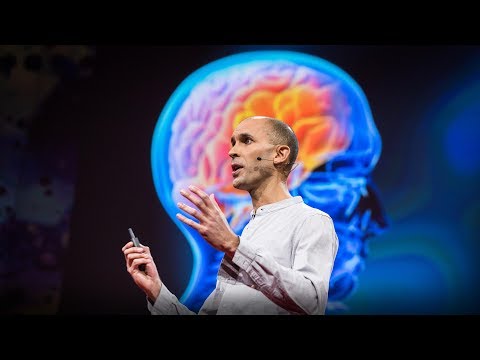
Your Brain Hallucinates Your Conscious Reality | Anil Seth | TED
The Mystery of Consciousness
In this section, the speaker introduces the concept of consciousness and how it is a mystery in science and philosophy.
Anesthesia and Oblivion
- The speaker shares their experience of being under anesthesia and how it felt like total oblivion.
- When waking up from deep sleep, there is a basic sense of time having passed, but coming round from anesthesia is different.
- Anesthesia turns people into objects and back again into people. It's one of the greatest remaining mysteries in science and philosophy.
Consciousness: How Does It Happen?
- The speaker asks how consciousness happens within our brains through billions of neurons generating conscious experiences.
- Consciousness for each person is all there is. Without it, there's no world, no self, nothing at all.
- The speaker wonders if other animals might be conscious too.
Conscious AI vs Living Organisms
- The prospects for a conscious AI are pretty remote because consciousness has less to do with pure intelligence and more to do with our nature as living organisms.
- Consciousness and intelligence are very different things. You don't have to be smart to suffer, but you probably do have to be alive.
Controlled Hallucinations
- Our conscious experiences of the world around us and ourselves within it are kinds of controlled hallucinations that happen with, through, and because of our living bodies.
Explaining Consciousness
- Once we start explaining the properties of consciousness in terms of things happening inside brains and bodies, the mystery should start to fade away.
- The speaker introduces the two different ways of thinking about consciousness: experiences of the world around us and conscious self.
Properties of Consciousness
- Consciousness can be thought of in two different ways: experiences of the world around us and conscious self.
- Experiences are full of sights, sounds, and smells. Conscious self is the specific experience of being you or me.
Perception as Informed Guesswork
The brain uses sensory signals and prior expectations to form its best guess of what caused those signals. Perception is a process of informed guesswork in which the brain combines these sensory signals with its prior expectations or beliefs about the way the world is.
Examples of Perception as Informed Guesswork
- Example 1: Illusion of Shades - Patches A and B are exactly the same shade of gray, but the brain perceives them differently due to prior expectations built deeply into the circuits of the visual cortex that a cast shadow dims the appearance of a surface.
- Example 2: Speech Distortion - The sensory information coming into the brain hasn't changed at all, but your brain's best guess of the causes of that sensory information changes what you consciously hear. When perceptual predictions are too strong, it can result in hallucinations.
Perception as an Active, Constructive Process
We don't just passively perceive the world; we actively generate it. The world we experience comes as much from inside out as from outside in.
Example: Virtual Reality Simulation
- Immersive virtual reality combined with image processing simulates overly strong perceptual predictions on experience. In this case, to see dogs. When perceptual predictions are too strong, it can result in hallucinations similar to those experienced during altered states or psychosis.
Conclusion: We Are All Hallucinating All The Time
If hallucination is a kind of uncontrolled perception, then perception right here and right now is also a kind of hallucination, but a controlled hallucination in which the brain's predictions are being reined in by sensory information from the world. We are all hallucinating all the time, including right now. It's just that when we agree about our hallucinations, we call that reality.
Introduction
The experience of being a person is so familiar, so unified and so continuous that it's difficult not to take it for granted. However, there are many different ways we experience being a self.
Different Ways We Experience Being a Self
- There are experiences of having a body and of being a body.
- There are experiences of perceiving the world from a first-person point of view.
- There are experiences of intending to do things and of being the cause of things that happen in the world.
- There are experiences of being a continuous and distinctive person over time, built from a rich set of memories and social interactions.
Fragility Of The Brain's Construction Of A Unified Self
The basic background experience of being a unified self is rather fragile construction by the brain. Many experiments show that these different ways in which we experience being a self can all come apart.
Fragility Of The Brain's Construction Of A Unified Self
- Experiments show that these different ways in which we experience being a self can all come apart.
How Does The Brain Generate The Experience Of Having A Body?
In this section, we learn how the brain generates the experience of having a body.
Rubber Hand Illusion Experiment
- In the rubber hand illusion experiment, both hands are simultaneously stroked with paintbrushes while staring at the fake hand.
- For most people, after some time, this leads to an uncanny sensation that the fake hand is part of their body.
- This means that even experiences of what our body is is kind-of best guessing -- controlled hallucination by the brain.
Perception And Regulation Of Internal State Keeps Us Alive
Perception and regulation of the internal state of the body is what keeps us alive.
Interoception
- Sensory signals coming from inside the body continually tell the brain about the state of internal organs.
- Perception and regulation of the internal state of the body is what keeps us alive.
The Biological Mechanisms of Being a Self
In this section, the speaker explains that our experiences of being a self are grounded in the biological mechanisms that keep us alive. All conscious experiences depend on predictive perception and stem from the basic drive to stay alive.
Our Conscious Experiences Depend on Predictive Perception
- All conscious experiences depend on the same mechanisms of predictive perception.
- What we consciously see depends on the brain's best guess of what's out there.
- Self-related predictions depend critically on sensory signals coming from deep inside the body.
Our Experienced World Comes from Inside Out
- Our experienced world comes from the inside out, not just outside in.
- Experiences of being an embodied self are more about control and regulation than figuring out what's there.
- Our experiences of the world around us and ourselves within it are kinds of controlled hallucinations that have been shaped over millions of years of evolution to keep us alive in worlds full of danger and opportunity.
Implications
- Misperceptions can occur when predictive mechanisms go wrong, leading to new opportunities for understanding conditions like depression and schizophrenia.
- Consciousness cannot be reduced or uploaded to a software program running on a robot because our experiences are shaped by biological mechanisms that keep us alive.
- Human consciousness is just one possible way of being conscious, and our individual selves and worlds are unique but grounded in shared biological mechanisms.
Celebrating Fundamental Changes in Understanding Ourselves
In this section, the speaker discusses how fundamental changes in understanding ourselves should be celebrated because they lead to a greater sense of wonder and realization that we are part of, not apart from, the rest of nature.
Greater Sense of Understanding Leads to Greater Sense of Wonder
- Fundamental changes in understanding ourselves should be celebrated.
- With a greater sense of understanding comes a greater sense of wonder and realization that we are part of and not apart from the rest of nature.
Nothing to Fear When Consciousness Ends
- When the end of consciousness comes, there's nothing to be afraid of.
Turn any video into a summary like this
YouTube links, meetings, lectures. With transcripts, search, and chat.