What is Diffusion? How Does it Work? What Factors Affect it?
Diffusion Overview
In this section, the concept of diffusion is introduced, explaining how molecules move randomly and spread out over time.
What is Diffusion?
- Diffusion is defined as the net movement of particles from an area of higher concentration to an area of lower concentration.
- Particles move from high concentration (bunched up) to low concentration (spread out), illustrating the process of diffusion.
Diffusion in Gases and Liquids
- Diffusion occurs in both gases and liquids, demonstrated by examples like perfume spreading in a room or food coloring diffusing in water.
Cell Membrane Permeability
This part discusses how diffusion can occur through cell membranes and highlights the permeability of membranes to different molecules.
Cell Membranes and Permeability
- Cell membranes are partially permeable, allowing only small molecules like water, glucose, and amino acids to diffuse through.
- Larger molecules such as proteins and starch cannot pass through cell membranes due to their size.
Factors Affecting Diffusion Rate
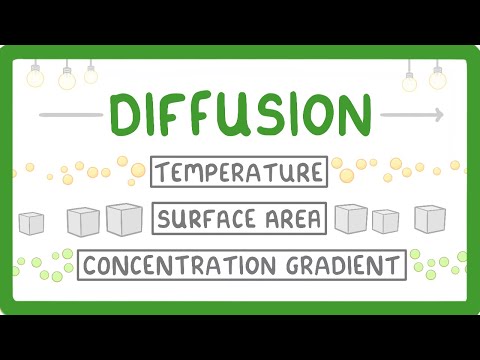
The factors influencing the rate of diffusion are explored, including concentration gradient, temperature, and surface area.
Factors Influencing Diffusion Rate
- Concentration gradient: The larger the difference in concentration between two areas, the higher the rate of diffusion.
- Temperature: Higher temperatures increase particle energy leading to faster diffusion rates.
Turn any video into a summary like this
YouTube links, meetings, lectures. With transcripts, search, and chat.