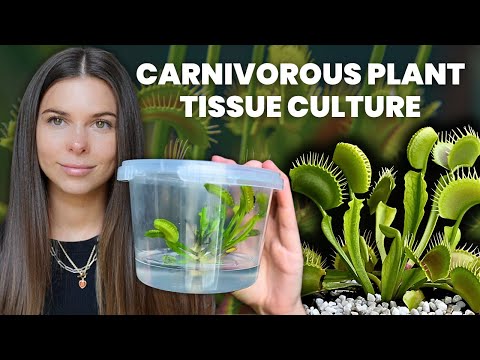
DIY Tissue Culture: Carnivorous Plants
Venus Fly Trap Tutorial Overview
Introduction to the Tutorial Series
- The tutorial is divided into four parts, focusing on different aspects of cultivating Venus fly traps.
- Part one covers the preparation of multiplication media for carnivorous plants.
- In part two, Francisco from Plant Cell Technology will demonstrate sterilization techniques for Venus fly trap explants in Washington DC.
- Part three involves establishing sterilized explants in tissue culture under a laminar flow hood.
- The final part discusses subculturing and provides a protocol for creating rooting media.
Preparation of Multiplication Media
Key Components and Adjustments
- The multiplication media for carnivorous plants is similar to that used for houseplants but with specific adjustments due to their nutrient-poor natural habitat.
- Approximately 800 ml of distilled water is used as the base; typically, 4.54 g of MS (Murashige and Skoog) medium would be added, but this protocol uses only 1.51 g (1/3 of the standard amount).
- A plant growth regulator, BAP (1 mg/L), is included to enhance multiplication speed; 25 g of sucrose (household sugar) is also added.
- For solid media, 3 g of gelling agent (gelling gum or alternatively 7–8 g of agar) is utilized; pH adjusted to 5.6 as carnivorous plants prefer slightly lower acidity compared to typical houseplants.
- Sterilization can be achieved using an autoclave, pressure cooker, or microwave.
Sterilization Process
Creating a Sterilizing Solution
- Sodium Doro is introduced as a key component in making a sterilizing solution mixed with water and surfactant (Tween 20).
- Half a gram of sodium Doro is measured and combined with two drops of Tween 20 to improve adherence to plant material during sterilization.
Taking Cuttings
- When preparing Venus fly traps for tissue culture, both traps and leaves can be used; it's recommended to include parts from the rhizome as well.
- Careful handling ensures minimal damage; scissors should be cleaned with isopropyl alcohol if used instead of hands for cutting.
Selecting Explants
Best Practices for Choosing Plant Parts
- Newer traps located at the center are preferred as they are cleaner and easier to sterilize than older ones that may have caught insects.
- Flower stalk segments are highlighted as effective sources for obtaining explants since they are easier to sterilize than seeds or other plant parts.
Final Steps Before Sterilization
- After cutting flower stalk segments into smaller pieces, they must also undergo sterilization before being placed in jars along with other selected parts.
Tissue Culture Techniques for Plant Propagation
Overview of the Tissue Culture Process
- The process begins with explants being placed on an orbital shaker for approximately 24 hours to ensure proper sterilization using a mild solution, which is crucial due to the small sterilization window for certain plant species.
- Upon returning after 24 hours, the explants show minimal color change, indicating successful preparation. Cuts are made to separate traps from leaves while preserving essential tissue.
- The cutting technique involves removing ends of explants and ensuring that white rhizome tissue remains intact, which is vital for growth.
Rinsing and Media Preparation
- Explants are rinsed in autoclaved sterile water to remove any residual sterilizing agents. This step is quick due to the low concentration used compared to stronger solutions like bleach.
- Multiplication media prepared prior to this stage is introduced. It's important to sort containers by type of explant; different types can be combined in one container or separated based on preference.
Establishing Explants in Tissue Culture
- When placing explants into multiplication media, they should make good contact without being submerged completely. Proper positioning encourages optimal growth conditions.
- After several months in vitro, some explants may grow large enough for acclimatization outside tissue culture; however, subculturing is demonstrated instead for instructional purposes.
Transitioning Explants and Acclimatization
- During subculturing, clumps are separated and any dead tissue or unnecessary roots are trimmed off since new roots will develop naturally in rooting media.
- A protocol for rooting media similar to multiplication media is provided. For acclimatization, a mixture of sphagnum moss and perlite is recommended over other substrates typically used.
Conservation Awareness and Resources
- A recent incident involving poachers illegally harvesting Venus flytraps highlights the importance of tissue culture in plant conservation efforts. Awareness about sourcing houseplants responsibly is emphasized.
- Gratitude is expressed towards Plant Cell Technology for providing lab space and sponsoring the video. Their products are linked as resources for viewers interested in starting their own home tissue culture labs.
- A discount code "plants in jars" offers viewers 10% off at Plant Cell Technology's website, promoting accessibility to necessary materials for aspiring cultivators.