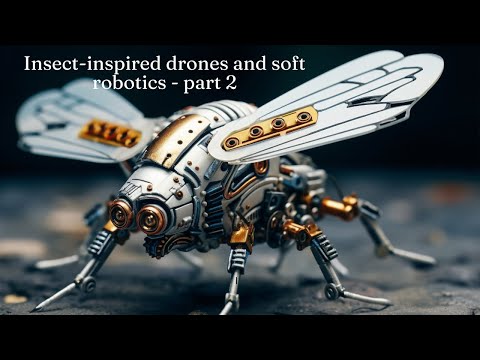
Insect-inspired drones and soft robotics - part 2
Insect Inspired Drones and Soft Robotics: Lecture 2 Overview
Introduction to Insect-Based Drones
- The lecture introduces the concept of insect-inspired drones, emphasizing their research-based nature compared to conventional drones.
- It highlights how insect characteristics influence drone design, particularly in behavior and control mechanisms relevant to applications in biomedical engineering.
Insect Intelligence and Drone Design
- Insects exhibit intelligent decision-making through parsimonious solutions, allowing them to navigate complex environments with limited resources.
- Key aspects of insect intelligence include embodiment (how insects sense their environment), sensory-motor coordination (interaction between sensing and movement), and swarming behavior (coordinated group actions).
Components of Artificial Agents
- The relationship between biological agents (insects) and artificial agents (drones) is explored, focusing on environmental perception via sensors leading to decision-making.
- Biomechanics play a crucial role in determining sensor placement and actuation methods for both insects and drones.
Mechanisms of Insect Behavior
- Embodied cognition emphasizes that an insect's interaction with its environment relies not just on cognitive processes but also on physical body mechanics.
- Swarming behavior enhances task efficiency by leveraging collective capabilities over individual strengths.
Examples of Insect-Inspired Robots
- Various robots are discussed, including Antbot (mimicking spider behavior), Smellicopter (chemical detection), RoboBee (pollination tasks), optical flow control drones, compound eye mechanism drones, tiny piercing drones, and Kilobots that follow pheromone trails.
Detailed Robot Applications
- Antbot features UV sensors for navigation in agricultural settings; it mimics spider locomotion.
- Smellicopter utilizes live moth antennae for detecting chemicals in the environment, alerting users about hazardous substances.
RoboBee Capabilities
- RoboBee is designed for pollination tasks; it can fly, hover, swim underwater, and perch on surfaces. Its swarm capability allows it to perform complex operations efficiently.
Optical Flow Sensing Drones
- These drones use color-sensing technology to estimate distances from objects based on their speed within the field of view.
Compound Eye Mechanism Drones
- Drones equipped with compound eyes maintain parallel alignment with ground surfaces to detect slopes effectively.
Tiny Robots for Search Operations
- Kilobots operate similarly to ants by following pheromone trails; they are used for searching food or other objects collectively as a swarm.
Transitioning to Soft Robotics
- The lecture shifts focus towards soft robotics inspired by natural mechanisms found in worms and insects which lack rigid structures.
Characteristics of Soft Robots
- Soft robots made from echoflex material can be controlled using magnetic fields; they exhibit various locomotion types such as tumbling or crawling similar to snails or inchworms.
Manufacturing Process of Soft Robots
- The fabrication process involves mixing echoflex materials with iron oxide particles before solidifying them under a magnetic field for desired structural properties.
Actuation Mechanisms
- Different actuation methods like pneumatic pressure control allow soft robots to mimic natural movements effectively while navigating diverse terrains.
This structured overview captures key insights from the second lecture on insect-inspired drones and soft robotics while adhering strictly to timestamp requirements.
Overview of Magnetic Micro Devices
Design and Structure
- The head of the micro device is made from magnetic material, featuring distinct north and south poles, while the tail can either be normal or contain magnetized microbeads.
- Rigid helical tail structures are fixed in place, allowing for controlled movement through a magnetized head that directs motion.
- Two designs for cilia exist: plain cilia and beaded cilia, both requiring magnetic field control to function effectively.
Mechanisms of Movement
- The presence of north-south poles on both the surface and individual beads is essential for directional control in soft robots.
- Control mechanisms involve applying magnetic fields to steer soft robots; different configurations allow for varied movements based on field direction.
Types of Magnetic Actuation
Free Swimmers vs. Surface Walkers
- Free swimmers utilize three methods for magnetic field application: rotating fields, oscillating fields, and gradient fields.
- Surface walkers require a base material to move along surfaces; they employ tumbling motions rather than swimming freely.
Motion Control Techniques
- Oscillating and on-off switching mechanisms facilitate planar motion in soft robots by controlling head-tail interactions.
- The combination of different magnetic forces allows for various locomotion types including rotary and planar movements.
Forces Driving Movement
Torque-driven vs. Force-driven Robots
- Soft nanoobots operate primarily under magnetic forces rather than gravity, enabling diverse movement capabilities such as up-down or combined motions.
- Torque-driven systems lead to rotary motion while force-driven systems enable planar movement in these robotic designs.
Fabrication Methods
Techniques Used in Manufacturing
- Various fabrication methods include self-crawling techniques where nickel-based heads drive helix formation during etching processes.
- Sensing angle deposition technology (glad-based mechanism), allows precise control over tail attachment angles during fabrication stages.
Materials Utilized
- Helical liposomes use palladium for heads and cobalt alloy for tails; these materials contribute to the functionality of soft microbots.
Applications of Nanoobots
Biomedical Uses
- The primary application discussed is targeted drug delivery within biomedical contexts, showcasing the practical utility of these technologies.
Turn any video into a summary like this
YouTube links, meetings, lectures. With transcripts, search, and chat.