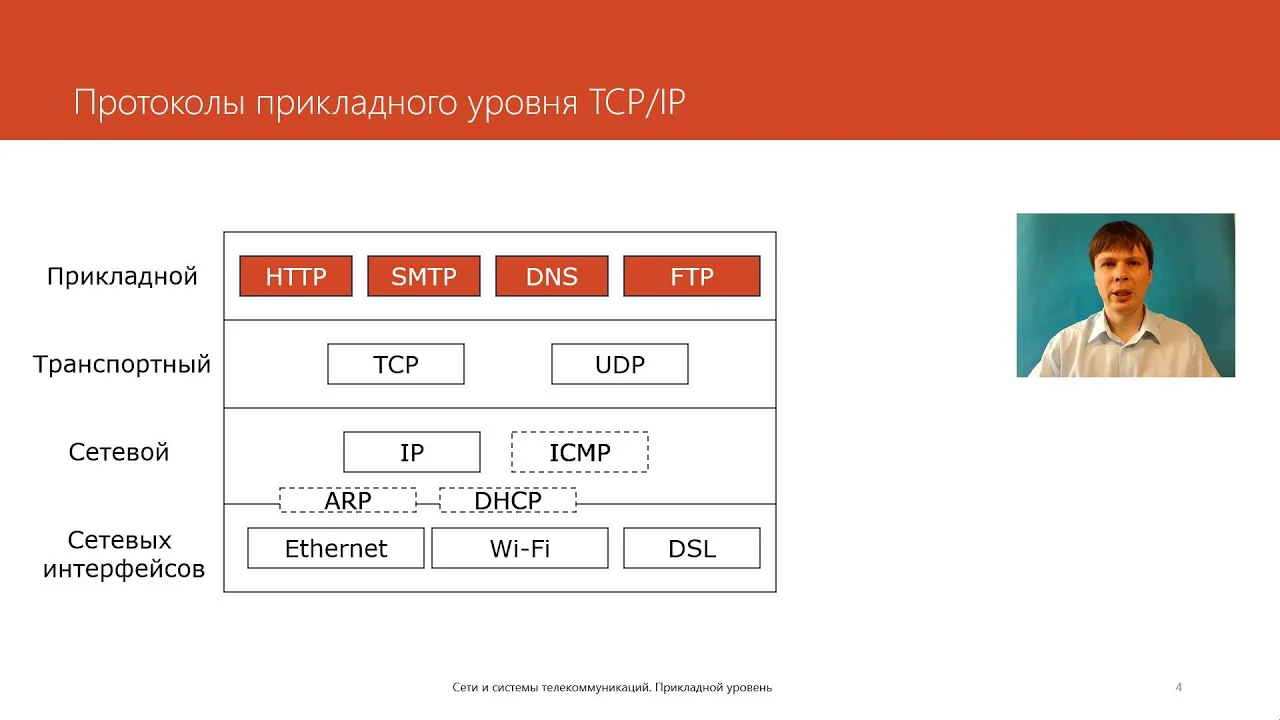
Прикладной уровень | Курс "Компьютерные сети"
New Section
The instructor introduces the course on network and telecommunication systems, focusing on the application level of interaction within open system models and TCP-IP.
Introduction to Application Level
- The application level facilitates communication between network applications such as web browsing, email services like SMTP, IMAP, and POP3, and DNS for domain name resolution.
- Network applications differ from protocols; applications perform tasks using protocols to retrieve information. Multiple protocols may be used by a single application.
- Applications like web browsers utilize various protocols like DNS and HTTP to access web content in the TCP-IP model.
Exploring Interaction Models
Discusses the layers in TCP-IP model compared to open system interaction models.
Layers in Interaction Models
- In TCP-IP model, the application layer is above the transport layer; contrastingly, open system models include presentation and session layers.
- Initially deemed unnecessary, functions of presentation and session layers were omitted from TCP-IP but are now essential due to complex interactions beyond simple requests/responses.
Enhancing Web Page Loading
Explores complexities in modern web page loading processes requiring multiple network operations.
Modern Web Page Loading Challenges
- Modern web pages contain diverse elements like images necessitating multiple network operations for loading a single page.
- Sessions in networking involve handling multiple operations towards a common goal; however, this responsibility falls on applications in TCP-IP rather than at a session level.
Security Measures in Networks
Focuses on encryption technologies for data security during network transmissions.
Data Encryption Technologies
- Encryption technologies like SSL/TLS ensure secure data transmission over networks with protocols denoted by 'S' (e.g., HTTPS).
- With increasing commercial internet use, ensuring data security became crucial leading to widespread adoption of encryption technologies like SSL/TLS.
Network Device Evolution
Examines advancements where network devices operate at both physical and application levels.
Evolving Network Devices
- Contemporary network devices like content filters analyze traffic at an application level restricting access based on protocol analysis.
SMTP, POP3, IMAP, DNS, FTP Protocols in TCP-IP Stack
The discussion covers various protocols such as SMTP, POP3, IMAP, DNS, and FTP within the TCP-IP stack.
Protocols in TCP-IP Stack
- Various protocols like SMTP, POP3, IMAP, DNS, and FTP are part of the TCP-IP stack.
- These protocols operate not only at the application layer but also at the presentation and session layers.